The Suchness of Striving: What Ten Days of Silence Taught Me
I spent many hours of my childhood on the hard floor of Buddhist temples, legs folded to the side, careful not to slouch, careful not to let my knees drift even the smallest amount apart. When I did, a well-meaning adult would tell me to be more ladylike, more respectful. That was consistent with my first lessons in Buddhism and in life: even sitting still was something to get right.
A couple of weeks ago, I attended a ten-day silent meditation retreat, my first time studying in the Theravada Buddhist lineage of my youth. I already had a meditative practice, many years of daily shamanic drumming taught by my teacher at Sacred Stream, who follows the lineage of Tibetan Buddhism, but I wanted to know what ten straight days of meditation could teach me that journeying alone hadn't. You see, I’m an avid collector of experiences and experiments to teach me more about myself. Three years ago, I’d undergone a four-day fasting vision quest that led to much transformation, and I was curious what a Western version of my own Buddhist lineage might open up. As an executive coach, I spend most of my time helping CEOs and tech leaders build their companies through healthy hustle, without burning out. I wanted to see what I could learn, both for myself and for my clients. After years of being a hypervigilant mom watching over my teen daughters' mental health, things finally felt stable enough to leave. I went in curious and a little eager. I did not go in thinking it would be easy.
Arriving at Spirit Rock
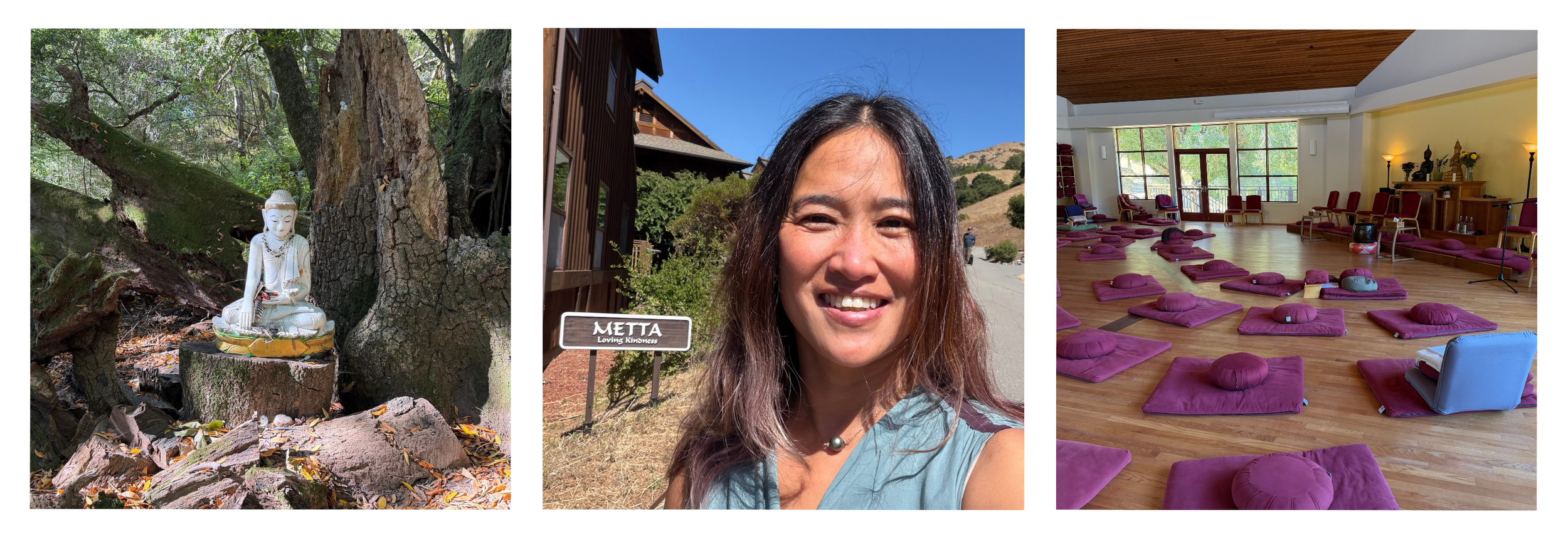
I drove out of my hometown of San Francisco, crossed the Golden Gate Bridge, and slowly relaxed into the rolling golden hills around Jack Kornfield's Spirit Rock meditation center. Check-in was easy. We signed up for our work meditations, the daily chores that keep the place running, and I found my room. The residential retreat holds about a hundred people, housed across four buildings named for the four immeasurable qualities: lovingkindness (metta), compassion (karuna), sympathetic joy (mudita), and equanimity (upekkha). I was lucky enough to get a single on the second floor, comfortable room, comfortable bed.
Dinner that first night was simple, and I was relieved to find the food was vegetarian, not vegan as I'd feared. A fridge stocked with hard-boiled eggs, jack cheese, and a communal cupboard of crackers and nut butters immediately calmed my “I won’t have enough to eat!” hypervigilance. And if you’ve watched White Lotus Thailand, have no worries — the food was organic and hyper-local. Chatting with other participants, I learned most of them were veterans, one man on his twentieth year in a row, a woman on her sixth or seventh, returning every six months to renew her sense of contentment.
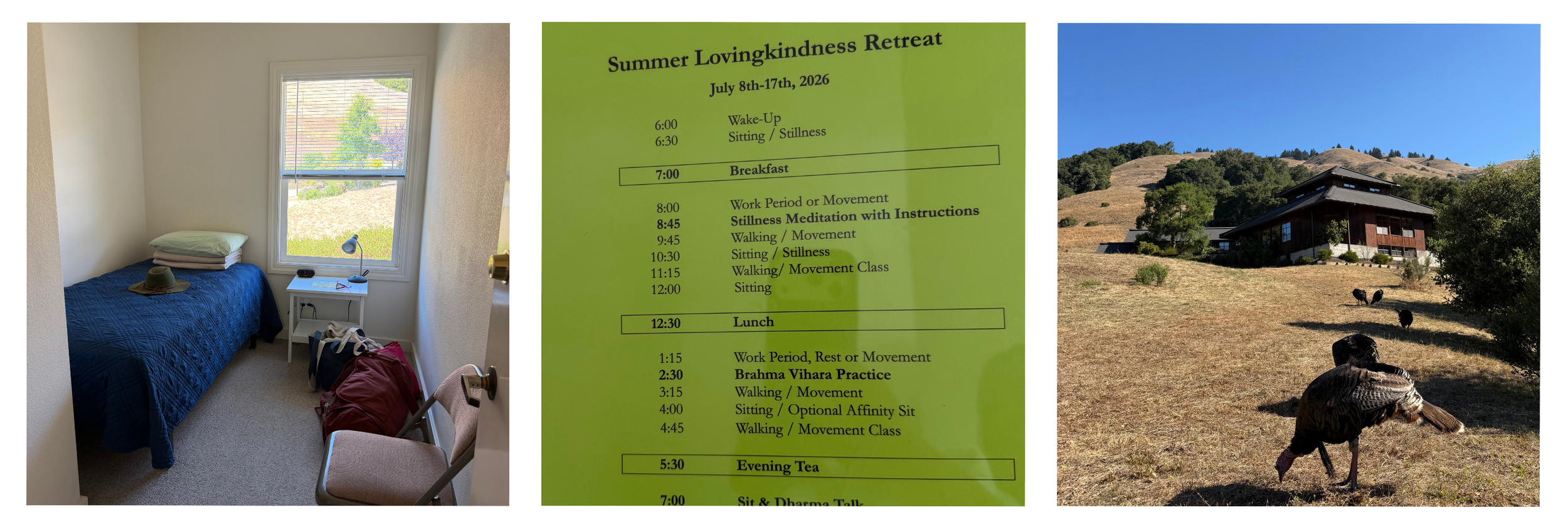
The schedule itself was calming. I like to have control, yet I've always loved relaxing into a rigorous structure held by someone else, especially one where delicious meals just appeared. The day was broken into 45-minute alternating sitting & walking meditations, three meals, a work period, a movement class, and three periods of guided meditation / dharma talks. This was six to eight hours of daily practice, taken in silence (other than questions for the teachers). All of this set on the beautiful land surrounded by hummingbirds, quail, wild turkeys, serene deer, and curious jackrabbits. The animals on that land had never been harmed or fed by humans, so they were uncommonly unafraid.
Choosing Lovingkindness
Unlike a traditional Vipassana or insight retreat, this one was built entirely around lovingkindness. Comparing notes later with retreat veterans, I learned the sitting and walking schedules were similar to a standard Vipassana retreat, but these meditations were more directed. I felt good about the choice, which honestly was just the one that fit my calendar.
My focus word for 2026 is generosity, and lovingkindness is the only meditation practice I've ever been able to follow regularly. In my midlife crisis year of 2018, when my father-in-law passed, my marriage fell apart, and my father died, I turned to lovingkindness to get through the days. Unlike meditating by focusing on your breath, lovingkindness uses a series of mantras to cultivate open-heartedness. My version of the phrases:
May I be happy.
May I be protected and safe.
May I be healthy and strong.
May I be kind to myself. (added some months later when I noticed how unflaggingly self-critical my inner voice could be)
May I live my life in peace.
I found this practice easier than following the breath. It gave my monkey mind something to hold onto, and it handed me wishes and hopes for a better life while I navigated a year of unexpected chaos and grief.
Day One: Striving to be the Best Meditator
Our first day was spent offering the lovingkindness phrases to our own bodies, easing the transition from our busy lives into the sensations of the body itself. This included a daily movement class with Rasika Link, who led restful yoga sessions that began with ten minutes of lying on our backs, legs up against the wall, listening to her gentle voice: Rest. Just rest. Rest. Just rest.
I tend to be a high achiever. I followed the instructions closely in every session. I wanted to get the most out of this, to do all the right things, and to be the best student. It wasn't hard for me to focus my mind on the phrases:
May my body be happy and at peace.
May my body be healthy and strong.
May my body be protected and safe.
May my body be kind to itself.
May my body live its life with ease.
I repeated those phrases for eight hours that first day… and my mind slowly calmed. There were a couple of sessions where I kept checking my watch, certain more than five minutes had passed, and waiting for the bell to complete our interminable forty-five minute set. But for the most part, I enjoyed it, especially the slow walking meditations: ten or fifteen paces, matching our footsteps to the rhythm of the mantra. You can picture rows of us walking back and forth inside the hall or out in the open air. The point of turning around at the end of each row, we were told, was that when the monkey mind wandered into future worries, reaching the end of each row was the gentle reminder to come back to the simplicity of the phrases. I liked the motion. Having my body moving seemed to stabilize my mind.
We were also offered a further renunciation: skip the 5:30 evening tea (aka dinner) to sharpen the mind's focus on opening the heart without the distraction of one more meal. As you can imagine, this high achiever was determined to do it all. Of course I'd skip dinner. And then, since I didn't want to be distracted by the smell of food, during dinner time, I would take a rigorous three-mile hike straight up to the ridge and back down. So I hiked, the rhythm of my boots and poles moving to the words of the mantra:
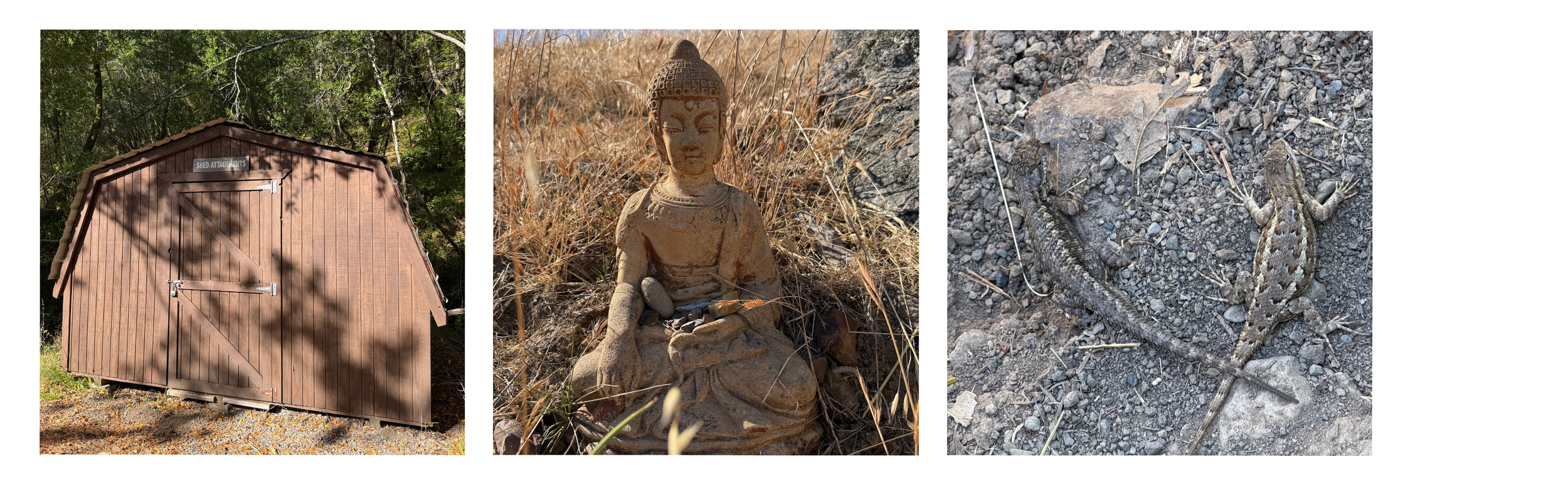
To the lizards darting out of my path: May you be happy and at peace.
To the shy deer I startled along the way: May you be protected and safe.
To the oak trees swaying in the breeze: May you be healthy and strong.
And to the beauty of nature viewed from the hilltops of the Spirit Rock lands: May you all live your lives in peace.
I was enjoying myself. Doing meditation right! I didn't know it yet, but I was already chasing my gold stars.
The Suchness of Tutti
On day two, we were directed to focus on an easy being in our lives, someone easy to love. My niece narrowly beat out my cats, mostly because she doesn't throw up or poop on my bed. I held the image of her twirling in a new dress at dinner days before, and the twenty-plus years of images behind it including her as a toddler in a bridesmaid's dress at my own wedding, tossing flower petals down the beach.
In a Dharma talk on the five hindrances that block meditative concentration, I recognized mine immediately: sleepiness. Especially after lunch. Even while sitting up straight, I'd start nodding into a pleasant, sleepy torpor. In a one-on-one with Anushka Fernandopulle, one of the retreat teachers, she suggested I stand up, bring more energy to the words, and add a nap to my schedule. Like any good student, I followed her directions, adding a nap right after my daily work meditation of sweeping and mopping the dining hall floor.
It helped, a little. Ever the striver, I added more vigorous vinyasa flow to supplement the hike. Might as well get some strength training in as well!
But on day four, something curious happened. In my next one-on-one, I brought it to another of the teachers, bruni dávila. I shared:
“My meditation practice is going well. My mind likes structure and rigor, so the phrases are easy to follow, both in sitting and walking practice. Standing up helps with the sleepiness.”
I also went on to share my daily hike and dinner skipping, eager to impress my teacher. But something else strange was happening:
“As I’m repeating the lovingkindness phrases, there comes a point when my mind becomes utterly silent. Everything fades, I see a pulsating light and there is a feeling of peace. Nothing else is present except the silence in my mind. It feels so good. Then right afterwards, I feel overwhelming sleepiness. I’ve tried standing up, and adding energy to my words. But it doesn’t feel quite right. What should I do?”
Bruni, in her mystical Yoda-like way, declined to provide me with an easy answer. Instead she asked if I knew what the suchness of Tutti was. I hadn't heard the word before and was a little confused by her Puerto Rican accent and had to ask her if she was saying the word S-U-C-H. She nodded and I asked her what is the meaning of suchness.
She pulled out a beautifully carved bell striker, one side ornate carved wood, the other wrapped in embroidered gold cloth, and asked me its suchness. I said its purpose was to ring the bell, but there was also craftsmanship and beauty to it. She smiled, then pulled out a plain ballpoint pen and asked the same question. I said the pen could ring the bell too, but it was more functional, and it also wrote.
With the analogies laid out, Yoda-style, I finally understood.
The suchness of Tutti is striving
I am a high achiever, raised by an Asian tiger mom to keep going, work harder, and work longer. When I hit an obstacle, the answer was always more effort. An A-minus meant more homework, more memorizing. In my Stanford computer science classes, if I wasn't following the logic as fast as my classmates, the fix was more all-nighters, more tutoring, more explaining from classmates who got it faster than I did. In my design career, if a solution wasn't quite right, I'd generate ten more variations, trusting that one of the ten would be the answer, or at least point toward it. I built a first career in tech on sixty to eighty hour weeks. You could always push through and get more done.
That was exactly how I'd approached the first three days of this retreat. Maximize every minute. Do all the sessions. Skip dinner, because that's what the most spiritual people do, right? Push my body up and down that ridge. Maximize the time. The suchness of Tutti was striving, and I'd brought it with me even here.
What My Body Was Actually Saying
I finally understood what my body was trying to teach me. That state of bliss and clarity, followed by sleepiness, was the message. The sleepiness wasn't a hindrance in the traditional sense: it was my body telling me I didn't always have to keep striving and pushing through. It was pointing me to another path, telling me it was time to take the easy, restful option, one that might be worth even more to someone whose suchness is striving.
That evening's Dharma talk reinforced my lesson. Kristina Baré, another of the teachers, spoke about the conditions required to reach samadhi (concentration or unification of mind), or the deeper jhana state that arises once samadhi is strong and sustained. The precondition, she said, is the same for all of it: you cannot get there by working harder. Being, not doing.
I should have known this. Across hundreds of coaching conversations, I've seen leaders hit this same wall. They learn that forcing their way through doesn't get them any closer to the healthy hustle they're actually after. The harder they try, the further it gets.
That was the turning point of my retreat.
Strangers Become Sangha
I'd already started to soften into it before that. There was the simplicity of being cared for, delicious meals lovingly prepared and quietly eaten in appreciation, and each morning's instructions telling me exactly where to put my attention. We moved from day one's focus on the body, to day two's easy being, to friends, and then to the neutral beings, our fellow retreat participants. Rather than treat them the way my kids would call NPCs (non-player characters), background noise in someone else's story, we were asked to notice one small detail about each person: the hairstyle a woman had chosen, the way an older man bowed his head, the vibrant scarf another woman wore. On the strength of that one detail, and the fact that we shared this sangha (a community of practitioners), we sent them lovingkindness, and in doing it, they stopped being background and became people.
From there we moved to a difficult being, then all beings on the land, then the whole world, the traditional shape of a lovingkindness sequence. When I'd learned it before, the entire sequence took ten or fifteen minutes. Here, we moved through it over ten days. Some teachers mentioned three-month retreats where the first month alone is spent on the easy being.
Day Five, Lying Down
Bruni suggested I try lying down for meditation, with a full bolster and pillow setup, instead of sitting upright on the bench. The first time I tried it, day five, it changed everything.
I know transformation stories tend to sound cliched in the retelling. They feel similar to each other. Even as I write this, I know that when I read this kind of thing from other people, I often roll my eyes at how trite it sounds. It’s difficult to put into words. But here is what happened. About ten minutes in, by then sending the phrases out to friends in my circle:
May you be happy and at peace.
May you be protected and safe.
May you be healthy and strong.
May you live your life with ease.
And in between, sending the same phrases back to myself, adding the self-wish for kindness.
May I be happy and at peace.
May I be protected and safe.
May I be healthy and strong.
May I be kind to myself.
May I live my life with ease.
As I lay there, the rhythm of the words started to blend. The words themselves disappeared, leaving a pattern of tones: bum, bum, bum, bum, bum. Then the tones dissolved too, into ripples, gentle waves rolling head to toe, sending lovingkindness through my whole body and out past it. Aware of what was happening, I wanted to share the open-heartedness, so I spread that field of contentment out into the meditation hall, and saw an infinity sign of energy moving between the Buddha altar at the front of the room and the one at the back, covering the entire sangha.
It felt like five minutes. Then the bell rang, ending the forty-five minute session. I didn’t want to stop meditating. I didn't want to come back to this world. I wanted to stay inside that contentment.
Everything Tasted Like Enough
The only other times I've touched that kind of bliss were in the deepest of my plant medicine journeys, specifically the intensity of ayahuasca work. That a series of lovingkindness phrases could ease me into the same state of peace, at one with everything, both for myself and shared out into a room of strangers, is still hard to believe without it sounding trite. But it was real.
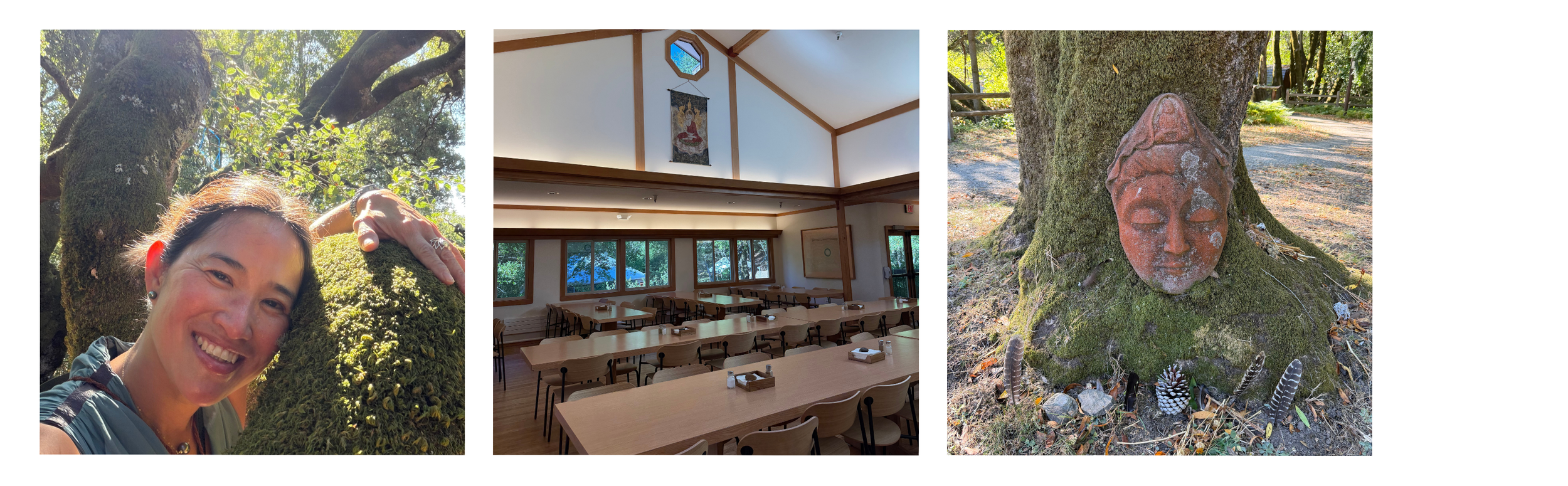
The days passed easily through the rest of the retreat. I rested in the crook of an oak tree, gazing up into the leaves. I'd wander toward dinner feeling genuinely present in my body and ask myself if I truly wanted to eat. Mostly the answer was no. But one night it was corn chowder, and I had four or five bites that tasted blissfully sublime. And that was enough. I danced through the eight hours of daily practice, sitting some sessions, lying down for others, listening to Dharma talks on the other three of the four immeasurables: compassion, sympathetic joy, equanimity, and the forgiveness underneath all of them. I felt the best I have ever felt in my life. It was simple, and it was easy, and I'm not used to things happening without a fight. It almost felt like cheating, except that this was the path. This was the way.
Coming Back
Near the end, I briefly entertained the idea of leaving my regular life behind, doing this full time. My kids don't really need me the way they used to. I could go be in this state for three months at a stretch. But no, I missed them. I missed my partner, my house, my cats, my regular life.
On the last day, when we broke noble silence, the vow of silence we'd kept for all ten days, and got our phones back, I had no urge to touch mine. I wandered around taking pictures instead. Driving a fellow retreatant back into San Francisco, I noticed I was going twenty-five in a forty-five zone, ten cars stacked up behind me. I had to concentrate, actually concentrate, to bring myself back up to speed. Merging onto 101 south, for the first time in my life, I found myself in the slow lane.
That evening, walking to dinner, I told my partner about all of it. He said being with me felt like spending time with someone completely high.
That's exactly how it felt, I told him. Everything just felt so damn good.