Intuition at Work— Follow Your Curiosity

Photo by Miriam Espacio on Unsplash
Have you ever had a sixth sense feeling that something was off, a small prickling of your intuition? I’ve heard stories from some of my trusted friends about feeling an ache in their right leg, and later on finding out that a close relative had injured his leg at that same time. As a surfer, I’ve had this feeling in the water. A tingling that something was not right. It’s happened multiple times, and one of those times I later learned of a shark sighting at the break I surfed that day. Often we dismiss and forget these feelings of intuition— this makes no sense, it’s not logical.
Most people know me as a skeptic. Full of questions to examine and pick out the most rational and logical answers. I trained in the Stanford computer science department. Despite this, I am learning to trust my intuition.
How do you listen to your gut and how do you express intuition in the workplace?
As a product design leader at Facebook, I remember debating the merits of a gut decision with other technologists. We all could get on board with having an understanding of the qualitative research, knowing what the data & metrics said, and when the direction was ambiguous, having to make a gut decision. We agreed, however, that the gut decision was based on years of experience that is likely a subconscious pattern matching based on prior situations that have been encountered.
While that is a fine approach, it’s lacking an aspect of faith and trust in oneself. We have an instinct for what’s right and wrong about certain situations. Our leadership will show up more powerfully if we surrender to this intuitive knowing without having to rationalize it. We will be more powerful if we embrace the magic of our intuition.
I vividly remember coming home after an interview with a Series B startup focusing on big data cleansing & visualization. I flopped down on my bed and moaned. You see, I knew that I was going to work there and my head was fighting that knowledge. This was weeks before an offer eventually was made and I received multiple other offers and eventually decided to go to this startup. My gut knew that it was right for me. My head said that the product wasn’t the most interesting. I didn’t think that I wanted to return to enterprise software after having worked in the design of consumer products for 10 years. At the same time, I knew that I had had two of the best conversations in my life with the CEO and VP of Product. I knew it in my bones. I had a yearning to spend more time with them and to join them in their vision of building both the culture and the product of this company. And my intuition was right— it was an amazing 2 years with fabulous people working on huge problems.
To listen to intuition at work, follow your curiosity and follow your inklings about people.
What If My Intuition is Wrong?
If I have a gut feel, how do I know to follow it?
What if I’m just in a bad mood or have indigestion?
There are three strategies you can try to help evaluate if an intuition is true or if it’s a lie.
The power of perspective. If you’re facing a decision and have a gut feel one way or the other, take the long view and see what feels right. Look at the decision and see how it will sit in 10 minutes, 10 days, 10 weeks, and 10 years. What does your gut say about those time frames?
Let it go. For now. You don’t have to make a decision or act on it immediately. Instead let it go and see what happens over time. When you wake up tomorrow morning, are you still thinking about it? Has the feeling changed? What about a few days later? When designing, sometimes the most powerful solutions to a question will appear in the shower or on a run several days after you’ve first starting considering it. Yield to your subconscious brain, and likely an answer will appear. And if you never think about it again, then perhaps that was also meant to be.
Curiosity and intuition are close kissing cousins. What happens when you direct your curiosity to the intuition & gut feel? In product brainstorm sessions, participants are encouraged to phrase questions in the “how might we…” format. This opens up possibility and whitespace to ask the questions.
- How might we learn more about this feeling?
- How might we collaborate together?
- How might we sit with if this is true or not?
What If I Don’t Know My Intuition?
What if I’ve never heard my intuition before?
There is a magical witchiness to opening up and listening to what your intuition is telling you. The best way to do this is via practice. Two paths towards intuition are with innate tools that are always with you — writing and your body. A third is through following your curiosity about people.
Writing with curiosity. Joan Didion said, “I write to know what I think.” If you’re searing for more intuition, consider starting the practice of morning pages, from The Artist’s Way popularized by Julia Cameron. First thing each morning, write 3 pages in a journal. It doesn’t matter what you write, if it makes sense or if it’s even legible. If you don’t know what to write, write: “I don’t know what to write” over and over again. The mechanical act of connecting pen to paper frees up cognitive resources and opens up access to creativity and intuition. Write from a place of curiosity and your intuition will come.
Listen to your body. Stop throughout the day and do a scan of your body. Which parts of your body want attention. Pay particular attention to your core — heart, chest, and stomach areas. If you’re experiencing emotions, such as dread or attraction, where does it originate in your body? Get curious about the sensation. Does that unlock any intuition?
Which people are you drawn to? What is it about them that’s attracting you? Is it an idea of theirs, a physical attraction, or simply some unknown chemistry? Get curious about why you’re drawn to them.
I’ve found it’s often easier to develop an intuition around people than around things.
Curiosity & Intuition
The opposite of curiosity is certainty and knowing. If you already know the answer, then why bother seeking more. When we are experts, when we have a clear 100% view of what’s right, then there is no place for curiosity.
So, as a path to accessing intuition, follow your curiosity. Each moment of the day, ask yourself: “What am I most curious about right now?” If you follow it, intuition may appear.
Bottom-Line
We don’t typically give ourselves permission to be intuitive, and especially not at work. We second-guess ourselves and need to be rational, logical problem-solvers. What would it look like to open up to more intuition? What would it look like to have a little more magic in our lives? For your next major decision, try listening to your gut. Follow the path of curiosity and it will lead to a more intuitive experience.
The Art of Celebrating Wins

Photo by Ian Schneider on Unsplash
Last week, I hit a monumental milestone that I’d set six months ago for my coaching business. I was both surprised and disappointed to find that I didn’t feel capable of celebrating this achievement. Does this sound familiar? Have you ever worked for months or years towards a big event or milestone, then felt a bit hollow or empty after achieving it?
There are many things that I am able to celebrate. First, I am an absolute birthday queen. For my big 40, we took a dream three-week trip to South Africa full of celebratory moments. In my house, we have birthday crowns, cakes & candles, presents, special meals, and much more. Secondly, I obnoxiously claim victory after a competitive game of Yahtzee. And lastly, throughout the year, we have regular rituals. We celebrate solstices, starting & ending the school year, and our own version of holidays. I even have rituals to celebrate the end of a day with all the things I’m grateful for, and the end of the work week with a Friday night bake. These things are all light, fun, perhaps even frivolous.
In contrast, a professional win feels different. Harder, more serious, and less playful. I am pretty good about dealing with setbacks and losses. I’ve developed an innate grit and resilience around bad news. It’s familiar and I know that part of continuous growth is turning losses into learning. Yet why is celebration of a professional accomplishment so hard?
I think back to my past professional wins— getting job offers for the dream job, getting a Greatly Exceeds as a coveted performance rating at Facebook, getting promoted, and being nominated to join an intimate women’s leadership training program. The only one I truly celebrated was the last one. I remember feeling the surprise and inner glow of getting nominated. To this day, I still don’t know who nominated me. It felt like a beginning, and opening, and indeed it was the start of my path towards leadership coaching. In contrast, the other professional wins felt more like a milestone or a notch while climbing the perceived ladder of success.
I could hear, and can still hear the limiting beliefs and self-sabotaging voices within my head:
“Don’t start celebrating, this is only one small step step. You can’t afford to slow down. You can’t take your foot off the gas pedal. Quick, quick quick… move on to the next milestone.”
I tend to be restless. To move on to the next goal, the next shiny object, the next dream as fast as possible. Part of the art of celebration for me is to slow down. Slow down to really focus on the present. Slow down to focus on the accomplishment that I’ve created. Next, I acknowledge my saboteurs. Then finally, I get in touch with my Why, per the wisdom of Simon Sinek. Why am I doing this professional work, and how does it fit it with the vision & purpose for my life?
Part 1: Slow Down and Savor
When I slow down, breathe, and connect with what’s really here inside me, I can focus on the accomplishment. I can start to name the emotions I’m feeling. As reference, because it can be difficult to name our emotions, I’ve included 2 charts of positive and difficult emotions at the bottom of this article. The bubbling cauldron of my emotions includes:
Pride. I set a goal and I reached it earlier than expected. I reached it faster than any of the benchmark data points I’d gathered.
Relief. Phew, I actually did it.
Appreciation. Thank you to the people I’ve learned from and my community who has been with me for each step of this journey.
Confidence / Optimism. Yeah… the things I’ve been doing are actually working. This is going well.
Inquisitive. I’m curious… what new projects and experiments can I try to continue this momentum.
Impatience. This one is very familiar to me and I’ve written about impatience, my nemesis. I want to do more, be more, move faster. But to what end?
Fear. Is this sustainable? Can I continue to do this?
This accounting and naming of my emotions is a first step. It helps me to realize that as with many humans, I tend to let my negative emotions— impatience and fear— drive me. They create the saboteur voice that doesn’t let me slow down to celebrate. And I’m also pleasantly surprised to get in touch with so many facets of my positive emotions.
Research from both positive psychology and neuroscience suggests that a coaching focus on positive emotions activates & reinforces the portions of the brain that focus on creativity, flexibility, and openness.
Part 2: Acknowledge the Saboteur Voice
We are all human and we have our self-sabotaging voices. These voices have helped us to be successful in the past whether in adolescence or in achieving early professional success.
My saboteur loudly proclaims: “If you slow down to celebrate, you will lose your edge. You gotta keep going. You gotta work longer & harder.”
It’s a voice that has served me well in the past. It’s the voice that got me through graduating as Valedictorian, gaining a BS from Stanford, and through working 60–80 hour weeks in design firms to best service our clients. One anecdote I often share is that when my company asked me to come back from maternity leave after 6 weeks to lead a London-based project, I heroically agreed and brought my baby along with me. I now look back on this career dedication with a mixture of horror and wry regret.
It helps me to acknowledge that my saboteur has helped me achieve success in the past, and that I don’t need this voice right now. This voice can turn ugly and move into a familiar space of self-flagellation and martyr/masochism. This voice exists, and I can choose not to listen to it. Instead, I can connect to a wiser, leadership voice that’s grounded in celebrating my values.
Part 3: Connect with Purpose
Finally and perhaps most powerfully, celebrating wins becomes amplified when they are connected to purpose. Success as an entrepreneur and a leadership coach for me comes from service and connection. The connection creates a resonance with:
The individual clients that I support on their paths of transformation
The communities I coach, and the support we give each other in achieving shared goals
The community of coaches & like-minded people who share this lifelong learning journey with me
I have never been as energized or in such a deep sense of flow when I can follow this resonance.
Bottom-Line
As high performers, we can easily downplay and skip over the wins we have in our lives. We continually strive to grow and learn and move on to the next challenge. Instead, focus on the art of celebrating wins by Slowing Down to Savor them, Acknowledging the Saboteurs, and Connecting with Purpose.
Thanks to Andrea Cerutti for your brilliant coaching on this topic.

Table of Positive Emotions

Table of Difficult Emotions
Change Management and Leadership: A Design Perspective

Photo by Suzanne D. Williams on Unsplash
Processes and frameworks are a way for us humans to make sense of the world around us, whether it’s using design thinking to build products, the Montessori method to raise children, the scientific method to create new vaccines, or the stages of grief to help process change.
I was inspired by a wonderful interview / teaching between Rich Litvin and Vicki Shillington, focused on Vicki’s work as an executive coach for ThinqShift around leading in crisis. The interview shares this model, borrowed from change curve theory about Three Phases of change— Chaos, Acceptance, and the New Normal.
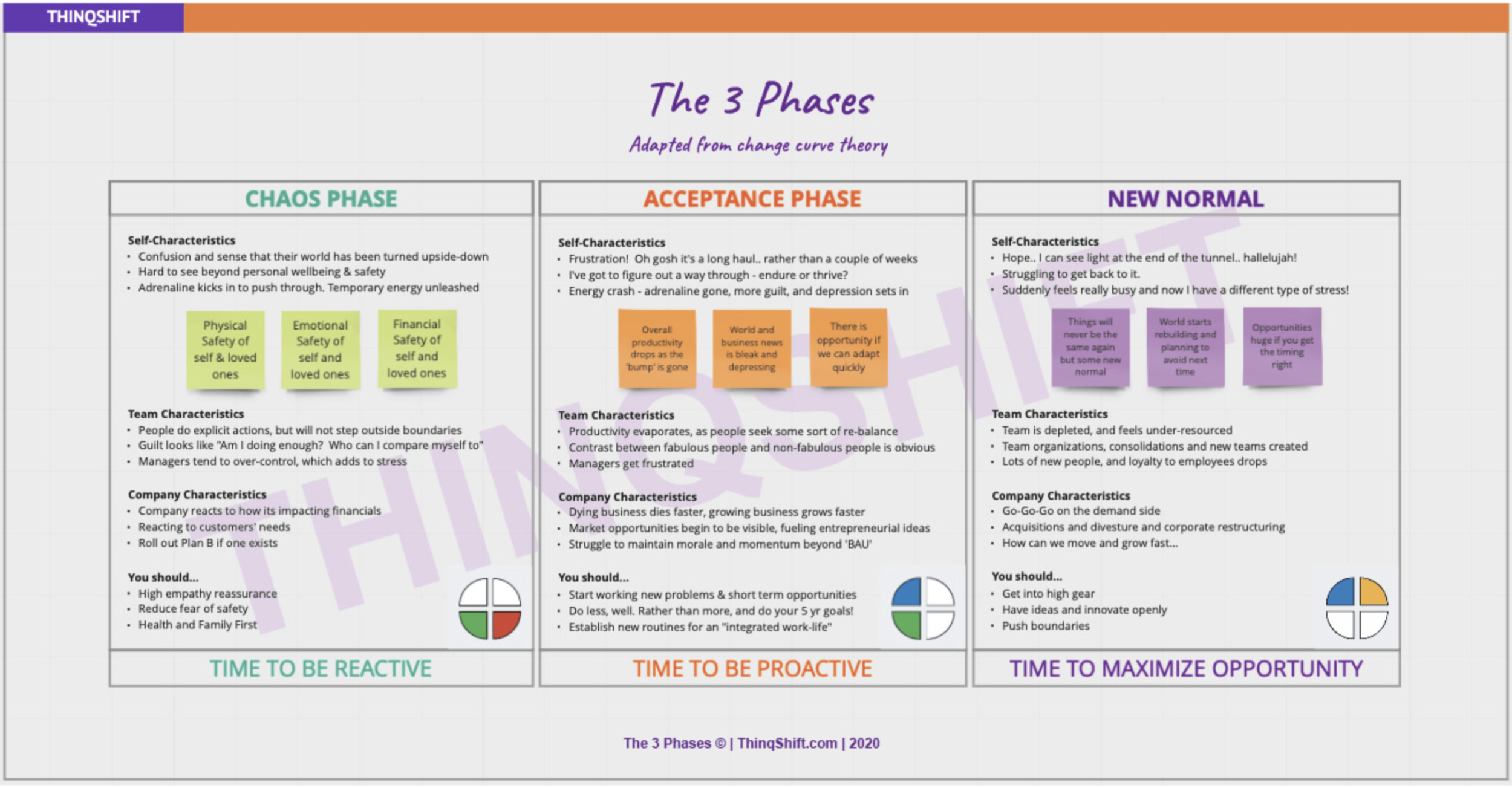
Courtesy of ThinqShift
I love this framework and in thinking about leadership through change management, have been adapting it slightly with my own design perspective to apply it both to the current pandemic and more generally to how leaders face ambiguity throughout their work & home lives. I’m sharing a design perspective of it to:
Help leaders faced with change understand and recognize what stage they’re in and what stage people around them are in
Collectively continue to make sense of this current pandemic
The goal is to move through the 3 stages, then rinse & repeat when the next change, big or small, comes along.
Chaos > Choice > New Normal

Stage 1: Chaos
Chaos begins when a new thing just happened. It could be the kickoff a new project, the death of a loved one, starting a new job, or experiencing a global pandemic.
🧸 Yearning for Safety + Security 🧸
Deep down towards the base of our hierarchy of needs, we are craving safety & security. We have a new thing that just happened and we’re not sure how our world view has adjusted yet. There are two paradoxical reactions to Chaos (Doing & Being) and often people will cycle between both rapidly, sometimes exhibiting traits simultaneously:
Reaction of Doing
Some of us jump into action and activity. There can be a flurry of expansive creativity— volunteering at the food bank, taking on more tasks & projects at work, perfecting that sourdough recipe, or creating that perfect hour-by-hour homeschool schedule for the kids. Some this is self-initiated, others are a reaction to external expectations depending on our jobs. This can feel motivating, satisfying, and impactful. We experience chaos through activity & creativity. When we’re in a new project or a new job, there is the expansiveness of brainstorming different ideas, with so many new things to learn and do.
Reaction of Being
Some of us are paralyzed and crave slowing down and giving ourselves time and space. We are scared and feel depleted. We want to take care of ourselves both physically— we know that we should sleep more, drink more water, eat healthily, and move our bodies— and emotionally— slow down, take time to think, relax, and mediate. We are grieving the loss of a different future, something that has been taken away because of this new change.
Keep in Mind…
Recognize that it’s chaos, that there could be an immediate burst of energy. First focus on what will be most helpful to you to satisfy the yearning for safety & security. Know that both reactions are OK.
Empathize with others. Ask yourself if Chaos is mainly impacting you, or if it is a collective Chaos in reaction to this new thing such as this global pandemic. Recognize that when it’s beyond your personal experience, every person is dealing with Chaos in a different way and at a different speed.
Stage 2: Choice
Choice occurs after an extended period of Chaos. The length of time will vary. The change or crisis has been happening for a little while and we’ve had time to live with it and do a bit of processing.
The psychologist and author, Dan Gilbert, in his bestselling book Stumbling on Happiness, asserts:
“It’s only when we can’t change our experience that we look for ways to change our view of the experience.”
🔮Acceptance and Yearning for a Path🔮
There is yearning for change, for something to be different after the immediate aftermath of the crisis or new thing in our life. There is the desire, and readiness to see something different, even if the path is not yet clear. In Choice, we may see a variety of characteristics:
Ways of Being
Frustration that this is going to take a long time. It’s a marathon not a sprint.
Energy crash because the original adrenaline is gone. There may be more guilt & despondence.
A slow learning that there is a different way. Moving into more resolution
Ways of Doing
Immediate focus on what needs to be done today.
Honing into what really matters. Understanding that there’s a giant list of to-dos and the need to prioritize to the few things that really matters, and ruthlessly cutting everything else out.
In product, this is where one or two use cases or design solutions starts to faintly shine through to show more promise and want to exist in the world.
Keep in Mind…
Embrace the new problems & new routines. Focus on the near-term and what needs to happen today. Continue to empathize and be aware that people are in different stages, some are in Chaos and others have moved to the New Normal.
Stage 3: New Normal
The New Normal is when the change has been incorporated into our personal and professional lives over time. A new path, or several paths, have been chosen and we’re going through living it and feeling our way through it.
🕊️Hopefulness for the Better 🕊️
The yearning is a hoping that this newness is now a part of life and that our experience has possibly improved. It’s still tentative and unsure, however there’s a renewed innovative energy of forward motion.
States of Being
There can be comfort in knowing that we are on a new path, at least for now.
There can be struggles & feeling depleted because the new path has different executional stresses.
There is the cautious sense of opportunity & optimism.
States of Doing
Settling in to a new rhythm and returning to the ways we did things before, yet with a slightly different twist & context of this new path.
Start pushing the boundaries of this new normal and new world.
In product, operationalizing and executing the new direction while taking into account the learnings & inputs from the process. Continuing to iterate on a focused strategy.
Keep in Mind…
Innovate and learn from this latest change. And recognize that the next change is about to happen. This is all a cycle of the human experience.
Bottom-Line
This framework for change management plays with the divergence<>convergence of the design process. It tends to be my worldview and is my current working model for handling change and a global pandemic. See if this continuing cycle of Chaos>Choice>New Normal is something that is helpful for your life. And recognize that when change affects a community of people, everyone will be in different stages. Knowing what stage a key partner is in can help facilitate empathy and communication.
How to Work with Difficult People... Start with Listening

Photo by Jason Rosewell on Unsplash
We all have difficult people in our lives. It could be someone who reports to you, a coworker, a boss, or a family member. In the past, there have been angry words, silent resentments, passive resistance, and an overall feeling of difficulty associated with this person. You can let some difficult people go from your life— perhaps you’ve ended a friendship or moved on from a job to avoid the person. And then there’s difficult people who for whatever circumstances will remain in your life. For these people, the secret of accepting or tolerating them is deceptively simple, yet so hard to execute— the secret is to listen to them on three levels of listening.
Three Levels of Listening
Diving deeper into the secret, let’s set up the framework for three levels of listening¹.
Level 1: Internal Listening. While I am listening to the other person, I am listening to hear only the information that matters to me. Often this listening is so that I can prepare what to say next, whether it’s my response, my question, or to introduce something entirely different to the conversation. Level 1 listening often gets a bad reputation, yet it’s entirely appropriate for particular situations. For example, if you’re being interviewed on a podcast, if you’re a student getting direction from the instructor, or if you’re listening to the waiter describe the list of specials in order to choose what to eat for dinner.
“What does this mean to me?”
Level 2: Focused Listening. In this level of listening, there is a sharp focus on the other person. I am listening intently to their words but also to what thy are communication beyond words. Focus is on their expressions, emotions, body-language, tone of voice, and pauses in-between the words. I am trying to be a mirror to absorb, internalize and understand what the other person is trying to communicate.
“I have time to focus on you.”
Level 3: Global Listening. Level 3 brings in awareness of the environment around both you and me. It pays attention to the energy of the individuals and the energy created by our interactions. It’s easiest to feel Level 3 with a large group of people. Have you ever walked into the room right after two people have been fighting with each other? You could cut the tension with a knife. There is deep discomfort, both between the two opponents as well as for all the observers. Conversely at a live comedy show, you can feel the joint laugh-out-loud amusement or the shocked gasp of “Did he really say that?” or the boredom when the jokes fall flat. In a scenario of two people, global listening brings in what’s happening in the environment — perhaps a fire engine going by, a book that falls off the shelf, or a knock on the door. Global listening also brings in energy & intuition. The sense that the other person is feeling uncomfortable or on the edge of tears even through their words seem perfectly normal. The conversation will feel easier, as if you’re not trying or focusing so hard, but instead have a soft diffuse awareness of the relationship.
“I am opening my awareness to what’s going on with us, and what’s around us.”

Working with Difficult People
With that understanding of the three levels of listening, there are four techniques when working with difficult people in your lives.
1. Move from Level 1 listening to Level 2 listening
The most straightforward and also the most trite is to truly listen to them. This may not be an easy ask as many people are difficult to the point that giving them your time and energy puts a drain on you. This is particularly true if they have low EQ or self-awareness of how their words impact others. While this is not easy, trying to aim for Level 2 listening will help. Rather than think about your rebuttal to their wrong perspective and what you’re going to say next (Level 1), slow down and focus on what they’re really trying to communicate. Listen beyond the words to the true meaning, the value, and the emotion behind this topic and what they care so much about it. Pull in the detached curiosity of a cultural anthropologist to truly listen so that you can understand their point of view.
2. Listen for the 10% Truth²
However, with these difficult people, it can be really hard to entirely shift into Level 2 listening, especially when we are very invested in the topic ourselves. This person is also difficult because of the shared history, repeated offenses, and the passion we both have for our different positions on a common topic. However, consider that the difficult person might not be 100% utterly and completely wrong. Rather than fully committing to Level 2 listening, listen enough so that you can find the 10% truth to what the other person is saying. Don’t lie and pretend to agree with them. Instead find the 10% that you can agree with. Restate that 10%, “What I really like about what you said is…” and then build upon it using the “Yes, and…” game from improv. There’s no need to tell them that you’re playing this game— simply listen enough to find the 10% of what you agree with.
3. Open up your Level 1
You have history with this difficult person. You’ve already tried explaining your position many times and feel like you’re at an impasse. However, when you are speaking in the conversation, open up your Level 1 to be vulnerable and truly share what’s going on and what matters for you about this topic. It invites them in and shows your good intent and desire for partnership by going first and sharing.
4. Connect on Level 3
Level 3 listening is the intuition, the energy and the environment created between you and the difficult person in this moment in time. Consider stepping outside the focused disagreements of the topic and incorporating other unsaid, more intuitive connection. For example:
Create a ritual (once we’re out of shelter-in-place) such as grabbing coffee or taking a stroll together that changes up the environment and creates a shared bond.
Lean into our current remote videoconference state and connect with the difficult person by noticing the spouse, roommate, children, pet, or background behind them. This is the opportunity for an intimate peek into your difficult person’s environment. Find some commonality to connect with, or alternately offer up your cute puppy or a piece of artwork behind your desk that matters to you.
Acknowledge any commonalities (“We’re dressed as twins today!”) or differences between the two of you. What are the two of you co-creating or have in common? Perhaps it’s the shared leadership of a project or as points of contact for your respective disciplines. Acknowledge the “us-ness” between the two of you. For family, a simple acknowledgement of “I love you” (when that’s true) and “Isn’t it funny how we’re still living our childhood patterns?” may help.
Bottom-Line
We all have difficult people in our lives, who by necessity of job or family will continue to remain in our lives. To work better with these people, consider the three levels of listening and using the four techniques of 1. Move from Level 1 to Level 2 Listening, 2. Listen for the 10% Truth, 3. Open up your Level 1. and 4. Connect on Level 3.
¹The three levels of listening was first taught to me from the Co-active Institute, one of my coaching schools and in their accompanying book.
²Find the 10% truth is courtesy of Shirzad Chamine’s research, courses, and books.
This is a continuation of the Difficult People series. The entire series is:
Five Secrets to Resilience

Photo by Karim MANJRA on Unsplash
This past Monday, I received some professional news that put me in a state of tears, failure, shock, and disappointment. It was the lowest that I’d been for almost a year. The experience itself felt devastating, and its effects were compounded by the overall anxiety of coronavirus and week 4 of shelter-in-place. Through this week, I’ve been experiencing all the emotions— shame, anger, grief, resentment, hurt and also freedom, compassion, love, support, confidence, and curiosity.
I’m definitely still in it and will continue to experience the cycles of grief throughout the coming weeks. At the same time, I’m sharing five secrets of resilience that have been fueling me through the week.
1. Acknowledge the Grief
The one coronavirus article that I keep returning to is a Harvard Business Review article explaining That Discomfort You’re Feeling Is Grief. We are grieving the loss of freedom, liberty, and the fact that so many things have been cancelled— weddings, events, gatherings, graduations, amongst others. We have loved ones who are sick, in pain, or dying, and we cannot be physically with them. The world has changed. It has become wildly uncertain. There is a sense of anticipatory grief that the article describes:
Anticipatory grief is that feeling we get about what the future holds when we’re uncertain…. Anticipatory grief is also more broadly imagined futures. There is a storm coming. There’s something bad out there. With a virus, this kind of grief is so confusing for people. Our primitive mind knows something bad is happening, but you can’t see it. This breaks our sense of safety.
Grief proceeds through all the stages: denial, anger, bargaining, sadness, and acceptance, however, it’s not linear. We may pass through all of these in a day, or even an hour, and they will continue to cycle over weeks, months, and years.
In the immediate day 1 of my news, I went through bargaining and denial. And then, knowing that I’m someone who typically processes bad news by driving myself into action to fix & change & learn quickly from what has happened and jump into an action plan, I decided to try something different. I took the counsel of my support system and my coaching training to Slow Down to Speed Up. I stopped to process my emotions rather than escape them by being busy.
What has worked for me when processing deep disappointments in the past is to deepen and acknowledge my feelings and sit with the emotions, acknowledging the reality of the sadness. Two exercises have helped me:
A) The RAIN method, which has us go inside to
Recognize what is happening;
Allow the experience to be there, just as it is;
Investigate with interest and care;
Nurture with self-compassion.
Tara Brach has guided meditations to lead you through this introspective process which allows naming of difficult emotions and letting them be experienced.
B) The loving-kindness meditation helps me to quiet my high performer who demands that I spring into action, often by criticizing myself for not having avoided this mistake by doing more, trying harder, and just being better. I use this series of guided statements to help me focus my attention. Jack Kornfield has a wonderful guided meditation.
May I be happy
May I be protected and safe
May I be healthy and strong
May I be kind to myself
May I live my life with ease
This is how I name and recognize that I’m grieving the loss of a potential future, and acknowledge that it hurts. That I have lots of feelings, and it’s OK to spend time with these feelings.
2. Permission to be Angry
Anger is one of the stages of grief, and sometimes in the attempt to be calm, to be contemplative, to be meditative, it feels that anger is not-OK. My long-time leadership coach immediately picked up on this and in our session, he pushed me to be angry. To express all the negativity, the judgment, the hatred that I was currently feeling for myself, for them, and even for him right now as he pushed me be angry.
We ran through exercises where we both yelled out the most extreme profanities against the news and the bearer of the news. He had me scream and be ugly. He had be push against a solid wall to feel the rigidity of something that I couldn’t control or move. I might have told him that I hated him.
This reminded me that I’d used my anger before in the past to help me get through the deaths of close family and also through my divorce. With my personal trainer, we’d done a sledgehammer and tire exercise that used all my physical strength against a giant tire, helping me feel the anger in my body. And through feeling it, be left with a feeling of satisfaction and physical exhaustion that allowed me to move beyond it. Since I’m not at the gym right now, I immediately texted my trainer and he gave me a home version to do ball slams involving a weighted medicine ball and slamming it against the ground. We will see if amazon considers this an essential item.
My coach gave me permission to be angry. He gave me a gift to express the anger inside myself. By naming it and fully starting to feel it, I’m able to start moving through it rather than suppress any slow simmering resentment.
3. Perspective across Time
I am grateful for my community of support. I’ve known one of my oldest friends for 27 years. He’s seen me and seen my stories as I’ve grown over time. I called him so that he would help give me a perspective based on all the “disasters” that have happened in my life. With that perspective and longevity, we both agreed that this news was a 3 out of 10 on the devastation scale. Hmm… maybe not so bad. And I’ve also recovered from the other “disasters,” some easier than others.
Another take on perspective When making a decision, my business coach asked me to think of how it would feel to make the yes decision and the no decision given the perspective of time:
In 10 days
In 10 months
In 10 years
With those 3 timeframes, my resilience kicked in and realized that this might still sting in 10 days, but that in 10 months or 10 years I’ll likely have forgotten about it, or perhaps use it as a major turning point to learn from. Perspective is powerful. Perspective helps you see things from a meta-view where the future version of you is already resilient and has moved on.
4. Find the Humor
Part of lasting resilience for me is not taking myself so seriously. The universe has a funny way of messing with you. Laughter is a release from the tension & severity of the situation. It’s a way to let loose and not take things so seriously.
I have a selfie of my sister and I at our father’s creation. We are outside the cremation chamber with a line of people behind us waiting to pay respects. We are both hysterically laughing & crying at the same time. The more people that gave us side-eye and shushed us for being inappropriate, the louder we laughed. It felt really good. Especially with the absurdity of taking a selfie in the moment.
When I talked to my oldest friend, after all the storytelling and processing, at the end of our conversation, we laughed together. We laughed because the way I was feeling now was reminiscent of all the times he’d comfort me in college when a boy who I liked, wouldn’t like me back in the same way. I felt like the world was over, and that I would never ever have someone fall in love with me. He wryly commented that it was his first thought when we got on the phone, but he had wisely avoided that analogy until I brought it up. Which led to more laughter.
Life is ridiculous. It helps to laugh at yourself. It helps to laugh at what the universe throws your way.
5. Connection to Meaning
Finally, towards the end of the process, when all the feels have been felt, and there may be a light at the end of the tunnel, what helps me with resilience is connecting to what really matters.
I have a strong sense of my values. I have a strong sense of what showing up as myself and playing full-out means. I have a sense of who my people are.
My meaning comes from helping people become better leaders. My people are high achievers, often senior leaders within tech companies or founders & CEOs of startups. They create products with meaning and value for the people of the world. Often they are “others,” they feel under-represented in some way, whether it’s being female, or black, or gay, or an immigrant, or ex-military, or bullied as a child. Often they have big dreams and would like a little help and creativity to dream bigger north stars, and some accountability to help them get there. When I help leaders become the best versions of themselves, they show up and inhabit their unique, values-based version of their leadership. With that strength, they inspire their teams and create more humane & ethical products for everyone else in the world to use.
Knowing my meaning and that I have a personal definition of success means that any setbacks are simply a bump. It helps me to find the inner peace to pick up and keep going. It lets me ask what value or meaning can I find from the setback? What is the gift that can derived from it? Perhaps that it’s a NO, so that the Next One will appear and be even better. Perhaps it drives some insight and learning about myself. After every event, positive or negative, my frequent question is “what can be learned here?” Taking all the answers and threading & theming them together starts to connect to a greater meaning.
Bottom-Line
Many things will happen that are out of your control and make you feel judged, a failure, or stuck in a bad situation. Five secrets to lasting resilience that have worked for me are to 1. Acknowledge the Grief, 2. give yourself Permission to be Angry, 3. view Perspective Across Time, 4. Find the Humor, and finally 5. create Connection to Meaning. They’ve helped me climb out of many pits of despair, and I hope they can also help you.
Deepest thanks to David Darst, Rich Litvin, Gilad Karni, Bob Russo, Danielle Baldwin, Moe Badi, Jeralyn Mastoianni, Pam Christian, Corrine Sandler, and my Kairos family for the support through this week.
Impatience, My Nemesis

Photo by Ahmad Odeh on Unsplash
I am not a patient person. I tend to move fast, be action-oriented, and eager to jump into solving the next shiny problem. This can make me anxious and overwhelmed as I commit to too many things. I logically know that I’d like more patience in my life; and I simultaneously struggle with it. I’ve learned that I often need to run head-long at the struggle and in moving through it, truly internalize the value of patience. I’m sharing what I’ve learned through working with my coaches, and also while experiencing coronavirus and shelter-in-place. It is a work in progress.
Have you heard the old Zen story of a woman who speaks to a Master, to ask about enlightenment?
Woman: Master, I want to reach enlightenment. How long will it take me?
Master: It will take you 10 years of studying, praying, meditating, reflecting…
Woman: But Master, I will study, pray, meditate and reflect harder than anyone you have ever met. How long will it take me to reach enlightenment?
Master: Well, then it will take you 20 years!
The first time my business coach shared this Zen story with me, I wanted to scream in frustration. Why can’t I work harder to make things happen faster? My bull-headed approach, is to work harder and faster, to put in more hours and more effort because I believe it will pay off. And after a couple of minutes, I laughed and laughed at the Zen paradox and begrudgingly accepted that I could see the perspective of the Master. Perhaps the working extra hard was not doing me any good.
Slowing down and being patient is a mindset that I am continually cultivating. This is what has worked for me.
1. Slow Down to Speed Up
Slow Down to Speed Up feels like the essence of patience for me, and it’s also liberally stolen from Rich Litvin. It’s a mindset that I aspire towards. It’s focusing on the long-term vision. It’s the recognition that it will take time to build any good and long-lasting thing.
I learned this when I moved from the design agency world where we would spend 8–12 weeks in an innovative field, such as the connected home. We would dream up the future of the connected home— create a product brand, understand the customer, and bring this future home to life with end-to-end stories, nifty interfaces and industrial design of useful devices. This was green field, making a new vision from nothing. Yet after doing this repeatedly for 5 years and rarely seeing any of the products make it to market, it started to feel fluffy and frivolous. In contrast, working deeply on a system for years, whether it’s a data visualization enterprise product or Facebook ads or the new Facebook Watch video platform had a completely different rhythm. Yes, there is the initial dreaming up a north star vision and bringing it to life with a concept video. But it felt so much more satisfying to release an MVP and then continue to iterate month over month. The iteration involves putting the products out into the world and having real people use it (sometimes to their own bad actor nefarious ends) and then evolving the product based on the learnings. And if the initial vision didn’t quite match people’s needs— that Facebook videos could be content that people bonded over socially— you could work over months and years towards creating meaningful social interactions around video. It requires patience to take this long view. It requires grit and perseverance to continue to experiment, iterate, and launch over and over again while keeping the North Star vision in mind.
I’ve learned that the long-term, the marathon no the sprint is what satisfies and fulfills my urge to create meaningful products and processes.
2a. Mind Tools: Reflection & Gratitude
If Slow Down to Speed Up is the mindset, two mind tools help when I’m in the midst of impatience. The first is the gift of reflection. I’m able to look back over my life and find instances where slowing down and taking the long view worked out better and gave me more fulfilled outcomes. Taking that long-term perspective only feels possible when I’m now in my 40s and have more professional experiences.
The second is the gift of gratitude. I’ve recently started a gratitude practice with my 9 yo daughter to help her get to sleep. As we snuggle in bed, we take turns talking about what we’re grateful for from the day. As we get beyond 5 things, they start to get a little more outlandish and creative— “I’m grateful that when our cat went poop outside of the litter box, he went in the hardwood hallway and not on the rug.” We keep going until each of us is out. Yes, we’re both slightly competitive which also stretches our imagination.
Some research behind gratitude practices and how it affects your brain comes from psychologists who write that gratitude improves happiness, relationships, health and ultimately changes the neurostructures in our brain. A UC Berkeley research study, shows lasting positive effects of gratitude on the brain, and, in another vote for patience, that these take effect over the long-term.
2b. Body Tools: Physical Exercise
We hold anxiety and tension in our bodies. I hold impatience within my body. My throat and core clenches. My shoulders feel tight. My whole body bounces up and down with nervous, anticipatory energy, all-wound-up with nowhere to release it. It’s a familiar body pattern for me.
Physical movement releases that energy and impatience. I like variety so I typically do 3 types of exercises:
Reflection. I go on gentle ambling walks around the neighborhood simply to get moving. As I walk, I notice details of the houses, landscaping, and streets. Next, I occasionally do yoga vinyasa flows and stretches. They help me move without pushing me so that I have to flow between poses and notice what’s happening.
Discipline. I strength train to reach weight goals and to build up muscle mass. It’s another source of patience as I’m adopting the long-view of taking care of my body. It requires mono-focus to do the reps on a front squat while exquisitely paying attention to form.
Expressive / adrenaline. I can’t get myself to run, or do most forms of cardio. However, dance raises my heart-beat, activates my brain to follow the routine, lets me be goofy, and also relate back to my dance-obsessed self in college. I’ll also go hiking, typically up mountains, as the other other way to raise my heart-rate.
Reflection+Discipline+Adrenaline: My ultimate physical love affair is with surfing. It gets me outside, spending lots of quiet time floating on the ocean. There is the discipline of maintaining physical fitness, especially upper body to make it out past the break, especially at Ocean Beach in San Francisco. And finally, the adrenaline of being pounded by the waves or the sheer joy of being up and riding.
When dealing with my impatience, depending on the moment in time, different forms of these physical movements work for me. Consistently, I know that I need to be in the water and surfing at least once a week and I have a planned trainer workout (now remote) twice a week.
3. Create Whitespace
Finally, if Slow Down to Speed Up is mindset and the Mind & Body Tools are strategies to mitigate symptoms, the biggest payoff and inspiration for me is creating whitespace. When I’m impatient and my mind is whirring, I watch for busy-work, for activities that I may be good at, but don’t necessarily have much impact— it simply makes me feel good to do them. When I notice myself doing that, I make whitespace in my schedule.
Whitespace in my schedule is similar to whitespace in a design layout. It is the unplanned, no to-do list time, to be open and breathe. It’s typically a block of 2–3 hours to think. It helps me connect to my longer life vision of what really matters. And it helps me contextualize the goal that I’m impatient with. If I want to build my leadership coaching business faster, and I have the luxury of time, I can open a sketchbook and capture all the experiments I could play with to grow. I can ideate what fun things I’d love to do.
Alternately, if I don’t feel like being too directed within my whitespace, I first establish an intention in my — e.g. take a long-term creative view of growing my business— and leave it there while doing something completely different. I might chat with a friend, play boardgames with my daughters, or bake a rainbow layer cake. Inevitably, I find that my mind will keep working on the intention and something unexpected comes up.
Whitespace is magical. We often don’t have enough of it in our lives. We are too busy to step away from the daily weeds. It makes us think strategically and long-term, and opens up untapped creativity.
Bottom-Line
Impatience is my nemesis. It’s something I’ll keep working on for the rest of my life. I’ve found that three things help mitigate the impatience: 1. Switching my mindset to Slow Down to Speed Up, 2. Using mind and body tools to manage the impatience, and 3. Creating whitespace to dream.
Creating Connection Within Social Distancing

Photo by Bence Balla-Schottner on Unsplash
We are all leaders within this pandemic. Some of us are overwhelmed and working 14-hour days as nurses, teachers, or small business owners trying to keep our communities stable and serve others. Some of us have swathes of time as we struggle with working from home and being isolated by ourselves. As we shelter-in-place and are only physically connected to immediate family and roommates, one question looms:
Within social distancing, how do you create connection?
As a designer, I love me a good framework. This 3-part framework for creating connection contains:
You in the center. You have the most control over your mindset, your feelings, and your needs.
Your People. Your people will vary. It could be your immediate closest family & friends, it could be your team at work, or your coworkers banding together to solve an immediate urgent problem. Contextually, your people can change depending on who matters most at each point in time.
Your Community. The circle of connection varies. You may not know each member of the community personally. The community can be your school, your church, your neighbors, your company, your alumni network, or your entire city.

You
We are living in unprecedented times. The good news is that the enemy of change is typically the status quo. Now, when everything is different, we have the opportunity to make conscious choices about what really matters to us. Focusing on you, consider what you need for connection. Consider that it can, and will, change day-by-day, perhaps even hour-by-hour.
Right now, today, what is your level of connection? Think about connection to yourself and connection to others. What would you like to be different about this?
If you don’t know, think to the past 24-hours and the past 7 days. What have you been yearning for in that time?
Some examples I’ve heard from people include
Connection to myself:
I need some time for myself to think.
I need to go on a run.
I need to get outside and get some fresh air.
I need to meditate more and get grounded.
Connection to others:
I need to talk to my parents or close relatives everyday for a small checkin.
I need hugs & physical touch. Related, I personally know 4 different people who have gotten dogs this week. Something about being physically at home and able to spend the time to train and love a new puppy. I imagine it feeds into the need for physical comfort and is a good excuse to take more walks.
I need to reach out to old friends to see how they’re doing.
I need to support / check in on my neighbors who are physically close to me.
What do you need right now? What could you do today to create more connection for yourself within physical distancing?
For me, my kids are split 50/50 between their dad’s house and mine. We are continuing this practice through social distancing as to do otherwise seems heartbreaking. When they are with me, I hug them tight. I work fewer hours and cherish the time I have with them. We go on walks, ambling around the neighborhood. I try to drag them to the beach. We exercise together — I follow the remote directions from my awesome trainer and they do their soccer drills. We talk baths together, luxuriating in Lush bath bombs. We bake and watch The Great British Baking Show reruns. When they are not with me, I surf. I meditate, I journal a lot. For my clients, I’m here for them to check in whenever they need and we’ve added more frequent sessions for some.
Your People
Think of the people who are closest to you. You’re likely already thinking of immediate friends & family. Who else do you count individually as your people? Perhaps they are physically close like neighbors. Perhaps they are old friends who you rarely see, but occupy a rare place in your thoughts. In a work setting, you’re likely thinking of your immediate team. What about other colleagues who you don’t work with directly or who you’ve connected with in the past.
For each group of your people, consider:
What might each person need?
Are there themes in the needs of people in the group?
How might you bring in your unique talents to serve?
Some examples that I’ve heard from people in a work setting include:
Having a daily remote standup to both check in on people’s well-being as well as work.
Being adaptable and welcoming that parents with kids at home will have a 50% or more productivity drop. Offering to help with extra tasks at work if you don’t have kids.
Getting a window into people’s home lives through remote calls, seeing pets & kids and a more human side of their work personality. Comment, connect & share over what you see. One rule that my wonderful editor, Holly Kennedy, created at work is if a family member / kid / pet comes into your video view then they should ideally be introduced so everyone can say hi!
Sharing memes & laughs of the day about the pandemic. Starting the call with a a joke.
Creating a virtual happy hour / coffee break / primal screams
For each group of people, if you have the energy, what will you do today?
Finally, especially for those of us who give a lot to other people, think about who can help me. Who will I reach out to for help today?
For me, I’ve been reaching out to old friends and former colleagues. Sometimes I dream about certain periods of my life and when I wake up I reach out to those people. I’ve also been asking my community of coaches for a lot of help. I’ve been reaching out to set up 1–1s for different parts of support that I need— advice on growing my business, when to charge and when to do pro bono work right now, and how to take care of myself when I’m supporting others.
Your Community
Rather than individuals who you can name, think of the broader community that you can connect with within social distancing. Perhaps they are an association of need or passion such as your kids’ school, the neighborhood, the dance group, or fellow dog owners. If you have the energy, how might you step up and set the cultural tone for your larger team or company? What values matter to you for your community or company? What would you like to live on for the group and not just individuals?
Questions to ask:
When this community looks back, what do we want to be remembered for?
What values does this community have, and how can I create programs/connections/etc that honor these values? For example, if kindness is a value, how might I show kindness across the organization. How might I start specific actions that inspire others to also be kind?
For me as a coach, I’m trying to serve the communities that care for. I belong to a Single Moms in Tech Facebook group and I’ve set up group coaching sessions around supporting each other to thrive in this situation. I’ve been doing a lot of research & content creation around a passion topic — “Get What You’re Worth: Negotiation for Women” and in this time when many coaches are worried about their livelihood, I’ve launched a 6-week group coaching program for coaches to truly understand their worth and how to set their rates.
Bottom-Line
Today’s burning question is “Within social distancing, how do we create connection?” First consider what you need for connection, then expand it out to your people and your community. Pick a single action to experiment on and see if it helps your audience. We are living in new times and it’s the perfect opportunity to keep trying new ways of connection for different people.
COVID-19: The Gift of Time and Space

Photo by Jackson Hendry on Unsplash
A caveat: As a mom to two girls, ages 12 and 9, I feel for parents who are currently working a double-shift— simultaneously trying get work done and adjusting to working from home while also homeschooling / entertaining their children. This article about the gift of time and space will likely evoke frustration or jealousy for those not working the double-shift. If you’re trying to just make it through the day without erupting at your partner or kids… you’ve got plenty on your hands right now.
It’s been a week of shelter-in-place for us in San Francisco. As a friend, as a neighbor, and as a leadership coach, I’ve been getting most of my energy this week from service. Service for me is spending more time with clients, leading support calls with friends, and doing group coaching for a variety of my communities. Most of my day-to-day work is remote, other than the now-canceled in-person workshops and speaking engagements. I’m grateful that I’ve already been able to learn to adjust with working from home and developing meaningful connections with people over video conference.
Right now, all routines have become completely up-ended. Everything is seemingly out of our control. We don’t have the luxury of going out to dinner, meeting up with friends in a bar, going to the gym, or watching movie or plays. As a leadership coach, I often point out that my biggest competition is the status quo. COVID-19 is currently disrupting that. Now our daily routines feel uncertain and out of our control. This is an opportunity to re-examine regular habits and schedules. Typically, these habits are engrained within us, and we are stuck in existing patterns. It’s hard to identify areas that we want to be different in our life, where we want to learn and grow. What if this social distancing could be a trigger? What if we use the gift of time and space to experiment with our lives?
If you have the gift of extra time and space, how do you want to take advantage of it? Consider 4 areas of exploration: Make, Learn, Think, and Connect. I guarantee it’ll be more fun than watching more news!
1. Make
Have there been projects or things you’ve been wanting to create but have never had the time? For many designers, there’s the side-projects we always want to do. Personal projects whether it’s a canvas, a podcast, calligraphy, or an app. Consider all the things that you could make with this time:
Arts: painting, drawing, sketching, photography
Crafts: knitting, crochet, scrapbooking
Cooking & baking
Woodworking & carpentry
Gardening
One personal side-benefit is that it’s fun to do projects with kids. I tend to be a selfish mom and work on projects that interest me. When they were younger, we worked on collaborative abstract paintings. Right now, they’re particularly enjoying learning to draw Totoro and they would have enjoyed Mo Willems’ classes if they were younger.
2. Learn
What do you want to learn about? Right now many educators are making their resources free with articles covering free Ivy League classes and platforms such as edX and ClassCentral. A quick browse finds some classes I’d love to take:
The Science of Well-Being from Yale University via Coursera
Science & Cooking: From Haute Cuisine to Soft Matter Science from Harvard University
Viral Marketing and how to Craft Contagious Content from the University of Pennsylvania
What else, maybe less high-brow, do you want to learn? Play that ukelele you bought a couple of years ago? Brush up on your high school Spanish skills?
3. Think
When I worked at Facebook, we tried to make time for focus blocks— 3 hour chunks of time to focus, work and get things done. In our rapid days now, we often move between 30-minute chunks of meetings, multi-tasking as we go. How would it feel to have blank chunks of time focused on nothing more than thinking? Could you focus on dreaming what type of life or career you’d like? Some questions I typically ask my clients to think about when we start working together are:
What do you want, personally and professionally in your life, that you don’t yet have?
What is/are your passion/s in life? What brings you balance, flow, joy, relaxation, etc.?
What is a secret passion you don’t think is possible?
If time and money were not factors, what would you like to do, be, have?
When you think of making a positive contribution to the world, what do you want to offer?
At the end of your life, what would you like to celebrate?
If you were to do any other job than the one you have now, what would it be?
What else would you like to think about?
If you’re running your own business, what products could you dream up?
If you’re working for a company, what else could your customers use?
4. Connect
Crisis, especially when communally shared, is a unifying force to bring people together. Since we are practicing social distancing, consider that we now have the gift of apparation, to seemingly bypass the constraints of travel via video conferencing to re-connect with friends or family. Everyone is now home, and likely more available. Who would you like to re-connect with today?
Bottom-Line
Do you have extra time and space in your life with COVID-19? Use this disruption of the status quo to explore something different. Consider what you want to make or learn. Use the time to think, or to connect with people through video-conferencing.
Coronavirus and the Myth of Control

Photo by Peter Hansen on Unsplash, not an actual infected cruise ship
“It’s apocalyptic!” exclaimed one of my clients at the start of our session this week. The stock market had crashed, Costco shelves are empty, school is closed, friends in Italy are under lockdown, and when you drive over the Bay Bridge, you see the docked Grand Princess cruise ship with quarantined passengers finally being released onto various air force bases around the US.
With all the chaos going on in the world around us, it’s human nature to slip into a state of anxiety, fear, and helplessness. These states of being are our saboteurs, which hold us back from our full leadership potential. Saboteurs are limiting beliefs and inner critics that harshly judge ourselves and others, keeping us paralyzed in the present and limiting forward progress. One of mine is the Controller. As described by Shirzad Charmaine’s research, this saboteur is an:
“Anxiety-based need to take charge and control situations and people’s actions to one’s own will. High anxiety and impatience when that is not possible.”
Emotionally, there is the need to take control because you fear being controlled by others or life. Through these past weeks, with coronavirus potentially becoming a pandemic, we can obsessively focus on controlling the micro-actions around us in an attempt to mitigate the uncontrollable macro-trends relentlessly blaring at us through feeds and video.
What can we do about the anxiety?
Using a mixture of leadership coaching and design processes, we can control our own mindset and energy. We control how we react to the world around us. We control what choices we make when circumstances land upon us. Within the myth of control, we can exercise this 4-step NEED process.
N—Name it
Awareness that control is a myth and recognizing that your Controller is a saboteur is the first step. Call out the fear and anxiety for an emotion that you’re experiencing, rather than who you are. Instead of saying:
I need to buy more toilet paper and 30-days worth of supplies to protect my family.
Try this alternative:
My Controller is anxious. It wants me to buy more toilet paper and 30-days worth of supplies as it thinks it will protect my family.
Naming the myth or fear allows a bit of space and some choice to appear. It allows a separation of identity between who we are, and our saboteurs.
E—Empathy
Design starts with research, and research starts with empathy and understanding for people. Empathy is curiosity and listening to different perspectives on a situation.
It immediately shifts the perspective from one of selfish preservation to a deeper understanding of the risks to a high-risk patient.
Empathy stops us from judging & shaming others:
“You’re overreacting, you don’t need to wipe down your desk.”
“Stop wearing a mask. You’re not high risk and you’re using up all the supplies that others may need.”
“You bought 3 gallons of milk? Really?”
“Eww… did you really need to give me a hug?”
Brene Brown’s research has shown”
“Shame needs three things to grow exponentially in our lives: secrecy, silence, and judgement. Shame cannot survive being spoken. It cannot survive empathy.”
When interacting with others in this age of coronavirus, start with empathy and curiosity. Ask how they’re doing. Share how you’re feeling. Make a connection.
E — Explore
From a place of empathy & curiosity, we can start exploring what makes sense for our reaction to coronavirus in this moment. I’ve recently shared how to Use the Design Process to Get Unstuck and it involves using the divergence of ideation and brainstorm to unleash creativity. As part of exploration, you can try on different perspectives, perhaps the ones of the various people around you and play out what that perspective could mean for you. For example:
I’m taking my family out to our cabin in the woods for 2 weeks.
I’m stocking up a 30-day supply of food & other necessities for survival mode.
When I wash my hands, I’m going to make like I’ve been chopping jalapeños and am about to put my contact lenses in.
Why take the risk? I’m going to limit all non-essential social gatherings.
If these are different perspectives, how would they feel for you to adopt them in your life? What else opens up when you try them on? How else could you react to this pandemic?
Another technique that Shirzad Charmaine advocates is the concept of 3 Gifts. Using the design process of divergence & ideation, it pushes us to adopt 3 positive perspectives for every negative circumstance. It can feel forced to begin with, but like brainstorming, the more you do it, the easier it becomes. The process stimulates the brain to be creative and visualize alternate scenarios.
For example, consider the scenario: I’m really disappointed, I was going to give a keynote at SXSW and it was critical to launching my business. 3 Gifts could be:
I will move my talk online and potentially reach a broader, more international audience for this topic.
I can keep refining & iterating this talk. By the time I give it at next year’s SXSW, it will be even more powerful.
I had set aside a week of focus to travel to Austin. Instead, I’ll take that week to write the first draft of my long-awaited book.
D— Do Small Actions
Then finally after exploration, having all those ideas makes it easy to pick one or two actions that feel meaningful and can be small experiments around control. Design thinking is about divergence and then convergence. After opening up the creativity, it’s often very easy to move into problem-solving mode and do one or two small actions. Treat them as experiments. For example:
Try using hand sanitizer (and hand cream) every couple of hours for a couple of days. Does it make you feel better?
Try limiting reading the news to once a day. How does that feel?
Try planning out a Saturday of indoor time and family bonding. Was that fun, or frustrating?
Bottom-Line
The 4-steps— Name it, Empathy, Explore, and Do — make up the acronym NEED. In the coming days, when it feels like the apocalypse is here and you’re stuck alone working from home in a cramped apartment, recognize that you do have control over your choices, and think of what you NEED.
Using the Design Process to Get Unstuck

Photo by Alexander Mils on Unsplash
Are there areas in your life where you feel stuck? This is a deeply intrusive, vulnerable question, while coming from a place of curiosity. I embrace being curious & inquisitive, both as a coach and as a designer. More often than not, people answer with an embarrassed look / averted eyes or a pithy quip: “Is there any area of my life where I’m not stuck?”
So, where are you stuck right now? We are all humans and as an essence of our humanity can tend to have many shared commonalities. We are often stuck:
losing that last 10 pounds
between voting for a unelectable progressive and a middle-of-the-road, boring moderate
mitigating losses in my event business due to coronavirus cancellations
in my current relationship
wanting more in my job and feeling unrecognized
playing mediator between my product manager and engineering lead
longing to do more at work to be successful AND also spend time with my loved ones
Are any of these familiar? Being stuck is heavy, low, uncreative energy. We are unable to see the path forward as we are dragged down by honey and mud.
Here’s where the design process comes in!
Exploring Divergence
At its most basic form, the design process is divergence and convergence. Divergence is generating a large number of ideas. Some call it ideation or brainstorming. The specific ideas themselves don’t really matter. It’s the volume of them that matters. There is a magic in going through the process of generating more and more. Divergence is challenging the team to come up with 10 variations of the drawing, 30 different directions we could go in, or 100 new ideas for the roadmap. Most of the ideas will be messy and bad… and that’s OK. The value is in the volume—the quantity not the quality. Letting go of the pressure of “good ideas” opens up a new creativity where more ridiculous and outrageous concepts can come to life.
If we know how to do this in the work context, in generating ideas in a brainstorm, this creativity can be transferred to a life context. Rather than generating new product or business ideas, strive to generate as many new perspectives as possible on the topic where you’re stuck.
Let’s say that I feel stuck playing mediator between my product manager and engineering lead. If I’m working with someone else, my manager or a coach, I might be able to jump in a room and brainstorm solutions together. It helps to have the joint energy of a group or another person. If I’m alone, I use a technique called mind-mapping where you capture the topic in the center of the page and then free-associate what comes to mind when you think of the topic. The topics continue to branch with more free-association around the new ideas.

Mind map I sketched in 5 mins around the topic of Mediator
I spent less than 5 minutes capturing a mind-map around the topic of Mediator. I started from the top right coming with a perspective of being Stuck. Quickly starting to generate new ideas, so many things starting opening up though this process of creative divergence— gratitude for having a central seat at the table, questioning if there needs to be a villain, exploring the possibility of co-creation.
Coming to Convergence
Convergence tends to be easier for people working in tech. It draws upon the skills of problem-solving, decision-making and getting sh!t done. Once you have a giant list of explored items, we tend to want to move towards selecting some to narrow down and act upon. We can establish more formal criteria, perhaps based on our values or what we’d like to do long-term or what matters most (e.g. the relationships within the team). That’s what the product manager in me would do. Or we can simply make a list asking ourselves the question:
What do I want to say Yes to? What do I want to say No to?
We tend to be drawn towards actions. An action might include going to coffee with both people to build trust in a neutral setting. Yes, you should capture the actions that open up after the divergence. Additionally, in the example below, I call out perspectives & attitudes we can choose to say yes or no to when looking at this stuckness of playing mediator.

Simple 2 column list of items to say YES and No to
Examples from above include saying yes to the perspective of Celebrating being in the room where it happens, and no to the perspective of being Afraid to be in a central role.
Bottom-Line
Divergence & convergence is the key to getting unstuck.
Next time you feel stuck in an area of your life, apply the design process of divergence and convergence to generate many new perspectives on the topic. It’s playful. It’s fun. It’s messy. The creativity in generating possibilities from your current situation naturally drives movement/motion/dynamism which fuels our natural sense of problem-solving.
Come play with me and try it!
The Art of Salary Negotiation

Photo by Mihai Surdu on Unsplash
I’ve been on the offering end of 50+ jobs over 14 years as a hiring manager in design firms, startups, and large tech companies. Over the years, I noticed that almost all the women accepted their first offer while men would tend to negotiate for more money about 2/3 of the time. These are highly unscientific data-points and they also inspired me to spend more time trying to change the narrative. I’ve informally mentored numerous women around salary negotiation to try to demystify the taboo around talking about money.
That taboo is convenient to employers. In the negotiation space, the employer has the uneven power dynamic of more information. California recently passed a law, AB 2282 The Fair Play Act bill, to help address this uneven power dynamic. As of Jan 1, 2019, it’s illegal for employers to ask about your salary history. Instead, they are permitted to ask about salary expectations.
There are 3 points that make up a comprehensive salary negotiation.
1. Know what you’re worth
Comparative research
Do the online research to better understand salary ranges. Depending on your industry, look at salary comparison sites such as glassdoor, payscale, or levels.fyi (for large tech) which are all my US-centric examples. Specific professional groups often collect & share salary data, for example designers can look at AIGA’s salary survey.
If this online research may feel a bit generic or irrelevant, another way to do research is to start initiating salary conversations. Consider opening up a conversation with friends in your industry where you mutually share salaries. This is a hard conversation to have, and may feel impossible given taboos about discussing money. Yet sharing this information only benefits each other.
When interviewing for jobs, the best way to know your worth is to try to create the scenario of having multiple offers in hand. While it’s difficult to create these conditions, even letting the negotiator know that you are still interviewing with other companies makes you more desirable.
Your value proposition
Gather your data and outline the benefits of what you bring to the job. Gather achievements & accomplishments based on data (e.g. sales numbers, customers reached, features shipped, etc.) as well as performance feedback. If you’re looking for an internal raise or promotion, start capturing your weekly & monthly wins so it’s easier to outline your value prop when it comes time for performance reviews.
2. Know what’s holding you back
“I’m afraid to ask. I’m thankful to just have made it in the door.”
“It’s a hard thing to ask for more money. It makes me uncomfortable.”
“They’ll take the offer away if I ask for more.”
“They’ll think that I’m selfish and not a team player.”
“I don’t know if I’m worth more than the offer”
I’ve heard variations of these limiting beliefs over and over again from many women. Many of us suffer from imposter syndrome, a belief that we’re not good enough, we don’t belong here, and perhaps we only got here through a combination of incredible luck and sheer hard work. Starting to notice these thoughts is a good first step. Next is realizing that you are not alone— these thoughts are common limiting beliefs, especially for women. Valerie Young does research & speaking around this topic. You can check out her book The Secret Thoughts of Successful Women: Why Capable People Suffer from the Impostor Syndrome and How to Thrive in Spite of It.
Research has shown that women are perceived as more likable when they present arguments for the common good. Like it or not, it’s one unconscious bias around female leaders that exists today in the professional world. It’s the result of decades and years of ongoing gender discrimination and can best be summed up with this statistic.
For workers with a Bachelor’s degree or higher, women are paid 75¢ for every $1 of a male counterpart¹
Knowing about systemic gender biases and the inherent unfairness of it can be a trigger to overcome what’s holding you back. Your negotiation is on behalf of an entire community of women, not simply yourself.
3. Know What You Want
Behavior change happens slowly over time. It happens when you can tangibly identify what you really want. This wanting-hoping-yearning for a different future helps as motivation to overcome what’s holding you back. As you enter a negotiation, consider what it is that really matters to you. My advice is to always negotiate on base salary — it forms the basis for your long-term wealth. However, consider what else really matters about this negotiation for you. It provides alternative options and flexibility should the first answer to a salary raise be “no.”
Things to ask for
Salary. This could include base salary, performance-based bonus, equity, and hiring bonus
Title
Vacation time, flex hours, working from home
Education budget / tuition reimbursement
Position responsibilities e.g. future head count, budget numbers & responsibilities, role as team lead, ability to mentor others
Other things to keep in mind
Relationship with hiring manager or negotiator. Treat this process as one touchpoint in an ongoing relationship. What are your hopes & dreams for the ideal relationship? Do you want it to be open, direct, trusting, fair, logical, or what else? Approach the negotiation with the intention in mind
How are you most comfortable negotiating— in person, over the phone, email, or messaging? My personal preference is over the phone, with a pre-practiced script and possibly with an email follow-up. I’ve found that to be the most common method with recruiters for a new job. When asking for a promotion/raise, it tends to be in-person. However, remember that you have autonomy and some control over the script. Which method are you most comfortable with? If you do the research and data-gathering, you could send it over first and then follow up with a conversation. For example, one of my (male) colleagues created & pre-shared a detailed spreadsheet outlining his research and salary comparables from industry friends.
It’s OK to be scared and nervous. Simply initiating the conversation starts to shift the power imbalance. This conversation can be in the negotiation context or a small step of starting to share salaries with a colleague.
Bottom-line
Just ask for something more. It’s simply a request. The answer could be yes/no/something else… and you’ll never learn without asking.
……
If you’d like to learn more, I offer Group Coaching on Negotiation.
¹ Data from Institute for Women’s Policy Research and the National Women’s Law Center
Leadership Coaching is Systems Design not Problem-Solving

Eames house of cards by @hhdoan on flickr
I pride myself on being a problem-solver. I worked in design studios for 10+ years where we advised Global 500 companies on the Future of X where X could be connected TVs, social networks, connected homes, mobile devices, cities, etc. Clients came to us, the expert consultants, to create innovative design solutions to their problems. As a design leader in startups and large tech companies, my team was expected to design the North Star vision of where our products were going. We identified people’s unmet needs and provided a solution to their problems, whether they knew it was a problem or not. And sometimes in doing so, we unwittingly created other problems that we never expected. In problem-solving for a near-term solution, we didn’t anticipate that bad actors could use our solutions for unintended purposes. Did I mention that I used to work at Facebook?
“We do not coach for a problem to be solved, we coach for a life to be lived.” — Jim Patterson
As a leadership coach, I work with my clients to be their most powerful selves, fulfilled leaders in their work and their lives. I honor them by not solving their problems—they are naturally creative, resourceful and whole enough to create their own visions & solutions. As a designer, I look at the entire system over time—not just the feature or short-term growth hack to move this month’s metrics. In systems design, there are multiple audiences and marketplaces each with different motivations. The system must be co-created with multiple perspectives and considerations, including:
People’s workflows over hours, days, and weeks rather than mono-focusing on isolated UI components on a single static screen design
How people’s behaviors change over time periods of months and years using journey maps
Mental models of individuals & groups of people. Which ones are implicit vs explicit? How do these models drive actions?
Motivations & incentives for all the parties within the multi-sided marketplace. What’s the perspective of a buyer vs seller vs middle-person?
How bad actors could abuse the system, and put guard rails in place
Setting up processes to quickly evolve the platform or system when it’s moved far beyond the original vision
Inputs from multiple perspectives whether it’s multiple designers, PMs, engineers; or the behaviors of people in the system which causes the system to evolve
Problem-solving & Coaching/Systems Design: The Differences*
The mindset of systems design is akin to the mindset of coaching. Both are long-term and different than the immediate gratification of problem-solving. These differences fall into five areas:
Expertise. A problem-solver has expertise in the context of the topic or problem at hand. Trust my past experience & knowledge to get to the solution. In coaching & systems design, it’s about Trust the Process. Expertise is in the (design) process which enables the person or system to flourish, which involves learning & growing over time.
Time Frame. Solving problems is very gratifying and helps focus on the short-term immediate shiny object. You are on-point and can offer immediate value that can be easily implemented today. Coaching & systems design is long-term. It takes time and inner work to reflect, ponder, try many small experiments, and wait to see what happens. These long-term solutions, which comprise of mindsets, rules or behaviors, are more holistic. They are universally applicable to other aspects of the person’s life or to the system.
Number of Solutions. Solving problems focuses on getting to a single, actionable solution (or maybe 2 if you’re going to A/B test it). Coaching & systems design is focused on a broad, wide exploration. The solutions are open, broad, spacious and explore what could be possible in the future.
Conversation Styles. When solving problems, the language is directive with emphatic statements of fact. This fact is driven by knowledge & past data. The problem-solver talks a lot, has past stories, and detailed explanations. The coach / systems designer has language that is more open-ended. The statements are shorter and end in questions. They are often a concise bottom-line observation. The coach/designer is driven by curiosity.
Conversation Modes. Problem-solving involves a lot of talking. Coaching is more listening and co-creating.

Leadership Lessons
Both problem-solving and coaching are helpful modes while doing design or working with people. They are both forms of support to help move people forward from a place of stuck-ness. Their intention is to be of service to help people and teams evolve.
Awareness. Know when you’re problem-solving vs coaching. Each of them has its place in a professional setting. If time is short and something is urgent, problem-solving is the way to go.
The relationship emotion. Do you know people who are chronic problem-solvers and may be perceived as know-it-alls / control freaks / experts of everything? How do you feel about these people? Annoyed? Grateful? Passive or silenced, because they always have the answers?
Agency & autonomy. Regardless of the solution, consider if it matters who came up with it. If you’ve ever had a teenager, does it make a difference if the parent tells the teen what to do, vs the teen coming up with it himself or with his group of friends? What’s the impact of allowing people to self-generate an insight? That solution will have their unique flavor & language. And it’s more likely to be actioned upon.
Co-creation. Consider this hybrid path of co-creation. Rather than being directive, move into brainstorm mode to identify all the possible perspectives on the issue. Serve as partners and co-collaborators to move the thinking forward. Be aware who’s choice it is to pick the action or experiment to try next.
When you’re working with people and projects, know when you’re in the mode of always problem-solving, and when you allow the autonomy for solutions to come from the mindset of systems design? How do you choose to lead— as a problem-solver or a co-creator?
*Learnings from the Co-Active Institute certification program audio training “Stop problem solving! Start coaching!” by Dorcas Kelley
Healthy Context-Switching in the Cult of Busy

Photo by Hulki Okan Tabak on Unsplash
“Hey, how are you doing?”
“Good, I’m really busy.”
How many interactions like that do you have in a day? Do you wince as you open up your busy calendar and see the neat column of meetings, some double- or even triple-booked? Is the work day an endless rush from room to room or zoom to zoom, barely having time to switch to the next context before the meeting is over? Are you multitasking through meetings hoping to clear out your urgent emails? Perhaps you don’t have time to do “real work” until late in the evenings? This used to be my life when I worked at startups and at Facebook.
Meeting Hell
There are many ways to mitigate the Cult of Busy, and they are all potential experiments to try for yourself:
Take an honest look at all your meetings. Do you really need to be there? Consider blowing up your calendar every 3 months by declining everything and only adding back in what is crucial. There is power in saying no. You have choice around how to spend your time.
Before your calendar gets blocked up, schedule 3-hour chunks of time. At Facebook we called them focus blocks where designers would fiercely protect their maker time by pre-emptively blocking off their calendars. It worked even better when the entire team of product/eng/design agreed to honor the same focus blocks in a week. Everyone needs thinking time and a quiet space for ideas to form
There is the pragmatic reality that calendars are a wonderful tool to manage how we choose to spend our time. Consider using your calendar mindfully to prioritize what matters in each day.
Multitasking
We’ve all read the research on multi-tasking and vaguely know that it’s bad for you, and we all still do it to some extent. It buys into the Cult of Busy, that we feel we can be more efficient and get more things done in a shorter amount of time.
Multitasking can reduce productivity by as much as 40% based on cognitive psychology research
An entrepreneur’s story on how he came to realize that multitasking is a myth with links to more research
Neuroscience research shows that multitasking is simply rapid fire context switching from task to task. And our brains struggle with this—multitasking is killing our brains and majorly stressing us out.
Healthy Context-Switching: The 3 Cs
The Cult of Busy and multitasking is a necessary part of life, both personal and professional. To mitigate stress and ease our brain’s executive function, consider slowing down the rapid jumping and choose to practice healthy context-switching. Healthy context-switching slows you down to focus on what’s in front of you. Focus on what’s happening now by using the 3Cs — Clearing, Centering, and Connection.
1. Clearing
You’ve made it to your next meeting. Butt down on chair and a sigh of relief that you’re not the last person there. Yet there’s still things on your mind. Perhaps you just scanned the news and are thinking about Trump’s impeachment trial, or Brexit, or the number of people suffering from coronavirus. There’s a lot of worry and anxiety in today’s world. Or perhaps you’re wondering how your friend is dealing with his job search, or thinking about the fight with your wife last night. Slow down and ask yourself, what’s here in my mind right now? The practice of clearing acknowledges what’s present in your mind. The worries, the celebrations, the conversations. Running through these thoughts and perhaps even saying them aloud to the person in front of you, acknowledges that they exist, that they are valid. And through acknowledgement, you are able to dismiss them and move to focus on what’s important now.
2. Centering
Take a moment to center and focus on what matters the most for the task or meeting in front of you. The meaning will be personal. Be honest with yourself about the one thing that matters to you for the next hour or several hours. For example:
I come to crit (design critique meeting) to support my co-designers’ draft thinking
I come to crit to get inspired by the wide range of designs
I come to crit to practice presenting my ideas and get early feedback
This 1–1 with my boss is to get advice & clarity for tomorrow’s leadership review.
I’m going to generate as many sketches as possible in the next hour to explore new options for why people are dropping off in the flow.
This staff meeting is valuable to see the health & individual state of my team-members
Center yourself and set a focused intention for the next meeting.
3. Connection
Connect with the person or people right in front of you. Notice if they’re multitasking & distracted with something else. Notice when they’re present. Be curious about what’s going on for them today. Consider asking about something you’d talked about earlier, either personal or work-related. Or ask them an unexpected question to trigger the connection. If this is your meeting, consider asking people to focus and put their laptops and phones away. Above all, be genuinely curious.
What’s the best thing you ate this weekend?
Did you do anything surprising this weekend?
What have we learned this week?
Is there any feedback for how this meeting series is going?
What’s been most stressful today?
What can I help you with right now?
Bottom-Line
The Cult of Busy, multitasking, and context-switching between all the important things are an insidious part of professional life. Maximize your flow state and brain function by deliberately slowing down. Focus on what’s happening now by using Clearing, Centering, and Connection.
The Quiet of Surfing

Photo by Nathan Ziemanski on Unsplash
Do you have a quiet, introspective place that brings you inspiration? It can be a space that’s physical or mental. For me it’s surfing. Most writing or videos on surfing emphasize a strong man, shredding as he flows through a series of cutbacks, bottom-turns, and aerials while riding out the length of the wave. Yet 90% of actual surfing consists of sitting around or paddling out to the break, and not being up and riding the wave.
Surfing is my community, my challenge, and most of all my quiet replenishing place. There is a camaraderie of nodding to each other as we change in the parking lot, checking the waves from the beach & discussing the perfect paddle out spot, and always a search for the best wave in the best conditions for right now. Depending on my mood, I can be a chatty Cathy while bobbing on the lineup, exchanging a congratulatory smile after someone shoots left down the line or commenting on the beauty of the morning surrounded by the pelicans, the whales or the dolphins. I can also quietly float solo, taking in the energy of the water, the sealife, and nature moving all around me. Surfing is my challenge, continually a new dynamic experience. On large days, padding out through the break can be a fatiguing workout taking tens of duck-dives to successfully make it out to the quiet beyond the breaking waves. And when I’m my worst surfing self, it’s been described that you can hear cuss-words and screams of frustration up and down the line-up as I loudly fail to catch waves or shriek in fear as I fall down the face. Surfing is my place of quiet rejuvenation.
Where is your quiet?
Quiet is the place where you go to replenish your energy. Even the largest extrovert will need an internal or solo place to reflect & create a solid foundation for the crazy of life. This place is needed as a cornerstone to remind you of a place without multi-tasking crazy-busy schedules. And in this place, when your mind stills, it makes room for serendipitous inspiration and creativity. I’ve practiced keynote speeches sitting out far from the break, solo, with only the seagulls as my audience. I’ve cried out deeply-hurt salty tears that mix with the ocean salt and eventually been soothed through my grief and come out the other side. I’ve had ridiculous breakthroughs and insight with product problems or strategy when I simply let myself be in the quiet. And I now know that I need to be in the ocean weekly to keep myself centered.
For many people I work with, their quiet is found in different places:
Getting outside and changing your environment. This could be a walk around the parking lot as a mid-day break or a bigger excursion to a park.
Noticing the nature around you, whether it’s the vastness of the night sky, the rustle of leaves in the wind, or the gorgeous daily sunset show
Losing yourself in the notes of a piano sonata, either playing or listening to the music
Waking up before everyone else to have the precious hour of quiet with coffee and a journal
A daily gratitude practice or meditation
The rhythm of a run or a vinyasa flow and perhaps the post-exercise relief of quiet stretching or the peace of savasana
Another place of quiet for me is the isolation with strangers of an intercontinental flight. It’s long uninterrupted thinking time with no connectivity.
What is your quiet? How might you experiment with the different places to add more quiet to your life? Find your quiet and you’ll find your inspiration.
Wanna surf? Some resources
Wahine Kai — the community of female surfers that I fell into in Huntington Beach, now expanded to northern California
Traveler surf club—a welcoming club with warm showers & community, originally started in my home break of Pacifica and now expanded to Malibu
Bay Ladies Surf — a Facebook group that coordinates outings together
If you’re a woman near San Francisco and curious about surfing, HMU. I will gladly take you out for your first session.
I often surf with a group of mainly designers, largely Facebookers who coordinate via a Facebook messenger thread. HMU and I’ll happily add you. While it was started by Facebook designers, everyone is welcome!
The Art of Giving Feedback

Photo by Jason Rosewell on Unsplash
Giving feedback is part of being human. We all have opinions. We all have relationships with other people. Put the two together and we spend a lot of time giving other people our opinions. It makes us feel good, it clearly benefits them, and overall it will make our relationship better, right? Yet how many times have we given feedback and had it blow up right in our face? Like everything in life, practice helps hone the skill. Let’s experiment with the art of feedback on two dimensions — 1. self-feedback which is basically the secret trait of all successful of successful product designers, and 2. feedback for others.
“If you want to change the world, start with yourself.” -Mahatma Gandhi
The Art of Self-Feedback
If you’re working on practicing a new skill, the most controlled place to start is with yourself. If you work in a corporate setting, you likely have meetings with many people. In the technology world, these people could include your manager, direct reports and peers in engineering, product or design. Think back to the last meeting you had and practice the art of self-feedback by using this question framework:
What am I proud of?
What did I do well?
What could I have done better?
What are my learnings & actions from the 3 prior questions?
Leadership can happen from a place of strength or a place of fear. Many high performers skip over all the things that we excel at to immediately zero into our areas of struggle so that we can fix them. Starting with questions #1 & #2 helps remind us to slow down and acknowledge what worked well. We want to reinforce and build upon these strengths. Question #3 lets us acknowledge areas of growth, the area we want to fix. And question #4 gives perspective and choice. Given all that we’ve just covered, what’s one insight, action or learning to try next time.
An example:
When I was a design leader at Facebook, my relationships with the head of engineering and product were crucial to ensure that we continue shipping high quality products that impact people’s lives. I walked out of a high stakes triage meeting with my two partners. Our product was not on-track to hit its goals this quarter and we needed to change what the team was doing. I reflected on how I did:
I’m proud that I was able to empathize and see the engineering leader’s perspective. I supported and even suggested running more design experiments in parallel to more rapidly see what would impact our goals.
I was able to remain calm and focus on the shared problem and not quirks of personalities that had side-tracked me in the past.
I could have better controlled my presence at the meeting. I should have ignored the pings on my phone to give full attention to the people in front of me.
Take-away: my long-term goal is building more trust with the engineering leader so I will continue to view things from our shared team goals and give fuller focus to the meeting in front of me.
Self-feedback can be a muscle, or an intentional moment that is taken after each critical meeting to quickly reflect and re-set the path. It doesn’t have to feel heavy like a performance review, and instead can be a quick scan of the 3 questions and one insight/action to keep trying.
For high performers, it can be challenging to acknowledge what we do well, rather than immediately dive in to fix what’s broken. This Harvard Business Review study suggests that the ideal ratio of positive to negative feedback is 5.6 to 1. Make sure to play to your strengths and acknowledge what is working in addition to making changes for growth.
The Art of Giving Feedback to Others

Posters line the walls of Facebook. This is one of my favorite messages.
Feedback is a gift is a frequent saying at Facebook. If someone else has taken the time and energy to give you some feedback, treat is as a gift. Yet as a giver of feedback, how do you ensure that your gift is well received and doesn’t inadvertently piss off the recipient?
The art of feedback breaks down into the following 4 steps.
1. Foundation of trust
First make sure that the relationship is strong. It takes time to build up shared trust so that you have an empowered relationship. This trust establishes that you are giving the feedback because you care about the person and hope that the feedback will better the relationship and your shared goals in some way.
2. Ask for permission
Ask for permission to give the feedback. Continue building the relationship by asking if the person is ready and willing to receive the feedback. Most of the time, they’ll likely say yes, however, if they say no, have the self-management to shut-up and save it for later, for a better time. One example phrasing:
Hey, I’ve been thinking about some ways that we could work better together. Here’s some things that I’ve been working on [insert specifics]. I also have feedback for you… do I have your permission to share it?
3. Be specificProvide examples and specifics to help contextualize the feedback. Stick with the facts not opinion. Talk about the impact of the action on you. One framework that I’ve been using with my 9 year old daughter for her relationships & expressing her needs with her friends is:
When you do ______ in ________ situation, it makes me feel _________.
Example: Elaine, when you laugh at my hiding place by the couch when we were playing hide-and-seek yesterday, it makes me feel like like you’re mocking me and it makes me sad & mad.
Then open up and listen to their response. Engage in the conversation & be curious about what happens next.
4. Be empathetic & experimental
You are the gift-giver of feedback, and you’re in this relationship for the long haul. Watch and see the impact of your feedback. Watch your partner to see their energy and reaction. See if your partner enjoys the experience of receiving the gift. If it is appropriate, ask them what their takeaway / learning / insight is. Be empathetic and approach the interaction with genuine curiosity of wanting to learn how to be a better gift-giver for that specific person. And keep trying. Be experimental and build that relationship for the long-term.
The Bottom Line
3 things are important for the art of giving feedback.
Start with self-feedback.
Feedback is a gift. You can learn to be a good gift-giver for each person.
Keep practicing.
Safety + Courage: Partners to Creating Empowered Relationships

Photo by Md. Zahid Hasan Joy on Unsplash
What relationships in your life are most important to you? Many people I’ve coached cite their partner, kids, parents, and friends on the personal side and managers as well as key partners on the professional side.
An empowered relationship is one of mutual respect and growth, where both sides gain more from the partnership.
Some relationships feel inherently unequal due to the power dynamics built in. Examples include teacher/student, parent/child, and the traditional manager/individual contributor relationship. Yet every relationship can become more empowered. Either person in the relationship can take the first step. And it enables even more trust for the person in the high power role to take the first step.
So you want to have better relationships in your life? The top ways create this empowered relationship is with safety and courage, and especially the dance between those two themes.
Safety
In our first 1–1, the best manager I’ve ever had, sat down with me over breakfast and told me that he unconditionally has my back, already thinks I’m awesome (we had previously had a mentor relationship), and that he will now start earning my trust by showing it through all our interactions. The impact of that conversation on me was huge.
In an empowered relationship, there is unconditional assumption that each person is inherently good and has the best intent & assumptions in mind. Any goof-ups made, are just that, simple mistakes.
Google and the Harvard Business Review (HBR) have done research on psychological safety, defined as the belief that you won’t be punished when you make a mistake. The highest performing teams have needed psychological safety to accomplish their audacious goals. And the ways you achieve it are through 1. approaching conflict with a collaborative attitude, 2. treating others like humans, 3. having difficult conversations with empathy, 4. replacing blame with curiosity, and 5. asking for feedback.
To build safety into any relationship, keep the following 3 principles in mind.
Unconditional acceptance. This is the belief that everyone in the relationship is here for the mutual benefit of the relationship. They are inherently good and operating with good intent.
Curiosity not blame. Everyone makes mistakes. It’s part of being human. What’s interesting is not the mistake itself but how it came to be and what can be learned from it for the future. Approaching each interaction with a sense of curiosity not blame will continue to build the empowered relationship.
Consistency over time. Relationships take time and can be built up or destroyed with each interaction. You might be having a bad day and snap at your partner. Make that a one-time exception and instead create a long-term consistent narrative of respect and empathy. The interactions build upon each other, so every little greeting or pleasant coffee exchange, as well as the late nights working through an emergency adds up. How do you want to be in the relationship—kind, reliable, helpful, strategic smart, supportive, or something else? Intentionally decide how you want to show up for the relationship, and consistently show up as that word.
Courage
That best manager of mine was in no way a pushover. Because he’d taken the time to establish trust and make me feel safe, he was able to courageously give me hard feedback. He shared that when I was stressed in the middle of deadlines, the delivery style in which I interacted with other people could become overly direct and transactional. The impact on others is that the style of the interactions would take away from the actual content. This was hard feedback for me. However, because of the pre-established safety, I was able to listen, treat the feedback as a gift, and have the courage to open up and work through making changes.
Courage extends beyond giving transparent feedback. Courage is about pushing yourself to do new things. Learning new things and making changes is really hard. And we all learn differently. Before someone can be pushed to do something difficult and for the first time, before we can be challenged to do something new, we have to feel supported. This is same whether it’s presenting the designs to the new CEO, writing that first blog post, speaking up and ask a question at the all-hands, or taking that first leap down the bunny slope on a snowboard. All the new things are scary. There’s the fear of looking stupid, the fear of messing up, the fear of public speaking, and the fear of falling flat on your ass. What helps with courage, and what helps to push people to do courageous things is the safety inherently built into the relationship.
I learned that courage was not the absence of fear, but the triumph over it. The brave man is not he who does not feel afraid, but he who conquers that fear. — Nelson Mandela
One first step towards courage is practicing transparent communication. This can lead to a hard and potentially awkward conversation, yet for both partners to grow, it’s important to:
Have a clear understanding of what your needs, as well as what you have to offer in the relationship
Provide clear, specific, and timely feedback to your partner. Feedback is both positive—how your partner acted with trust & respect, examples of what she did well— as well as growth-oriented. This HBR study suggests that the ideal ratio of positive to negative feedback is 5.6 to 1. Over time, providing both the positive as well as negative feedback shows consistency and continues to build safety.
To dive deeper, check out Kim Scott’s radical candor management philosophy which talks about caring personally while challenging directly.
Safety + Courage
Both safety + courage are needed for the empowered relationship. If there’s only safety, then the relationship is fantastic and feels good. But eventually it will stagnate from lack of growth. Neither partner gets to move forward. If there’s only courage & challenge without safety, the likelihood of success is lower. The relationship is less likely to be successful and growth-oriented. And with more failure, our self-critic and beat mercilessly on us for the mistake, leading to a vicious cycle with less courage. Dancing between safety + courage helps everyone grow in an empowered relationship.
Thanks to Holly Kennedy for reading early drafts of this post.
True Collaboration with Cross-Functional Peers (Engineering + Product Management + Design)

Photo by Kelly Sikkema on Unsplash
One of the biggest lessons I learned in my last corporate job at Facebook was how to truly collaborate with my cross-functional peers. As a design leader, my main collaborators formed the trifecta of PM/engineering/design—the core team that got products shipped while being supported by many other functions including research, data science, content strategy, and product marketing.
While I’ve found a lot of articles written by designers on collaboration with engineers (examples from Facebook, Dropbox, and a seasoned designer) and product managers (example from Facebook), I had a hard time finding articles about leadership collaboration, so was inspired to write this post. Many of these points are familiar and are relevant to all leaders, whether you manage people or not. I am writing this from the perspective of how to collaborate as the design/eng/product leader of a team in technology.
1. Build Trust
A three-headed leadership team can’t function as leaders without genuine trust and affection between all three members. Trust takes time and is slowly built over many interactions, meetings, successfully launched products, and crisis situations. To help accelerate trust building, there are two foundational values:
Understand what matters to the product manager and engineering manager, both personally and professionally
Genuinely like each other. It’s easier to develop affection and find more things in common when you spend more time together.
The main tactic to facilitate trust is setting up weekly 1–1s. This regular cadence prioritizes your partners in a busy calendar and the first meetings should be used to create an atmosphere of mutual respect. The meetings must be co-created to meet both party’s needs. The bonus efficiency move is to combine the meetings into a weekly 1–1–1 with all three members. In the meetings, make time for informal hanging out and understanding of the person’s context and life in addition to strategizing about the road map or problem solving the latest resource constraint. One tactic that’s worked for me in the past is scheduling weekly 2-hour lunch.
Sample questions to help get to know a cross-functional peer.
What matters the most to you about working here?
What leaders & leadership style inspires you?
How was your weekend? Can you share something you did that would be surprising to me?
What’s most pressing for you right now?
What keeps you up at night?
What one thing can I do to help you this week?
2. Align on a Common Goal
You’re a leadership team together for a reason. Why are you here? What is the vision for the team & the products that you are building? Do you share the same long-term vision?
In addition to long-term vision, which at a tech company could mean 1 to 3 years out, there must be alignment on the short-term, the next 3–6 months. Many disagreements happen when there is agreement over long-term vision, yet disagreement over sequencing over how to get there. I may believe that we should start with A, before moving to execute on B and C simultaneously. You could have a different opinion. Lock yourself in a room, understand the variables and get to some agreement for the short-term.
Also important to discuss is how will we know we’ve achieved that vision. There are various ways to paint this picture:
Quantifiable metrics. Our app has X downloads or Y daily users. This program was adopted by Z people.
Qualitative metrics such as net promoter score (NPS) or sentiment surveys about how users feel about the product.
Ensuring you have a crystal clear vision of common long-term and short-term goal will make it easier to work through the inevitable disagreements.
3. Disagree and Commit
When working in fast-paced, ambiguous spaces, momentum is key. The three-headed leadership team will inevitably have disagreements. True collaboration is how you handle them.
First, always assume good intent. Each person has the best interests of the team in mind. Each person wants to achieve the common goal. Have arguments based on data and hypothesis, not personal attacks. Time-bound the arguments as it will likely be more important to pick a direction to move forward rather than spend another week debating.
What’s important is to agree to disagree. Even if the path forward wasn’t the one you would have independently chosen, be able to articulate the reasons why it’s the current part forward. Let your team know that you are on-board with the decision. Also, share an understanding of the risks and open questions. Have a clear commitment that this is the current path for now. It can be re-evaluated when new info or new data comes in.
4. Mutable Perspectives
In this leadership triad, there are stereotypical roles. The design leader helps dream the vision & pushes for building more, the engineering leader gets the MVP built the most efficiently, and the product manager is the CEO who keeps all the workstreams going by driving the roadmap.
Imagine the nirvana state where each of the three leaders could just as easily take any of the other two perspectives. I’ve had an amazing engineering leader push the product quality and argue for higher design excellence. I’ve occasionally been the voice of restraint, wanting to test many paths simultaneously, including some where I doubted the design. Having mutable perspectives ensures leadership trust and empathy and helps the entire team realize the value of multiple perspectives.
Wrapping Up
While all my teams have been amazing, I’ve had the rare pleasure of having a handful of cross-functional trios that have felt like mind-melded Voltron machines. When that happens the entire team soars. We work through adversity together. We ship better products faster. Work is fun and feels like effortless play. How might you strive for true cross-functional collaboration with your peers? Take the first step to building more trust.
Four Strategies to Work Through Slumps

Photo by Matthew Henry on Unsplash
Winter is hard. (winter is a season and a metaphor) The days are short. It gets dark early. It’s cold. It feels like all the excitement leading up to the holidays with the joy of first snow and the celebration of New Years are all over. It’s back to bleak January and back to work.
So what should you do when you’re in a slump and nothing feels enjoyable?
First, Understand
Do you know what the slump is about? You may be feeling stuck and meh overall. Ask yourself some questions:
Is it related to work or home? Both?
Is it around a specific person or location?
Take a look at the Wheel of Life to see if the slump is around a particular facet.

Helping to understand what’s driving the slump may help to get through it. At the very least, it provides an area of focus to work through the slump.
Patience
I personally struggle each day with being patient, and essentially doing nothing. It helps to know that slumps are normal and just a part of being human. It’s a part of the cycle—there are days of having amazing highs and other days or weeks or months where things feel blah. Doing nothing is hard. So keep doing the things you do. Keep your routine of work and commute and chores. Take an active role of tracking and observing. The more specific the observation, the better. The tinier the observation, the easier it’s likely to be to record.
If your slump is about work, what’s the one thing you were most excited about at work each day
If your slump feels like it’s about everything, notice the one thing you’re most grateful for each day. More about the neuroscience of gratitude.
Track your observations of each day. Are there themes?
Kindness
When you’re in a slump, be kind to yourself. Get enough sleep, exercise, and eat well if you can. If you can’t, don’t beat yourself up about it. When (if) you have down-time don’t worry about being productive. Binge-watch Netflix, read Us magazine, take a bath, do whatever works for unwinding you that you won’t feel guilty about afterwards.
Inspiration
What inspires you? Knowing what type of person you are, as well as your slump focus area may help you. Some examples:
Spending time with a friend who’s kind & who seems like she’s rocking it with your slump area
Read memoirs of terrible childhoods & protagonists with the resilience to rise above that adversity. I highly recommend The Glass Castle and Educated
Bake or cook. Fingerpaint or draw. Make something with your hands.
Get outside. Surround yourself with the mountains, the ocean, or simply a little bit of green at a park.
Make a playlist of music that excites/soothes/fires you up
Move your body
Take a bath or a shower. Change your environment.
Figure out what works for you by trying different things. One of the sources of inspiration may break you out of your slump.
And ultimately, know that this slump is temporary. Patience, kindness, and inspiration can help you exit it faster. This too will pass.
Defining Your 2020 North Star

Representative of the North Star. Photo by Mike Setchell on Unsplash
Have you been working on 2020 vision projects to define the future of your work products? How long has this been going on—3 months, 6 months, 3 years? While at Facebook, I remember a team working on an inspiring 2020 sprint to redesign News Feed. And this was all the way back in 2018! The 2020 sprint eventually evolved into a facelift for Facebook that launched earlier this year showing the power of visionary design sprints. Think of the hours & effort you’ve spent dreaming of a future for your products. But what about for you?
How might you apply a 2020 North Star to your own life?
I’m not talking about making a New Year’s resolution that’s kept up all the way through the end of January. Yet starting a new year is momentous. Whether we embrace it or not, the year is based on our planet’s journey around the sun. We share a common physical environment that changes due to seasons, weather, daylight savings, etc. Summer feels lighter with more sun and longer daylight. And even though I haven’t been a student in decades, fall still evokes a feeling of the start of a new school year.
So with this new milestone year, have you thought about making goals, including 5-year or 10-year plans? Maybe you make them? Or maybe you don’t and feel guilty about it? Or perhaps they’re an expectation about what you’re supposed to do?
There are expected paths for many of us to take, with an understanding, often from others, that these are things we should want.
In school, we want to get good grades. And also show leadership in extracurricular activities.
Goal: get into collegeIn college, we also want to get good grades and perhaps experience the world through a semester overseas.
Goal 1: Get a summer internship (to land a good job)
Goal 2: Get good grades to apply to grad schoolIn your first job, you’ve made it! But wait, now there’s anxiety about performance and imposter syndrome. And you’re supposed to have a goal? What is it? To be promoted? To become a manager?
On the personal side, there’s other conventional milestones and goals. First kiss. First date. First dance / prom. Getting a boyfriend/girlfriend. Moving in together. Buying a house. Getting engaged, married, having kids.
Have you ever stopped to think about what you want as opposed to simply meeting other people’s expectations?
Early in life, as a student or a young adult, it can be helpful to have a defined path, especially if you’re a pleaser and your learning style fits well with book learning and test-taking. Yet it’s not the only way. Increasingly, more paths are available, whether it’s entrepreneurship, learning a trade, traveling, or working a gig economy job.
What if you’re now in the working world and you feel that there’s something missing?
What do you truly & deeply desire for your 2020?
I’ll give you some examples of common wants. Some of them might apply to you, but the exact want is less important than why you want it.
Lose 10 pounds
Be healthier
Get more exercise
Get a promotion
Achieve work/life balance
Make a job transition
All of these are valid, however, it’s more crucial to know why it’s important to you. Knowing why the need matters, how it relates to your identity & values, and being able to visualize how your life will be different — all of these will help make the need a reality.
And if you don’t know what you want for 2020, try a number of experiments to see what might work for you.
Make a bucket list of all the things you’d like to do before you die. Notice any themes?
Try sketching out a mind map. List out hobbies or activities that you enjoy. How do they relate to each other? Does it help you think of other skills?
What are values that you’ve held through your life. Example of my values. Which values are currently being honored in your life and which ones are being stepped on?
If you’re still stuck, consider using the next couple of weeks to gather data. As your go through your days, notice your energy. When are you at peak positive or negative emotions? What triggers that? When are you in a state of flow?
Setting Intention not a Resolution
Rather than setting a New Years resolution that’s supposed to last the entire 12 months, instead try setting an intention. Think about a single word or phrase that represents your best self and how you want to show up for the next couple of months. Ones that I’ve used in the past have been kindness, patience, curiosity, receptive to new beginnings. Feel free to scan through the list of emotions at the end of this article to see if you want more of any emotion in your life.
My 2020 North Star
And for me, it’s the first time in my career and my life that I don’t have a 1-year or 5-year or 10-year plan. This is quite atypical — many know me as a type A mega-planner.
My 2020 North Star is to embrace the unknown and become more comfortable with uncertainty. I have a coach who’s supporting me with that. I am in the midst of reconnecting with many people I’ve loved over the years and simultaneously meeting many new people. I’m especially curious as to where my 2020 year of leadership coaching will take me.
Along the way, I’ll do other things. I’m a natural planner and I have a fierce drive. But these things aren’t giant challenges for me like finding comfort in the unknown. They will have hard aspects but they’re simply a part of what I do. More tactics than the core of a North Star.
I’m talking to business coaches and will likely embark on a fresh journey with one in January as I tweak ways to build my coaching business.
To complement the individual coaching, I’m working on co-creating workshops with some awesome collaborators. I’m also planning on doing more speaking around topics that blend coaching and design.
I continue to love & support my girls, as well as build stronger relationships as a co-parent with their dad. I nurture & learn how to love my partner more.
I’ll take my girls back to Burning Man this year. I’m excited to have the time to be an artist and builder, not just a financier.
Want some help?
Do you have a sense of what your 2020 North Star is? I’d love to hear more and help you co-create it if you need support. Drop me a line or book some time to chat with me.
Appendix of Positive Emotions

Holiday Highs and Lows

Photo by Ilya Orehov on Unsplash
We are in the midst of the holiday season with festivities all around. Each of us may have some type of tradition, varying depending on beliefs and the people around us. For me, highlights include decorating the tree with ornaments from our travels. For my kids, it’s re-building the same holiday Lego kits of a miniature gingerbread village and a Santa snow globe. Having grown up with a British mother, it’s also the tradition of pulling festive crackers on Christmas Day.
Yet along with these highlights, the holidays are also fraught. It’s a time of great anticipation and high expectations. We eat a lot and sleep a little leading to our bodies feeling run down. We spend time with extended family that we don’t often see or necessary agree with. There is the social media angst of seeing identically pajama-clad families enjoying their holiday bounty. And there’s the loneliness. What if you have moments of isolation despite the cheer around you? What if you don’t have friends or family physically surrounding you?
Emotions will run to extremes in the holidays, from the highest highs to the lowest lows. Both are normal and part of experiencing an extraordinary day.
The holidays are special because of their emotional peaks and valleys as compared to an ordinary day. We remember these days the most because they are out of the ordinary. There is joy as well as the capacity for deep sorrow. It’s about the emotional range to experience the highs and the lows of a special day. That’s living. That’s the beauty of experiencing a day that’s out of the ordinary.
And what about the return to normalcy on the days after? We can embrace it because there’s something comforting and joyous about routine. There’s something wonderful about getting back to a schedule and getting regular sleep. There’s something wonderful about eating normal meals. There’s also something wonderful about getting back into a regular work routine—you catch up with colleagues, escape the frenzy of the house & socializing, and perhaps, it also feels good to start working again.
Transitions are hard. Yet as humans, we are hard-wired to be OK with change. After some days or weeks, we hardly remember the former state. Consider how to best transition back to a state of normalcy.
Recognize that your first couple of days back to work are a transition. You may not be used to getting up so early, or wading through 100s of emails. Be kind to yourself.
Schedule something fun for your first day back in the office. Perhaps a catch up lunch with your office BFF or 30 minutes to read through industry news.
Remember the best parts of the holidays. Savor your highlights and talk about what activities you’d like to turn into traditions.
Consider gratitude for the routine. It’s only against this backdrop of normalcy do the extraordinary days truly stand out.