Be Polarizing and Find Your People

Photo by Alessandra Caretto on Unsplash
A new client of mine asked me yesterday: “What is a difficult person?” She’d read some of my articles around how to work with difficult people and was curious. This question floored me for minute.
You see, for decades, I had self-identified as a difficult person and wore it as a mark of pride. I’ve always been a person with a distinct point of view. I have strong opinions on everything ranging from the best pets (cats that think they’re dogs) to the right approach to solve a design problem. And I know that everything in the world can be framed as a design problem.
This made me quite polarizing when I worked in tech. Many people I worked with loved how I was—direct, transparent, passionate, and full of ideas. Other people couldn’t stand my aggressiveness and the way I made them feel when I debated and picked their ideas to pieces. When working in corporate, I learned to adopt a broader leadership range to be more inclusive and draw out opinions of people not like me. And this is what I shared with my client. That “difficult” is often in the eye of the beholder.
My client’s question of “What is a difficult person?” made me reflect on my pride in being difficult, in having a strong point of view, and in being polarizing. Because being polarizing helps you to find your people.
Ones and Tens
One of my coaches shared a thought-provoking article from Steve Pavlina on Ones and Tens. Steve shares that when we play it safe, most of our relationships in life aren’t 1s or 10s (out of 10) but tend to hover around the middle of the scale.
Playing it safe is an effective social strategy if your goal is to create loose bonds with a variety of people. When you stick with polite conversation, keep your most striking differences and oddities private, and do your best to avoid controversy, you’re likely to do well socially on a surface level.
Playing it safe is what happens in networking conversations, cocktail party chatter about the weather, and the agendas of 80% of our oh-so-boring work meetings reporting out status or mind-numbing project details that you’re not at all invested in.
But if you never take social risks, you’ll also prevent yourself from attracting those deeply intimate 9s and 10s. These types of connections require some risk taking, such as by sharing the parts of yourself that aren’t popular and which aren’t as socially acceptable.
In order to get those 9s and 10s, you must risk creating some 1s and 2s. Many people fear the 1s and 2s more strongly than they desire the 9s and 10s, and so they settle for 7s at best.
The search for 1s and 10s requires the introspection to know what it is you strongly care about, and the courage to share it widely with others.
Ones and Tens at Work
I’ve worked with a wide variety of corporations through my 22-year career ranging from world-class design firms, startups, and technology companies. Working at a design firm on innovation projects for clients was incredibly creative and non-committal for my restless soul. With a 3-month project, any abusive clients who were 1s would soon be gone. You’d hope to extend the client who were 10s on future projects with them or their next companies. Either way, the work was a beautiful shiny new object.
Working on products deeper in-house was harder. I’ve made the mistake of thinking that I could change culture and processes during a short-lived 3 month stint running a mobile innovation team at JP Morgan Chase. I knew it was the wrong culture fit on day one, but tried to stick it out. That job, as well as most of the people at the company, with the exception of the boss who lured me in, were 1s.
At Facebook, where I got my polarizing feedback, I learned that there were a lot of brilliant, high-achievers who cared deeply about their work and the people around them. It was easy for me to find 10s. There were people who on a personal level were a 1 for me due to our fundamentally different values about personal success vs team success. However, I was able to find aspects of these people which I could respect enough as a 10. We could find common goals that we believed in and focus on that tiny sliver of shared values to build our mutual 10-ness.
Now, working as an entrepreneur, I surround myself with coaches and designers who are 10s for me. We partner and co-create programs together and it feels magical to work with 10s who are simultaneously similar and different from me. Increasingly, I’m only working with clients who I consider to be 10s. I’m lucky enough to have had the space to better understand what’s a 10 for me, and to have the business luxury to say no to those who don’t fit the criteria.
Tens for Me
People who are 10s for me have some common threads:
Playful and curious; committed to boundless self-exploration & growth in their lives
Courage to be open, vulnerable and share the scary things
Kind. Innately believe in the goodness of others, that people are well-intentioned even while they make mistakes.
I hold them in awe. They inspire me to be better
Where it gets even more interesting is when I find people with crazy, creative passions. My own passions include trying a lot of different risky, adrenaline-inducing adventures. Ways I’ve found of accessing that weird is through surfing, traveling like a local and exploring new-to-me cultures, and spending time with the Burning Man community. The nature of other people’s passions doesn’t really matter. I simply love the utter fanaticism of having a passion and it makes me want to learn more about the person and their obsession.
Ones and Tens in Life — Seeking Intimacy
Life can be perfectly pleasant with many 7s surrounding you. There’s neighbors, family members, friends who’ve been in your life for a while. You may enjoy spending casual time with them, perhaps over a beer or a movie. Conversations may be light banter over sports, politics, or celebrity gossip. This is a fantastic default-mode to be in.
Yet 2020 isn’t a year that’s convenient for default-mode. As we narrow our pandemic bubbles and closely limit the people we physically interact with, we crave deeper intimacy and connection. We’ve lost the casual conversations with strangers at a bar or coffee shop. This is the time to re-consider the 7s in your life and seek out the 10s.
Be polarizing and try some new things when interacting with people:
Share your desiresThings can be really difficult right now in the 8th month of a global pandemic when we continue to immersed in multiple world crises. Yet it’s OK to dream and think about what you really want. It’s OK to think about your bucket list and all the dreams and desires on it. Rather than waiting for the pandemic to end, consider adapting some of the bucket list items for what’s feasible right now.
Fly your freak flag
What makes you a freak? What’s your crazy passion or obsession that everyone else outside of your small niche would consider crazy? Is it an addiction to cosplay, antique cars, the spiritual realm, a polyamorous life, or woodworking? What are you petrified to talk about to others?Claim your boringness
And if you think you have nothing that you’re passionate about, then talk about the details of something that could bore the other person to death. It could be needlework, baking, reading a book, catching up on emails, watching a WWII documentary— whatever brings you joy, relaxation, and is an indicator of how you spend your time.
It’s all a mater of perspective if the activities you spend your time on are weird or boring. Declaring them out to the world, being polarizing, that’s the first step to finding your people. In your next Monday zoom staff meeting, try sharing how you really spent your weekend.
And when you proclaim these things out in the world, you’ll find that other people respond to you. It may inspire them to share their bucket list or connect with the pleasure of a solitary night of Netflix. And through these interactions with people who might be 7s or 8s, you can refine what you love. You can learn more about your desires. You can experiment and try on new ways of being. You’ll find some new intimate relationships, and you might offend some people along the way (congrats, you’ve found a 1!). Try it out! I guarantee it will make life a lot more interesting.
How to Pick a Career/Executive/Leadership Coach

Photo by Cory Woodward on Unsplash
I am a full-time professional coach. Previously, I was a design leader in technology and had spent 22 years in corporate, both as an individual designer and then leading teams working in startups, design firms, and a variety of large companies including Disney and Facebook. I currently support leaders in tech corporations and startups work through challenges where they feel stuck.
But that’s not the story I want to share today. I’m currently seeking a new coach to support me, and I’m outlining my personal experience with coaches in the past, and the current process I’m going through while seeking a new coach. I’ve had a life-long deep yearning to learn and keep growing myself. I was once described by a colleague as the most curious person they’ve ever met.
About a decade OK, the first time I sought out a coach was to fix a problem. I was working as Head of Design and General Manager of the San Francisco office for a digital consultancy with engineering roots. I had been told that while I was a brilliant, passionate, hard-working leader, the other execs in the company had trouble working with me because of my communication style. I had the reputation of being a difficult person, and I worked with my coach to identify what really mattered to me and how to adjust my range of working with others. I didn’t really know what I was doing in terms of finding a coach — I simply asked some colleagues for referrals, and ended up working with the first coach I talked to. I lucked out — we had great chemistry.
When I started working at Facebook, every manager was assigned an executive coach. I didn’t have a choice and it felt like a nice bonus perk where Facebook Learning & Development helped me become a better manager. She was an OK coach, but it felt like we were following a template and we never really connected About six months later, I was lucky enough to be nominated to a women in leadership program where a cohort of 12 of us were supported by 4 coaches. We workshopped together for a week where I was able to experience coaching from all of them. After the week, I bonded with one of them and immediately requested to have her become my executive coach. I stayed with her for 3 years, and unfortunately, when I left Facebook also had to stop working with her as she only worked for corporate clients.
As I left the corporate world to start my own business, I knew that I needed help. As part of my coaching certification program, I needed to select a coach. My experience of all the seasoned coaches who had led many classes was that while I loved coaching, I had a fierce rebel streak that was slightly nauseated by the cookie-cutter inspirational-poster-style of positivity that was natural to many coaches. I was drawn towards the non-nonsense, sarcastic, challenging coaches. This time, I was wiser in picking a coach—I had complimentary 1-hour coaching sessions with three coaches I admired, and after checking the chemistry of the sessions, ended up picking a coach I adored, David Darst.
I’ve had three coaches in 2020— David Darst, Rich Litvin (through a business coaching mastermind), and Rosy Elliott who is supporting my partner and I in co-creating our future lives together. And now as I look ahead to who I want to be and what I want to create in 2021, I realize that I’m yearning for a long-term coaching relationship to support growing myself and my business.
Having talked to many clients who had never worked with a coach before, I’m demystifying the process and breaking it down into four steps: 1. Name the Pain, 2. Ready to Dream, 3. Investment in You, and 4. Dating and Chemistry.
1. Name the Pain
What’s the particular challenge that you’re facing right now? What’s different about it? Most of us address challenges in our same default mode how we’ve always handled them our entire life. For me, I tend to be cerebral— I write lists of pros & cons, try to imagine multiple outcomes, and also consult my close friends. This approach tends to work well for binary decisions such as Should I accept this job offer? Should I negotiate for a bigger salary? Should we move to Montana?
Yet sometimes you get to a place of stuckness for months if not years and can’t easily see a way out. My challenge right now while looking for a new coach is that I’d like to spend time with more self-growth and learning, both for how to be a better person, and also how to fully embody this better person in my business, whether in service of coaching clients, or other consulting projects. It’s something I’ll work on for the next years and likely the rest of my life, however, in these early transition years of starting a business—I’ve heard that the first three years are critical—I’d like a guide who’s been through this to help me along the way.
My clients, who are all incredibly high-performers, tend to ask for help with the following pain-points:
I’ve just leaped into a new professional phase, and I need help developing my leadership to rise to the level of challenge. The skills that have gotten me here won’t get me there. Professional phases vary from being in the C-suite for the first time, starting a new job and wanting things to be different, inheriting new teams across multiple countries, or managing a team for the first time.
I am driven, smart, and have high expectations. And there’s a problem when I apply these high expectations to the people around me— people call me difficult and my relationships suffer. (more reading at How to Work with Difficult People… When You’re the Difficult Person)
Many flavors of career transitions. e.g, I am currently interviewing / looking for a new job and I want help figuring out what’s a good fit for me. Or I’m working in corporate with a side-hustle that’s my startup or own small business—help me make the leap to quit.
I’ve always been a high performer and have spent years being successful in my career. Now something feels missing and I’m stuck. I’m looking for something to be different, but am not quite sure what.
What pain are you dealing with? How acute is it? Most clients have tried reading books, talking to friends, and working through these issues using their default tools. But it’s not working. This is likely a trigger to seek outside help with a coach.
2. Ready to Dream
As you’re pondering working with a coach, and you’ve already identified the problem, spend some time considering if it’s the right time. To work with a coach and make changes, you have to be willing to dream. You’ve got to be ready to open up, think long and hard about what you really want, how your life could be different, and how big and fulfilling life will be once you start to address the pain.
And sometimes people aren’t ready to dream big. Perhaps there’s not enough time right now because it’s too busy with the end of year sales rush. Perhaps you don’t have enough time to focus on dreaming when you’re barely holding it together balancing the schedules of two working parents while also being a teacher for your distance learning kids. Perhaps you’re at full capacity as a caretaker for loved ones.
Another distinction to make is the difference between working with a therapist or a coach. About a third of my coaching client, also have a therapist. When I’ve worked with a therapist, it’s typically been to look backwards and process past or current trauma & grief that has occurred. While there is a huge variance between therapy practices, often therapy is looking backwards to make sense of the past and of present emotions / reactions to the past. Processing the past is needed before there’s enough activation energy to be ready to dream.
3. Investment in You
If you know what your challenge is, and you have the capacity to dream, next consider what you’re willing to invest to create change in your life. One of the teachers in my coaching program was a seasoned Israeli coach in his late 60s. He’d successfully run a couple of IT companies before switching gears to become a coach in the last decade. As we were scheduling some time to chat, he casually mentioned that his entire month of March was blocked for some learning & growth programs, and when I pressed for more information he matter-of-factly shared that he had an annual 10,000 euro budget for his learning. My jaw dropped! I’d never known of anyone budgeting for personal growth before. It inspired me to create my own budget because of course I value growth and change; and how better than to learn than from other experts.
The other investment I talk to clients about is time. Coaching sessions aren’t simply navel-gazing conversations to discuss issues and come up with insights. Instead, much of the learning happens in between the coaching sessions when clients follow through on an action plan of experiments that are co-designed. Applying new behaviors into day-to-day situations and learning from them helps cement new behaviors and ways of being in the world. How much time are you willing to invest in reflection and running experiments to see how you could do something differently?
Consider how much you’re willing to invest in yourself to grow, to achieve a bigger dream and to eliminate pain in your life. How much money would it take for you to take your problem seriously and want to work on it. I’ve spent $15K for one of my coach’s 7-month programs and another of my coaches charges $400/hour. There’s a range of prices and coaches — what investment of both time and money are you willing to to put in to create change?
4. Dating and Chemistry
Finally, if you’ve thought about steps 1–3 and you’re ready to get started, consider it a process of dating and chemistry. There are a lot of coaches out there and each coach has a distinct style, area of focus, and way of serving her clients. The only way to see if this may be a good coach for you is to get out there and start dating. Every coach will offer complimentary sample sessions where you get to know each other and see if there’s the click of chemistry and resonance. You’re looking for if this person truly gets you and can help you see & become a better version of yourself. My recommendation is to talk to 3–5 coaches and explore which one you’d like to be in a longer term relationship with.
One of my good friends, recently called me up to ask for advice as she’d talked to six different coaches and couldn’t decide who to work with. She told me about each one and gave me pros/cons and wanted help making a decision. I told her not to settle, that she should keep looking and eventually there will be a feeling of amazement of fuck yeah!— I must work with this coach. She kept on dating and several people later found a coach who felt like magic to her.
Bottom Line
Many people haven’t gone through the experience of looking for a coach before so I thought I’d pull back the curtains and share a bit of my 4-step process — 1. Name the Pain, 2. Ready to Dream, 3. Investment in You, and 4. Dating and Chemistry.
What would RBG do? … Finding our way with Guides & Not-Comparing

Photo by Flickr user @vpickering
The text came in Friday at 4:56pm from a good friend: “Just saw the news that RBG died today. Fuck.” My heart sank. I had just pulled up with my oldest daughter at her dad’s house. She saw my stunned face, and given that her world has been rocked with unexpected news multiple times over the past years, she demanded to know what happened. We sat in the driveway as I explained the implications and shared my fears. Later as I drove away, I let the tears freely fall to mourn another heaviness of 2020— that the fierceness, beauty and power of RBG was no longer with us.
The Magic of White Space
I had a ton of work to do that Friday night—projects I needed to finish, a workshop that needed content, invoices to send—I’d put these all off until I had the time to focus without the girls. I knew that there was no way I could work with the heaviness of the RBG news. I ditched it all, grabbed my board and headed for the ocean.
I needed the white space to clear my head, get in touch with my body, and truly mourn. Surfing has always done that for me. Friday evening at Ocean Beach (OB) was eerie. The fog was so thick, you couldn’t see more than 20 feet in front of you. OB has always intimidated me— the current, tides and fierceness of this ocean has frequently taken lives, and I never felt that I was the strongest surfer or young enough to have the stamina to deserve to surf there. That day I trusted the report from a surf-obsessed chat thread and paddled into the white gray nothing on faith alone. I sat in whitespace bobbing up and down in the waves. Every direction looked the same—white-gray magical mist against the gray of the ocean water. My tears blend with the salt water. Seabirds and dolphins appear and disappear through the grayness. I nod to the other surfers around me, relieved to not be alone. And then I surrender to the rhythm of the ocean and the joy of surfing. I’m thankful for the glassy playful waves that emerged from the fog.
As I bobbed and surfed in my white space, I kept flip-flopping between the paradox of conflicting feelings I had:
Hopelessness and grief. Fuck, how did 2020 give us yet another disaster? How’s this going to affect the election? What can I do? Likely nothing… if RBG has tried so hard to impact the world, and yet this is effect of her death, who am I to think that I could do something?
Admiration for her life well-lived. The inspiration of RBG to live life in my own way while also fighting for meaningful causes I believe in.
The Danger of Competitive Comparisons
As I think about Ruth Bader Ginsburg, three things come to mind:
She’s had a long journey through life, even before her relatively recent notoriety as a Supreme Court Justice. She’s always been a feminist—as one of nine women in her Harvard law school class, as an equal household partner to her husband, and a fighter for gender equality at the ACLU.
On her deathbed, she continued to serve her values & her causes telling her granddaughter Darla: “My most fervent wish is that I will not be replaced until a new president is installed,”
She’s persevered through a lot of deaths in her life—her mom dying on the same day as her high school graduation, her beloved husband passing away a decade ago from cancer, and her dear colleague Antonin Scalia despite opposite judicial views.
Those three things trigger a sense of hopelessness in me. How on earth could I even aspire to do 1/100th of the things that RBG has done?
Brene Brown in a recent podcast episode talks about the dangers of comparison in the context of comparative suffering:
Unfortunately, one of the things that’s immediately triggered when we go into fear and scarcity is comparison. Comparison and who’s got more, who’s got it better? What are they doing? What’s crazy about comparison when it’s triggered by fear and scarcity, is that even our pain and our hurt are not immune to being assessed and ranked, So, without thinking, we start to rank our suffering and use it to deny or give ourselves permission to feel. “I can’t be disappointed about my college graduation right now. Who am I to be sad that I’m not going to be able to have this great ceremony, because there are people sick and dying?” Or, “I can’t be angry and afraid about being sick right now, because there are people sicker than me. I can’t be scared for my children because there are homeless kids who have nowhere to sleep tonight. Why should I be tired and angry, I have a job right now and so many people don’t.”
Brene’s wisdom reminds me of the dangers of comparison. I’m no RBG and will likely never have the extent of impact. And that’s OK. She was on her path and I’m on mine. And with her death, I can choose fear and scarcity or I can choose to be inspired by her path.
The Wisdom of Guides: What would RBG do?
Each day and each situation gives us dilemmas and choices. That’s the magical unfolding of the mystery of life. We can choose how we want to react and we can choose who guides us.

For me, RBG represents independence and the fierce courage to always speak her mind and choose her own path, whether it’s being about to be “a little deaf” in service of marital harmony or speaking her mind about Trump as a presidential candidate and then later apologizing.
Having her as my guide helps provide another perspective. And when I’m faced with issues of the day I can ask myself “What would RBG do?” and use that perspective as a way to guide my path forward.
Right now, as I grieve and process, I choose to hear my version of her voice guiding my path forward:
Tutti, stop beating yourself up over comparisons. You can be your own person, be independent. It’s OK not to have the emotional capacity to do more for this upcoming November election. It’s OK to keep going as you are— loving your family, supporting your clients, and continuing to speak your truth. That is enough.
That’s my version of choosing RBG as a guide. It’s likely nothing she’d ever say, yet I can choose to honor her independence and follow this guidance. It offers me a different perspective.
Bottom-Line
Like many of us, the death of RBG affected me greatly. It felt like yet another disaster from 2020. My way out is to treat myself with kindness and gift myself the magic of white space. White space helped me process grief and clarify the path forward. I choose is not to compare. I choose to have Ruth be my guide. I continue to ask myself: What would RBG do?
The Pit of Despair

Photo by Stefano Pollio on Unsplash
My favorite movie of all time is The Princess Bride. I first saw it in junior high school and it’s a rare 80s movie that still feels watchable today. I’m drawn to the adventure, the romance as an impressionable teen, the offbeat humor, and the utterly quotable lines.
[spoiler alert]
In the movie, our hero, the Man in Black is trapped, tortured, and ultimately killed in the Pit of Despair while his true love is about to be wed to another.
We’ve all been in the Pit of Despair sometime in our lives. The Pit of Despair is the feeling of utter darkness, shame, and hopelessness with zero possibility or potential of a way out. It’s a fatalistic giving up of agency or any path forward. I was introduced to this topic in a coaching session this week when I was stuck in the pit. My coach introduced the concept of a place called Realm.
I want to make a distinction between experiencing bad things and this state of despair. We’ve all encountered pain, disappointment and grief in our lives. They can vary from experiences such as having a break-up, being fired from a job, or declaring bankruptcy to dealing with chronic illnesses and the death of loved ones. When experiencing these “bad things,” we move through different states of grief. At times there is a resignation and knowledge that there may be a gift and positive side to this event. At other times, there is anger or the need to create an action plan to get through the coming weeks. In some times, there is complete apathy and hopelessness. This last description is the Pit of Despair or the state of Realm that I’m referring to.
I’ve had one moment in my mid-20s where I half-seriously contemplated killing myself. There were some related events— I was in a state of shame and despair over mistakes I’d made in my relationship at the time, we were on month 6 of an adventurous-but-grueling low budget trip around the world, and my mother had recently been diagnosed with breast cancer. I was sitting on the cliffs above the Yangtze River somewhere in China. I’d been there for hours looking down into the roiling water and feeling the waves of negativity and hopelessness flow through me. There was the incredible appeal of jumping into the water, to surrender and be able to float away so that all my troubles and shittiness would disappear. It scared me to realize that I could contemplate ending it all. That fear jolted me into action and motivated me to get up and get moving to continue my day. That day, I never seriously considered jumping, yet even today, close to 20 years later, I can still remember the feeling of fatalistic despair that led to those thoughts.
My coach this week talked about Realm. It’s a state of being that feels black and stuck. It’s completely fatalistic with no hope or way out. It’s not a state that I’m at all comfortable with. She brought up an interesting point about Realm:
Realms are naturally releasing. You cannot force or skill your way out of it.
As a go-go-go active problem solver, this statement made me angry and frustrated. Of course, I can fix anything. I can plan, think and maneuver my way forward through ALL situations. How can there be no way out by actively doing something?
Yet at the same time, there was something comforting and familiar about Realm. It felt like depression, an old friend, and a place where I know I will eventually emerge from. It’s a sense of surrender to the ease and flow of letting the emotions carry me for a period of time. There’s also a relief to the knowing that I will be released when it’s time, so there’s no need to do anything right now. This too shall pass.
Three things help me when I’m in this place of waiting it out.
1. Routine
There’s a certain rhythm to a daily routine. It’s driven by the scheduled meetings on my work calendar. There’s a comfort in the regularity of weekly team meetings, weekly check-ins, biweekly client calls, and monthly gatherings.
There’s also a comfort in living with 12 and 9 year old girls. I have them 50% of the time and when they’re with me there is routine in their distanced learning schedules, distanced soccer practice, and our planned excursions.
Part of getting through the pit of despair is getting up each day. Keep following your existing routines, and go through the day one hour at at time. Eat, shower, move from room to room. And keep going. Tomorrow may be different.
2. Intentional Distractions
Look for the activities that have sparked some joy in the past. These can serve as intentional distractions to get through the times until things feel better. The distractions that work for me are:
Reading, especially children’s books where the language is simple, the character’s dilemmas are interesting, and you’re guaranteed a mostly happy ending
Surfing always gets me out of my head and into the body. Being out in nature reminds me that there’s so much more than me out there.
My two cats have an instagram and their carefully curated friends are other cats, with the occasional dog or bearded dragon. Nothing gives me more pleasure than browsing their feed.
3. Experience the Emotion
We are often afraid of experiencing a difficult emotion whether it’s fear, anger, shame, grief or many others. We’re conditioned to tap down the emotion and bandaid over it with happy thoughts. Yet suppressing the emotion is a temporary coping strategy and when you’re in a pervasive pit of despair, may not be possible.
One of my ways to experience the emotion is through this RAIN meditation which brings a focus and compassion to difficult emotions through a process of:
Recognize what is happening
Allow life to be just as it is
Investigate with gentle attention
Nurture
I always find a shift in emotion and a sense of peace after doing the guided 20 minute meditation
Bottom-Line
I am intimately familiar with my problem-solving, get-shit-done self, yet increasingly am learning that there is a different path. This different path is the way of ease and flow. When I’m in the pit of despair, the way out is not through fighting harder but through surrendering to the experience.
The Path of Ease and Flow

Photo by Austin Neill on Unsplash
I tend to be a go-go-go driven person in perpetual motion towards the next milestone, goal, or dream. It’s the default mode that I’ve been familiar with since childhood. And increasingly through the years, I’m feeling a deeper pull towards a different way of being—the path of ease of flow. I’m sharing three vignettes from the path.
If I slow down, I’ll lose my edge
About a decade ago, I was sitting in the office of my first coach, Matthew. He’d been trained as a cognitive-behavioral therapist before becoming a coach and I figured he was ideal to help me with specific leadership feedback. As the only female leader in a startup, I was simultaneously viewed as a role model of strength to the 50% female staff, and also as an opinionated and strong-willed design advocate. The COO had asked me to work on softening some of my rough edges. I’ve written a lot about my past as a difficult person, yet while that specific topic landed me in Matthew’s office, I gained so much more as he provided my first peek into the path of ease and flow.
I was fiercely proud of my success and of being a fighter for what’s right. The mantras that had driven my life to date were all performative and I thought they had served me well. I relished my drive and grit that kept me trying, striving, fighting, and to never stop.
Matthew asked me: “What if the path was easy and fun, not so hard?” I laughed at his foolishness and confidently replied:
“The easy way is not for me. If I slow down, I’ll lose my edge.”
You see, I was conditioned to look for the challenge. I felt that challenges and hardship shaped me, and I had a disdain for anything that could be considered the easy path.
Fast-forward a decade and I’ve been through some major hardships with the death of 2 parents (my father-in-law and my father) and a divorce that instantly shattered the lives of my two girls. I now know that I can see the gift through whatever life throws at you. And I also know that the fear of losing my edge is a limiting belief. I share more in this parody piece— The Perfect System for Success & Exhaustion. I’ve learned that this fear of losing my edge holds me down and keeps me performative. It feeds into the rational, problem-solving part of myself, while ignoring the emotional richness and intuition that comes with the path of ease and flow.
I’ve been working on these limiting beliefs over the past decade and will continue to do so in the coming decades.
How can we be more design-led?
One of my clients, a startup founder, asked me this question the other day. He’d launched a lot of products before and was struggling with how much time to dedicate towards building new features vs going deep on the design to craft the best experience for the existing features. This is an age-old prioritization question that product people repeatedly face. As I rolled up my sleeves and prepared to put on my rational problem-solving hat, I took a pause to understand what he was really asking. Listening deeply, I realized that he was looking for a competitive edge to make his product stand out, and also a framework for a different way of thinking.
Instead of a rational conversation about use cases, feature-prioritization, and his two-sided marketplace, we slowed down and envisioned:
“How do you want the people using your product to feel? What emotion should they walk away with?”
Many of us technologists are hyper-rational. We are able to understand goals, milestones, metrics and sprints. We can size up the addressable market and create a sprint plan that bundles related features together. Yet this fails to account for the indescribable feeling & experience of encountering a product that unexpectedly makes you smile and relish the click of familiarity when you’ve found something that deeply touches you or solves a need you never knew you had. I’m referring to the mysterious power that can emotionally tug on someone’s heart.
Community products like Facebook groups or Slack networking group provides a sense of belonging with others who share your same passions (and perhaps also the deep shame that’s the dark side of the passion)
Photo filters in any variety of apps gives you a sense of professional pride as someone who can take good photos
Maps provides the feeling of power and knowledge over uncontrollable factors such as like traffic, road construction, police presence, and stopped vehicles.
As my client sought to be more design-led in his MVP (minimal viable product), we explored the emotion of how his top users should feel. We explored how their golden path through his product could be adjusted to strengthen their sense of accomplishment. We explored a balance between the intuition of how the product should feel versus the rational list of features. And the path of ease and flow started to open up around feelings & emotions.
Surrender to Ease and Flow
I spent this past long weekend in the clear clean air of Mendocino, a coastal retreat of artists, boutiques, fantastic food and wine but most of all, stark beauty. Majestic nature surrounds you—the steep bluffs overlooking the sea, the insanely blue rivers, and the majestic nearby redwoods. My partner and I had been working hard through the past weeks and were looking forward to this glamping getaway and chance to reconnect.
Half of the weekend was really hard. My driven challenge-minded, fearful self-critic pushed fiercely for connection. I was afraid that we might be hitting our upper limit of couple-dom and gave in the weight and fears of the unknown, and where we might be going as a couple. We had many tearful, emotional conversations sparked from recent couples coaching where we were co-envisioning a future together. We jumped into the realm of anger, grief, and resentment. There was nothing easy about it. As my partner put it, “That wasn’t a connection— it was a dissection.” We pulled apart and hyper-analyzed many of our fears and faults. This was exhausting. It left us both drained and faint shadows of our adventurous, exuberant selves.
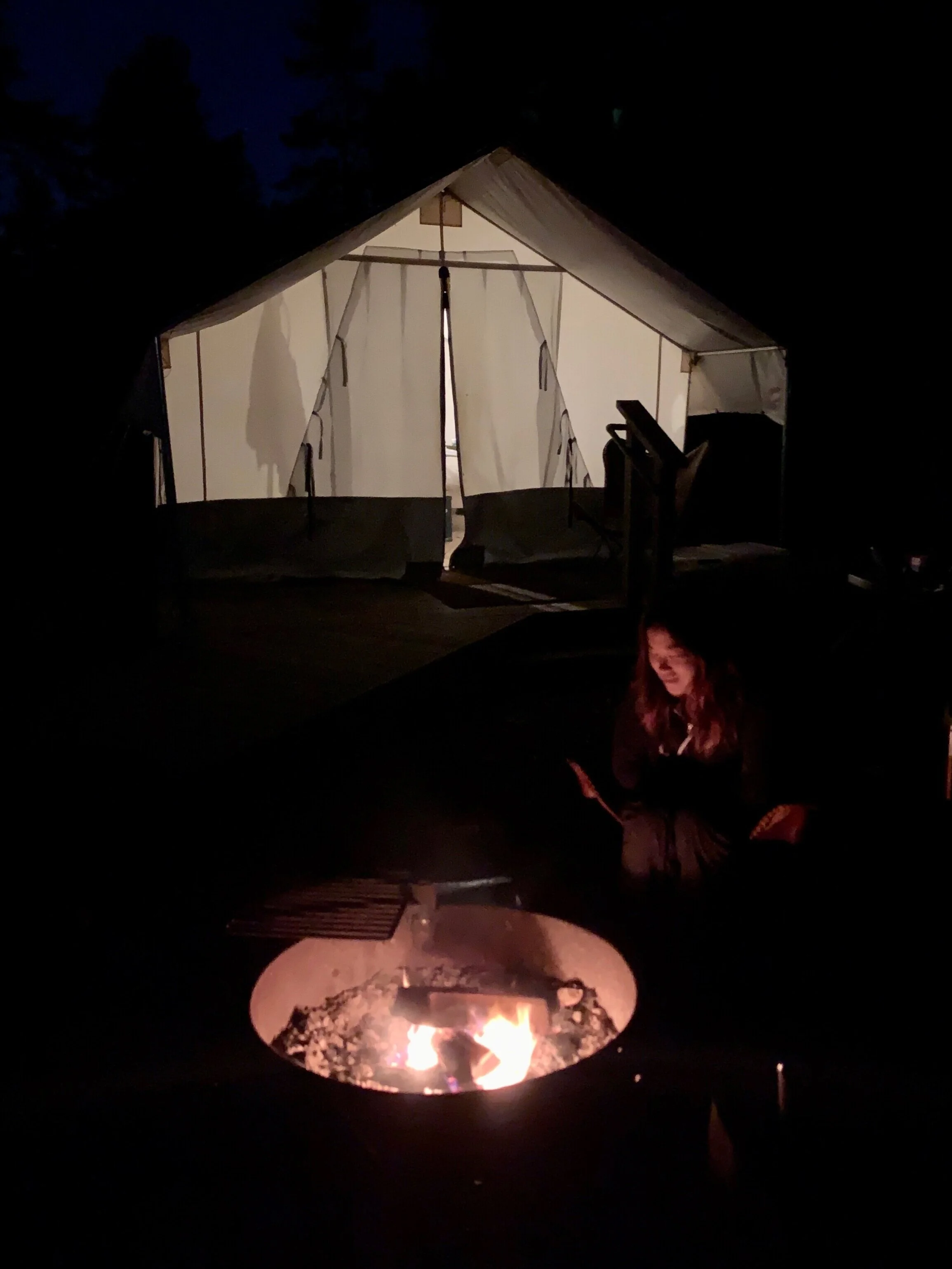
Yet interspersed through the challenge were glimpses of ease and flow. The joy of flying down a dirt bike path surrounded by blackberries and pines. The ease of floating down-river on our backs on a paddleboard, juxtaposed against the flow of digging in hard to paddle our way back against the wind and current. There was the accomplishment of building a fire and cooking lemon-wine scallops on a camp stove. I felt awe in feeling the weight of my own footsteps walking through a redwood grove surrounded by 1000-year old trees.
And that’s what fuels us. Hard stuff inevitably happens and coaching can support us in confronting what’s hard in an atmosphere of safety. That’s a challenge that I never shy away from. Yet perhaps, the act of doing, the act of trying so hard to get things right and perfect is itself self-defeating. Interspersed between the doings & pushing is the simplicity of being. Of doing nothing and surrendering to the path of ease and flow because that’s the beautiful moments that fuel the soul and generate creativity.
Bottom-Line
If you’ve been one of those people, like me, who fiercely marches into challenge, consider if there might be a different way. Consider that the path of ease and flow where you follow the fun might get you to an entirely different place. What would success look like from this path?
How to Work with Difficult People — The Controllers

One of my strongest self-sabotaging behaviors is my need to control other people and the plan of what we’re doing together. It’s led me to be described as a difficult person. In the parlance of Shirzad Chamine’s Positive Intelligence framework, my saboteur is the Controller. The Positive Intelligence website describes the Controller as having an:
Anxiety-based need to take charge and control situations and people’s actions to one’s own will. High anxiety and impatience when that is not possible.
The Controller is the dark side of some of my strengths. I am decisive, driven, able to challenge myself & others to do the right thing, and action-oriented towards an outcome.
If you have Controllers who are difficult people in your life, or if you are one yourself, I’ve found three focus areas to be helpful. Each area discusses the strengths around being a decisive person while providing suggestions for how to deal with a difficult Controller in your life.
1. The Paradox of Product Design
There’s a symbiotic relationship between controllers and creation. As a designer, you are making a product where you need to envision all the details of how a person could use the product. You create the use cases, the flows, the interactions, and screens. When you’re designing for complex ecosystems, you think of best cases, edge cases, and worst case scenarios where there are bad actors in the system. You are the architect of this perfectly controlled system. Yet inevitably, there comes the moment where your product is first exposed to the people who use it. This may be in early user research, beta testing, or during the MVP release. When that happens, no matter how carefully controlled the system, you are always humbled and learn how people interpret your carefully controlled system in different unexpected ways. It’s no longer under your control and takes on a life of its own.
While the designer had to be the controller to architect this system and create a carefully constructed plan, she also has to hold a light attachment to the product experience so that she stays open and flexible to the inevitable and unexpected changes that will come.
For controllers like me, try to embrace this paradox. Do your best work with the goals, plans, and use cases. Celebrate your strengths of moving to action towards a product launch or goal. And at the same time, remind yourself to lightly hold your attachment to the goal. You also care about relationships, the team, feedback from users, and you have a strength of being able to see the possibilities arising from new and unexpected changes.
For people dealing with difficult controllers, acknowledge the controller’s strength, that there was value in the details of defining the goal. And there’s also the opportunity to re-visit it now things have changed with new inputs and new data. Holding both together, while paradoxical, can also be true.
2. Leadership: Take Charge vs Delegate
Controllers are often leaders of teams and companies. I coach many executives and they are where they are due to their strengths of confidence, decisiveness, challenge, and the ability to both see possibilities and actively move towards a goal.
Controllers naturally gravitate towards taking charge. Their need to control situations and people’s actions can have them take charge of everything—the entire forest and every single one of those individual trees. One implicit delegation style is to bark out orders and have the person follow the precise directions. I used to manage like that. I refer to it as the “command and control” style of management. As a creative director for a world-class design firm telling all the top brands what the future of their digital products should be, I had to “command and control” the vision, the story, and each precise narrative of the design. Short-term, this strategy often works. You reach the immediate goals, you hit the milestones, and make the client happy. But at what cost?
The first cost is your time and anxiety. When you are the controller and you do every single thing yourself, no one else is going to step up. Why bother, when the controller will simply re-do the work you’ve done. As a controller, you feel resentment that no one else is pulling their weight, and also some anxiety that you have to be the person who knows all the answers all the time. Bearing this burden can also take an unbelievable amount of time. There’s a correlation between controllers and workaholism. If this executive example doesn’t resonate, consider the example of a new mom. She takes charge at home—she knows the single right way how to swaddle the baby, change the diaper, pick the right clothes, breastfeed or bottle-feed, and nothing that dad or the other mom tries to do is ever right. Yup, I’ve been that controller too.
The second cost is long-term relationships. If you’re the all-business puppetmaster, barking orders and making sure that the goals are met, then you aren’t taking the necessary time to nurture and build your team’s diversity of opinion. You don’t know what each of their strengths and quirks are. You don’t know if they could have done one of those tasks way better than the way you told them to do it. You had fierce control and could make sure everything is perfect for the short-term, but that’s not sustainable for long-term relationships. You didn’t make time to hear everyone’s opinions and leave space open for debate. You didn’t take the time to understand each team member’s depth of knowledge and unique perspective that could bring a fresh look to the goal. You didn’t let each team member try things in his or her own way, and perhaps fail and learn to improve, or perhaps wonderfully succeed and bring that team member incredible pride in their progress.
For controllers like me, think about what you are gaining in the short-term and what the long-term cost is. Consider the personal cost of time and anxiety. Consider the cost of relationships.
For people dealing with difficult controllers, emphasize that you can help save time or anxiety by helping to bear some of the load. Have a clear conversation about the desired outcome and impact of the task, and not the exact details of how each step of the task should be done. Try to build a personal relationship with the controller by listening to what really matters for them.
A word on sexismI’ve been female in corporate America and technology for 20+ years. Many of my clients are female. I’ve experienced and seen many instances of deliberate sexism and more examples of unconscious bias. We societally believe that strong, powerful women (controllers) are less likeable because we associate assertiveness and decisiveness with men and warmth and caring with women. I’m definitely oversimplifying the issue and you can read more about women’s unseen barriers, gender bias, and unconscious bias in many sources. Yet I want to acknowledge that this real, many of us encounter it, and it’s an additional burden for women who are controllers.
3. Range of Connection Styles
The decisive, get-things-done nature of controllers can mean that they prefer to connect with people in competition or challenge. In a conversation, controllers enjoy playing the role of devil’s advocate, often without letting the group know that that’s what they’re doing. Controllers will be direct and straightforward. Their connection style towards others is how they prefer to connect. Which only works out well for a group of controllers.
This connection style has a huge impact on other types of people. My partner is more of an intuitive person who feels his way through decisions and is highly in touch with his emotions. My connection style comes across as overly analytical, critical, and angry. It makes him feel scrutinized and shut-down. In a business setting, Controllers will be surrounded by people with all types of connection styles and in order to reach the business goals, will need to adapt and vary for a range of connection styles. The controller’s confidence and directness can sow doubt in others and destroy any confidence in their own opinion.
For an inclusive environment where everyone’s opinion is heard and valued, relationships should aim for interdependence. I provide this, and you provide that. Together, this diversity of opinion leads to a better long term outcome.
For controllers like me, adapt your connection style for the context of the conversation that you’re having. Especially in a 1–1 meeting but useful for all meetings, take the additional time to connect with the other person over something non-work related that you’re genuinely curious about. Recognize that your style may shut down other people and explicitly make space for dissenting or diverse opinions. If you are playing devil’s advocate, acknowledge that it’s the role you’re temporarily playing, as a way to assess risk to the project. Focus on the long-term relationship and the connection with people, in addition to the content of the meeting.
For people dealing with difficult controllers, try to focus on the content of their message and not the controversial or antagonistic delivery style. Listen for where you can find the 10% truth within what the controller is saying and build upon that kernel of truth. Explicitly ask the controller if they believe the position they’re stating, or if they’re doing a risk assessment or playing the role of devil’s advocate.
Bottom-Line
We all have controllers in life, whether it’s us or people around us. There are strengths to being decisive and action-oriented as well as areas of difficulty for others. Consider the paradox of product design, take charge leadership, and the range of connection styles you should attention to.
This is a continuation of the Difficult People series. The entire series is:
The Dark Side of Your Strengths

Photo by Andrew Hughes on Unsplash
You’ve been asked these questions in an interview or performance review setting:
What are you really good at? / What’s your superpower? / What are your strengths?
What’s a growth area you’re working on? / What would you like to get better at? / What’s your biggest weakness?
You likely have an easily-accessible list of your strengths and weaknesses. Yet there is a symbiotic relationship between your biggest strengths and the dark side of these strengths when they’re overused, also known as your weaknesses. The traits that you’re most inherently good at can be celebrated and propel you forward, or these very same traits can be overused or abused to self-sabotage your progress.
I’ll give you some examples.
Quality <> Perfectionism
I’ve been lucky enough to manage, lead, and coach hundreds of designers. For some of them, their superpower is an intense attention to quality, craft and detail. This superpower lovingly creates the overall quality of the end-to-end product experience; the minute UI details of corners, line-width, shadows and overlays; and micro-interaction transition moments of delight when you touch something on screen. When you experience a well-crafted, high-quality product, there is a feeling of perfection and ease, that all your needs are taken care of.
Yet one dark side of this attention-to-craft can often be perfectionism. When quality is taken to the extreme and becomes overused, there is a sense that the design always needs something more. There’s more time needed and infinite rounds of iteration to explore each change to further improve the detail and quality. It can feel like nothing is ever good enough. And leave you with a hollow unattainable feeling.
Collaborative <> Indecisive
One of my former clients leads a large team of product managers at a tech company. She is known for being flexible and collaborative. People want to work with her because of her empathy and her ability to pull teams together. She is known for listening to everyone’s perspective and people feel heard on her teams.
Yet one dark side of this collaboration is that she can be hesitant to confront problems head-on. Her preference is working behind the scenes to build consensus and agreement. When this collaborative strength is taken to extremes, she avoids conflict and wants to make sure that everyone’s opinion is taken into account. The dark side of being collaborative is that she can lack a strong leadership voice and perspective of her own. When she values people’s opinions to the extreme, she’s viewed as indecisive and bending in the direction of the loudest voices.
Visionary <> Impractical
One of my clients is a startup founder who’s known for being the visionary. He is madly creative. He is brilliant at predicting trends and dreaming up new features to enable the company to become the product leader 2–3 years in the future.
When he is solely focused on looking far out, the dark side of his strength is that he misses the details of this month’s sales figures or this quarter’s road map. This can be frustrating for his team who needs his attention on today’s operations and tradeoffs. His team is discouraged by what they view as impractical, future-facing long-term visions rather than what’s needed for this month.
Passionate <> Difficult
I’ve written and spoken often about difficult people, being one myself and also a defender and coach to many difficult people. The strength here is being passionate and fierce, including having many ideas, opinions, and suggestions. Taken to the extreme, when the ideas and the controlling need to win takes over, then you develop a reputation as a difficult person. When the need to be right becomes more important than the people and relationships, there is a negative obstinacy and stubbornness that prevails. These negative feelings come from the dark side of being passionate, and overusing that strength.
Try Something Different
Three keys to working with the dark side of your strengths.
Name it to tame itEvery time you celebrate a strength, ask yourself if there might be a dark side. Consider what that strength taken to an extreme state of overuse might be. Ask yourself if you are feeling positive emotions such as flow, ease, inspiration, and collaboration with others while using this strength. If you feel those positive emotions, that’s great! However, if you’re feeling negative emotions such as stress, anxiety; or if the impact on others is frustration and conflict, consider if you’re using that strength to the extreme and crossing over to the dark side. Start to recognize the instances when this happens.
Context: People & SituationsYou’ve used your strengths throughout your life and career. Now consider the context—the people & situations, that you’re interacting within. Will the impact of your strength with those people or in those situations be positive?
Consider the visionary founder example I talked about. He can amplify his strengths when working with people such as his design team or board of directors. Yet, he may mitigate it more when chatting with the head of operations or finance department. Situationally, a sales kickoff may be the perfect place to inspire and paint a vision, whereas that vision could be toned down more in a roadmap prioritization meeting where features need to be cut.Range
How might you play with the range of your strength? On a scale of 1–10, consider the number that represents how much you’re exercising that strength right at this moment. What would happen if you turned that dial up to a 10? Is it too much, or just perfect? Would it work better if the dial was at a 4? Play around with that number. Experiment and find out what your sweet spot is for different contexts.
Bottom-Line
We all have natural strengths and talents that we’ve honed with practice and experience. Consider that each of our strengths, when taken to the extreme and extensively overused also contains a dark side, a weakness that causes negative emotions for us and the people around us.
How to Do Nothing

Photo by Urip Dunker on Unsplash
I’m frantically trying to finish How to Do Nothing by Jenny Odell before my digital library loan expires in two days. It’s this month’s book club pick. Unfortunately, while I’m a glutton for leadership, mindfulness, and inspirational non-fiction, I can’t help falling asleep every time I pick this one up.
My 12 year old observed: “Mama, this really doesn’t seem the right book for you. You’re not a person who can do nothing,”
“Mama, stop listening to this book, you’re going to fall asleep and make us crash!” added my more opinionated 9 year old from the back seat of the car.
As we drove back from our last blissful mini summer getaway, the girls were getting sick of me ranting about the book I had to read. I moaned about how I didn’t care for the history of communes or the vast works of Henry David Thoreau or any stories about Diogenes. I was getting angry reading / listening to a book tracing the history of How to Do Nothing.
Don’t get me wrong, I have a vague longing and feel a sense that I should do more nothing. I speak and teach about the balance of being versus doing— that many of us corporate workers and Silicon Valley technologists are overwhelmingly focused on getting shit done, moving on to the next milestone, goal, product launch, or promotion… whatever it is that needs to happen next. Existing in this state of doing can keep us in go-go-go mode with the accompanying state of anxiety and stress. Yet it’s also an implicit expectation of the way we should be in the world. We are expected to study, take tests, get good grades, to do well in school so that we can get to better schools, which will get us a job, and then lead to better jobs. It’s all a state of doing things, and once which I’m very good at. And simultaneously, it felt that I was terrible at doing nothing.
Type A Traveling
When I was 25, my then-boyfriend and I took 7 months off from our jobs to embark on a round-the-world trip. While you’d think that we had all the time in the world to leisurely soak up the environment of each city or country, this wasn’t the case. I traveled with a philosophy of scarcity — there is so much world to see and I have so little time to see it all, so let’s go as fast as possible. In my type A traveling, we hit 7 countries in the first 2 months. We rarely spent more than one night in any destination. I needed to hit it all! Eventually we encountered a forced slowdown — my mom was diagnosed with breast cancer in the middle of the trip and I was lucky enough to be able to spend time with her in Bangkok. The tail end of our trip in Asia was small jumps to neighboring countries before returning to Thailand, then a glorious 2 months through much of China. But the pace was much the same. The only time we spent 3 nights in a single location other than Bangkok was when we were both delirious with fevers and ear infections in Guilin.
Eventually we had young kids and I stubbornly refused to slow down, continuing world adventures with them in tow. My concession to naptimes and kids that didn’t have the stamina to explore a new city from 9am to 9pm was staying for 3 nights in each destination. There’s so much world to see!
My kids and I went to Japan last year — a short 8-day trip squeezed into spring break week. I’d been there many times, so was finally able to truly slow down and let the kids set the pace. We skipped most of the temples (though I snuck in a couple on my own as they rested) and must-see tourist destinations instead spending hours in various kawaii animal cafes, people-watching in Harajuku, and eating our way through all the foods we could find. We even spent a day in Nara Park lounging on the grass with the deer, happily reading and drawing— doing nothing, if you will.
Travel with Covid
Now we are in the 6th month of Covid-19. Many of us are working harder than ever, doing double-shifts of work and educating kids. First responders continue to settle into this new everyday urgency of their jobs. Many people in tech are filling the time they used to spend commuting or walking between meetings heads down focused on their laptops. Yet, there is still more time and space as we are not socializing as much as before.
This summer, we didn’t go visit my family in Thailand. We didn’t travel to a new country. Instead, we went on local getaways every other week. We’d drive off and camp for 3–4 days. It was a slower mode of travel. One that focused on doing all the things required for outdoor survival. We spent hours setting up camp, cooking, cleaning, making fire, and breaking down camp. There was plenty of time to do nothing— go for walks in the wood, a paddle on a lake, chill on the hammock, and roast smores around the campfire. It was travel and it was a different type of slow travel. It felt soothing, calm, and rejuvenating. It gave us all a fresh perspective and appreciation of family.
As I remember all these travels, they were each perfect each in their own way. Some had more activity. Some had more doing nothing. Some were more planned. Others had room for spontaneity. All the travels provided fresh new perspectives and was a different mode than the day-to-day monotony of weekdays and weekends.
My Version of Doing Nothing
I’ve realized that my version of doing nothing can be a more active than other people’s. I have a restless soul and thrive on newness and the next shiny experience. I also have a yearning for the whitespace that opens up unplanned time for creativity, learning, and making things. I’ve found that “doing nothing” means doing something in a different way. Being able to deviate from default mode, the routine of weekdays and weekends to do something useful or frivolous that’s just different. Yet through all these activities, it means being present. Being aware of what is happening and slowing down to enjoy and savor the moment. My version of doing nothing includes:
Pulling weeds from the garden and chopping back tree branches in a rare sunny San Francisco afternoon
Rocking in my hammock writing a blog post, with a People magazine, frivolous beach read, and a leadership book all within my grasp.
Having a detailed plan for the day including activities, socially distanced friends to see outside, cooking plans for lunch and take-out plans for dinner. And then being able to dump it completely at a whim or because a power outage has de-railed all the plans
Having a luxurious whole afternoon of nothing, and being able to spontaneously decide what I want to do with it
I’ve realized that there are a ton of shoulds around doing nothing. I should meditate. I should take a nap. I should relax into self-care in a bubble bath. I should do a digital detox weekend. And I lean into throw all those shoulds away. Having the luxury to do nothing is having the luxury to have a plan and shred it to bits when something else catches my fancy.
What’s your version of doing nothing?
How to Make Fulfilling Decisions

Last week I had to make a decision about taking on a product & design role for a well-respected coach to help him work on his company and their coaching app. It’s been a year since I left product design leadership at Facebook. While I’d coached many people over the past ten years, I’m now a full-time leadership coach running my own business. This opportunity and decision-making put me right back into a familiar space of having to make what felt like the agonizing decision of “Do I take this job?”
Looking back through my career, I’ve made this decision 15 times. My typical thinking, brain-first method is to figure out what I want from my next role and how well this opportunity checks those boxes. I create a pros & cons list. I consult with several close friends and family members.
This time was different. I took the time to slow down, connect with myself, and deeply understand what really matters to me. I got coached by several talented people in my community as well as my formal coaches. I tried not to stress out too much about it, and even after making the decision, to be OK with the tension that still remained.
I’m sharing a 7-step framework for how to make fulfilling decisions, incorporating both head and heart, and with plenty of room for whitespace.
1. Envision the future
Think about your particular decision. How long into the future would you need to see clear results / outcomes from the decision? Perhaps it’s 3 months or 6 months into a new job? Perhaps it’s one year after launching the MVP (minimum viable product) for your startup? Pick that amount of time and envision what your life would be like after the clear result of your decision. Some people can dream and imagine the future while doing something else such as taking a shower, a hike out in nature, or drawing / sketching / coloring. For others, it’s helpful to journal. Part of dreaming and creating this north star involves speaking it aloud as if it’s already happened.
Here’s part of mine:
It is February 2021. My business is doing better than ever. I continue to support powerful leaders in 1–1 coaching, group coaching, workshops, and speaking engagements. I am able to impact a large community with the products & programs that I create. I’ve also experimented with many programs, products, partners— some have worked, some haven’t, and I’ve learned from all of them. I’ve successfully integrated my product building skills and my coaching skills to continue my journey of exploration.
2. 10/10/10 Perspective
When you have to make a particular decision, it can seem like a giant black cloud, crowding out all other thoughts, with its rain threatening to soak through every single part of your life. One useful tool is the 10/10/10 perspective. How are you going to feel about this decision in 10 days, 10 weeks, or 10 months? This perspective helps give some space & time to the urgency and importance of this rain cloud. Perhaps it’s a giant decision that will matter a lot in 10 years, such as deciding to have a child. Or perhaps the decision isn’t all that important… it feels really important right now, however in 10 days it won’t matter at all.
You can also play with the unit of time. Perhaps 10/10/10 stands for 10 weeks / 10 months / 10 years or it could be 10 minutes / 10 hours / 10 days depending on what the decision is.
3. Space to say Yes and say No
Consider your options. When you say yes to this decision, what else are you saying no to? Or vice versa, when you say no to this decision, what else are you saying yes to? Come up with as many list-y items as you can. Rather than a pure pros/cons list, this ideation lets you play with all the facets that are important to your life and work. It can start to show interconnected threads or themes. It also helps with a clear sense of prioritization, and mitigates any positivity or negativity with the decision. Saying no doesn’t have to be a negative / failure / a dead end option, because it enables you to say yes to other things.
4. Ask your voices
The psychologist Edward de Bono outlined the concept of Six Thinking Hats where in every situation, you put on one of the six hats to approach the problem in a new way. Often while in a meeting setting at work, we would assign specific hats to individual people to play the perspective of that particular hat. The six hats are:
Blue: big picture & overall goals
White: facts & information
Red: feelings & emotion
Black: critical judgement, often the worst case scenario
Yellow: positive, the best case scenario
Green: new, creative, innovative ideas
For the decision, you can ask yourself what would each hat (or voice) have to say. Feel the particular hat and perspective. Learn from its opinion and hear them all out before you make any decisions.
Another way to look at your voices is seeing what your self-critical or self-sabotaging voice says. Perhaps it’s a voice of fear that says you’re not good enough or that you don’t deserve the job. It’s important to label this voice and call it out for what it is— a negative perspective that is telling you lies. A different voice to listen to is that of your inner leader or sage¹. This is the part of you that is calm, peaceful, full of positive emotions and wisdom. This voice knows how to make decisions and has done so in the past. What is this voice telling you?
Asking your different voices activates different areas of your brain and allows for a variety of perspectives and inputs into the decision.
You can also ask your friends to be different voices for you to gain additional perspective. Keep in mind that they will each bring their own biases and opinions to the decision. It’d be useful to pick friends that truly have your best interest in mind.
5. Whitespace
With all of these inputs, divergent ideas, and options on your decision, sit still and do nothing for some hours or days. Stop working so actively and trying so hard to push the decision into being made. Instead, simply go about and live your daily life and work. Think about the decision and all the options before you go to sleep at night. See if anything pops up.
We are often so active and driven to do things, solve problems, and progress forward with tasks and decisions. Giving even a tiny bit of whitespace to allow yourself to simply stop and be with the unknown space before the decision will open up some new insight.
6. Trust your intuition
Near the end of my decision-making process, I talked to one of my best friends about this product & design role for the coaching company. With unerring logic and deep love, he told me that it was a complete distraction from my long-term goal of building a coaching business. When he spoke the words out loud, I knew that he was right. It didn’t make any logical, rational sense. Simultaneously, I also knew that I wanted to take the role and that it was completely right for me. Both things could be true. My head said that it didn’t make any sense, yet my heart yearned for the connection to design, to making things, and to an exciting new mentor and opportunity to co-create.
I told him: “Yes, everything you said makes complete sense. And I’m going to take this role anyway. Because I want to.”
Ultimately, trust your gut. Listen to what you really want. Listen each morning to see if the thing you really want is still true.
7. Aftermath
Even after the moment you’ve made a decision, there’s still extra details to consider. These details are what remains to be figured it out. For a job, it could be things you negotiate— the title, the salary, responsibilities, and agreements about how you will show up. For another decision, it might be the boundaries and constraints you need to put in place to truly be happy with the decision. It’s important to make sure you have a good grasp of these details and agreements.
After the details is the aftermath. This comes after you’ve signed the paper or verbally committed to someone. Take a moment to consider how you feel. Is there relief? Disappointment? Tension? Excitement? Fear? Self-doubt? Or some combination of all of them. It’s OK. Sit with the emotions and recognize that you’re a complex person. It’s OK to feel all these things and still know that you’ve made the right decision.
My Decision
I ended up co-creating a product & design advisor position part-time. It enabled me to focus the majority of my time on my coaching business. Yet it also gave me an avenue of experimentation with a new partner relationship, access to intriguing content, and a wonderful way to integrate my past product skills with my current coaching skills.
I used many parts of this framework to make my decision and also set clear boundaries & agreements for how the position would look. Having a framework that integrates head, heart, and whitespace in decision-making only leads to more fulfillment.
¹The concept of saboteur and inner leader is taught in the Co-Active Insitute coach training program. Saboteur and sage is from Shirzad Chamine’s Positive Intelligence research
Permission to Savor Success

What limits do we put on ourselves? Photo by Markus Spiske on Unsplash
I read a lot of books. Being in the leadership business, I devour personal growth, mindfulness, and psychology books at an alarming rate. I recently read Gay Hendrick’s The Big Leap: Conquer Your Hidden Fear and Take Life to the Next Level and its surprisingly simple premise kept resonating and re-emerging through many aspects of my life.
“Each of us has an inner thermostat setting that determines how much love, success, and creativity we allow ourselves to enjoy. When we exceed our inner thermostat setting, we will often do something to sabotage ourselves, causing us to drop back into the old, familiar zone where we feel secure.”
— Gay Hendricks, The Big Leap
Hendricks calls this the Upper Limit Problem. That when we hit our Upper Limit of good, positive emotions, we hit a wall and self-sabotage in some way to become more secure in a familiar, more negative zone.
This hit home hard.
You see, I am a high performer and through all external measures, have had a successful career and life. Yet while getting these medals of external validation has always felt good and given me a brief moment of happiness, it was never enough. One moment later after the fast flash of relief is the look ahead to what’s next. That insidious little voice tells me:
“Don’t stop. Don’t relax. If I slow down, I’ll lose my edge.”
My fierce self-critic tells me that the things I do aren’t enough, that I need to keep going, keep striving and do more. I won’t give myself permission to celebrate, immediately going back to the familiar stress/competition/drive to find the next achievement. I had set my own inner thermostat of love, success, and creativity with a low upper limit and refused to let myself savor any success.
But Why?
Hendricks’ research identifies four hidden barriers that limit our happiness thermostat, which he calls the Upper Limit Problem. He goes into more detail in the book, however, you can read about all four barriers in this article. The barrier that resonates with most with me, and my harsh internal critic is the the first hidden barrier of feeling fundamentally flawed.
“The first barrier is the false belief that we are fundamentally flawed in some way. If we carry this feeling within us, we sabotage our success because we think we’re essentially bad.” — Gay Hendricks, The Big Leap
Even reading this sounds a little silly to me. What? How on earth could I think that I am fundamentally bad? Yet it comes back to a basic fear that I am not good enough. It’s the imposter syndrome of working at a world-class company like Facebook surrounded by thousands of brilliant minds and feeling that I don’t belong here. I’m a fraud and a sham and only made it in here by accident. It’s the feeling that makes me externally strive for more gold stars and medals whether it’s another job, another promotion, another degree because that external validation of my worth must mean that someone else thinks I’m good. And if enough people think that I’m good, perhaps it will be true.
I grew up with a tiger mom in true Asian tradition. She had high expectations of me and kept pushing me to do more. Love was won by achievement, the things that I did. Growing up, this was mainly through grades (“A-? That’s it? You couldn’t get an A?”) and being a dutiful, quiet, well-behaved daughter. I learned that what I did was more important than who I was, and that there was always more that I could do. Growing up like this created a fierce drive and ambition, and it also limited my thermostat of believing that I deserved love, success, and creativity.
Limiting my Thermostat in Career
I was Valedictorian at my elite private school in New Delhi, India, surrounded by diplomats’ kids, expats, and wealthy Indians. My striver had to complete all the Advanced Placement classes plus complete the much harder International Baccalaureate diploma. There wasn’t much doubt in my mind that I would be Valedictorian. I got another hit of external validation when I got accepted to all the universities I applied to. I was already looking ahead to the next rung— how well would I do at Stanford. And then ahead to the next ones— what job will I get after, when will I start managing people, and when will I get that promotion. It was an endless, exhausting treadmill in the corporate world.
Limiting my Thermostat in Relationships
After getting divorced some years ago, I am in a new relationship. Things are going wonderfully and we fell in love remarkably early. The way that I feel when I’m around him is buoyant, adventurous, giddy, funny— all positive signs of love and happiness. This happened in our early new months and kept continuing after 12 months, 18 months, and kept going even as we better understood each other’s quirks. I noticed early in the relationship that I kept “looking for the cracks.” I looked for all the things that could go wrong, silently judging us together, and having this critical commentary running through my head 24/7. Even worse, I justified this behavior by letting him know that this is just how I am, I am a person who keeps “looking for the cracks” and needs to control and perfectly plan out the future. Happily, he loves me despite that.
Starting to Change
One of the most brilliant leaders at Facebook told me something that I’ve never forgotten. He’d been my mentor for over a year and now we were sitting down to have breakfast and talk about how our relationship was changing from mentor/mentee to manager/direct report. He said:
Tutti, I believe in you and support you unconditionally. I think you’re great and I wanted you on this team because of who you are and the qualities you bring. You’ll make mistakes and that’s OK, and underneath it all, you have my full complete trust.
It was the first time a manager saw me for who I was, warts and all. As my mentor, he’d seen all my mistakes of failed projects and broken relationships over the past year, and it didn’t matter. I’d been used to measuring my success and value based on the accomplishments of what I did. He wanted me on his team for who I was, and because of that intrinsic belief, it didn’t matter what I did. Because no matter what I did, he would continue to support me for who I was. The warmth of this moment has been one of many that’s helped me recognize the negative power of my vicious self-critic.
Breaking through Upper Limits
Various strategies have helped me break through and expand past my upper limits. I continue to practice them throughout my life and work.
1. Name it to tame it. Becoming familiar with my fierce self critic and the language she uses helps me to recognize that vicious language. It gives me perspective and a name to the negative emotions that I’m feeling. That might not completely help in coming to a solution, but it’s a first step to acknowledge that my self critic is speaking. Similarly, books like Gay Hendrick’s The Big Leap gives language to a familiar feeling of continual stress & striving. It helps me name that I don’t give myself permission to celebrate because of my Upper Limit Problem. And it helps to realize that I am not alone, that many people share these same behaviors.
2.Surround yourself with people who believe in the best version of you. When we look in the mirror, it’s easy to fixate on what’s wrong — the wrinkles, gray hair, chubby belly, sagging arms. We find it easier to focus on our issues and not our strengths. It’s easier for other people to see the beauty within us. Find these people in your life. Find the friends, the bosses, the colleagues, the lovers who believe in the best version of you, no matter what. Because they can help you see that for yourself.
3.Imagine beyond the goal-settingYou’ve likely got some career goals ahead, whether it’s to find a new job, get a promotion/raise, or shift into new responsibilities. As part of the goal setting process, take some time to imagine what it would feel like the day after you’ve achieved the goal. For example:
Who would you want to joyfully share the news with? What would it feel like when you’re sharing?
When you’re alone after getting the news, what emotion bubbles up? Where do you feel it in your body?
Picture the small details of how your life will change for the better after achieving this goal.
Notice what emotions if any interfere with the positive feelings the day after. If it feels a little hollow, perhaps this might not be the right goal?
4.Practice savoring positive emotionsStaying in the moment and experiencing all the positive emotions that happen in a day helps the practice of savoring. It could be appreciating the colors of a sunset, the juiciness of biting into a plum, the pleasure of a cool breeze on a hot day, or the unexpected humor of a wry joke in a meeting. Many people find a daily gratitude practice to be helpful. My 9 year old daughter and I have it built into our bedtime ritual.
Bottom Line
I found The Big Leap to be a valuable & resonant resource to identify the Upper Limits that I put on my love, success, and creativity. I continue to be a work-in-progress in my continued practice to create better work and relationships from a place without Upper Limits. I remind myself to surrender and give myself permission to savor all the feelings of success.
Requiem for my Adventure Van

Vanny in Bothe Napa State Park
“Fuck! Fuck! Fuck!!! Sariya get some water!” I screamed at my daughter as I looked at the small flame under the hood of my 2003 Volkswagen camper. I ran to the driver’s seat to grab a water bottle and returned to a larger flame that had multiplied into three locations. The “set the van on fire” incident was one of many memorable highlights in this beautiful relationship. I’ve been reflecting on this memories now that the van has taken her last trip with our family this month.
Stepping back in time, I first met this beautiful 2003 VW Eurovan in the fall of 2019. It was love at first sight. She was sleek silver-gray and reminded me of the grace and agility of a regal elephant. As I drove her for the first time, I was strong and powerful from my elevated perch above the road. As I learned her secrets— easy transformation into a sleeper home, efficient storage under the seats, swiveling chairs and a mini dining room— I could envision seamlessly folding her into my life and having my family become more with her in it.
1. First forays into camping and road trips
I’ve always valued adventure, exploration and travel. Throughout my life, much of this travel has been by plane to explore new global destinations. Having grown up in large cities and with Asian parents who couldn’t imagine wanting to sleep outdoors, I was first introduced to camping in college. During my sophomore spring break, I took a delightful week-long road trip with four other women. My first time sleeping outdoors was in the depths of backcountry camping across Zion and Joshua Tree. I fell in love with sisterhood, road trips, and freedom.
Fast forward some decades and I had regularly integrated car camping into my family life with two city-born girls. It was the opportunity to live outdoors, slow down and appreciate a simpler life. We would spend our time cooking, hiking, swimming; and this allowed my girls the independence to take solo bike excursions. It was something we did and enjoyed as a family of four. Fast forward some years, and one weekend soon after my then-husband moved out of our house, I realized with horror that we had committed to camping plans with my youngest daughter’s classmates. We decided to go, and I enrolled both girls into owning their places in making this adventure work for our new family-of-three. That weekend, I learned that as a solo adult with two little people, I could install our roof rack & carrier, pack all our gear into a car, set up a tent, cook, and even find moments of relaxation through the sheer work of solo parenting.
2. Freedom and Expansion
Through the months post-divorce, we healed. We found new rituals in a different version of family. I explored more of what it meant to expand into myself after having been part of a couple for so long. After months of questing, I left my corporate job. Soon after, as part of going deeper in my coaching journey, I felt a tug and a yearning for spontaneity, freedom, and adventure. And all those feelings wrapped themselves into my heart and came into being with the wild dream that I wanted a Volkswagen camper van. As things felt uncertain with my work and my relationships, I became convinced that the one thing I knew for certain in 2020, is that I was going to take my kids back to Burning Man, and we needed a vehicle to call our home. The universe continues to laugh at my certainty and planning.
Yet I planned on, spending many hours on craigslist dreaming of adventure. I am not a patient person. When I get an idea or a dream into my head, I make it happen as quickly as possible. This van was an impulsive instantiation of the dream, a restless explorer that matched my heart.

I purchase a 2003 Volkswagen Eurovan
3. The Naming of the Van
The naming of things is an important ritual. It signifies a portentous beginning and hopes and dreams wrapped up in the thing. From my professional history as a brand strategist, having been responsible for running naming workshops for many companies and products, I figured this would be easy. Rather than being a dictator as the sole stakeholder, I created the unique design constraint that all three of us — my two girls and I— would have veto power over the name.
We had a broad variety of options, and had a a giant sticky note that all visitors to the house contributed to. Some favorites included:
Silver Streak
Sylvie
The Fat Limo
Bouncy Bus
Ellie the grey elephant
Vanessa
Vanny McVan Face (inspired by this naming meme)
After several weeks, it was clear that we were not going to get to a universal consensus. Reluctantly, I acquiesced to the entreaties of my kids (note to self: it’s unwise to give 8 and 11 year olds veto rights) and our gorgeous adventure van was given the oh-so-original name of Vanny.
4. Snippets of Memory
… The first trip was a glorious exploration up to Napa Valley. I felt strong and invincible at the wheel of Vanny, elevated from my diminuative 5' 2" and merrily bouncing along with camping gear packed into the custom little boxes, all safe in their grooves. It felt like having a golden ticket — we pulled into Bothe Napa state park without a reservation and got a secret camping spot reserved for “pass-through” single night travelers self-contained within their vehicles…
… The next trip with kids involved hauling bikes and paddleboards in addition to all the camping gear up to a blissful weekend near Point Reyes. Vanny waited for us patiently as we glided over bat rays and jumping fish paddling through serene Tomales Bay…
… Driving vanpool on the first week of school, insulated as the driver in the front as 5 pre-teens behind me laugh and try to synchronize their phones to all simultaneously play the tik tok video in stereo…
… Vanny took us on multiple snow-boarding trips up to Lake Tahoe, hauling boards and gear for 6 people and making it up and over Echo Summit. She handled like a champ in the slippery ice…
… Vanny hauled surf boards and was with us the first time I paddled out at treacherous Steamer Lane in Santa Cruz where brave and foolhardy surfers take off right by the edge of a cliff…
… Vanny was whitespace and freedom. The ability to pick up and get out of town at a moment’s notice, self-contained and free, carrying our house on our back…
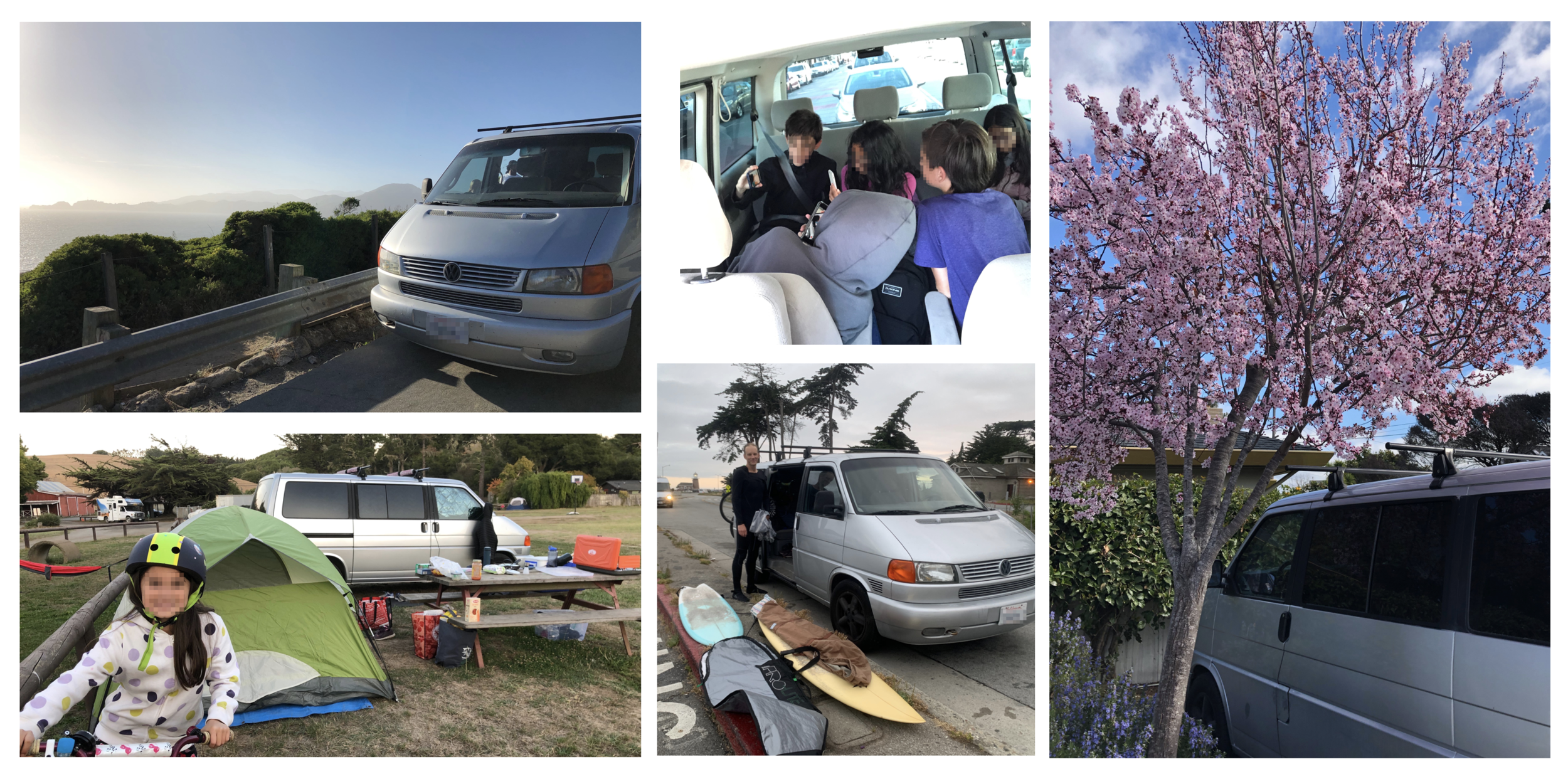
Adventures in Vanny
5. Ingenuity & Growth
I learned a lot about engines and maintenance, avidly following multiple online communities and DIY Youtube videos. I learned to buy a scantron to track the engine temperature and other diagnostics. I learned to pull out the battery and lug it into Autozone, obstinately refusing the men’s help to carry it, to charge for free. I felt competent and powerful, unafraid to ask all the mechanics and online fellow VW-lovers for help and advice.
And along the way, there was the day that I set Vanny on fire. I had a dead battery and in the time of Covid-19 was unwilling to interact with AAA. I pulled up my Mazda3, popped open the two hoods, and armed with Youtube and jumper cables prepared to connect the cars.
I mutter to myself “Red to red. Black to black? Or is it black to ground? Hmm…”
“Oh shit, there’s sparks flying.” I google “should sparks fly when you jump start a car” Phew… OK sparks flying are normal.
Alright, the moment of truth. I start the Mazda3, so far so good. I start Vanny and she starts up immediately. The kids cheer from the sidewalk.
Then to my horror, one little flame flares up under the hood. “Fuck! Fuck! Fuck!!! Sariya get some water!” As the flames get bigger and multiple into three, I feel a strange sense of calm as we empty water bottles onto the fire and it slowly dies down.
A lesson: it’s red to red and black to black. Not black to ground. Oh… and “ground” does not mean any piece of exposed metal that you see under the hood. Connecting “ground” to the exposed metal controlling my windshield wiper system was not a good idea. Though setting something on fire is still kinda cool.
I learned that I had managed to set my car on fire, and everything was still OK. Kids were healthy, and only a minor bill later, the wipers and rest of the electrical system were restored.
6. The Summer of COVID-19
Vanny gave us freedom this summer. We could pull up to our favorite restaurant, get take-out, and eat inside Vanny on real plates & silverware while parked on a cliff overlooking the Pacific.
As things slowly opened up, it felt safer to travel with Vanny and sleep in the uninfected air of our cocoon as we returned to camping. We started to head out of town every other weekend, feeling the pull of the open road after many months of shelter-in-place.
And then there was the day that Vanny died.
We were headed to our friend’s house in Lake Tahoe. Vanny was fresh from the shop, made road-worthy with a new suspension system, control rods, and a clean engine & transmission inspection.
As we headed out of Sacramento on the 80, each of us enveloped in our own music and happy to be headed out of town, I noticed that the air conditioning seemed to be malfunctioning. As I fiddled with the controls, there was an ear-splitting alarm blare from the dash— massive overheating, which had caused the air conditioner to shut down. We pulled off the freeway into a residential street, listened to the furious hum of the radiator fans, and watched the white smoke billow from under the hood. We waited and waited. As the engine cooled down I went knocking from door to door begging for some water as we’d already emptied all the contents of our bottles into the near-empty coolant tank. Coached by multiple mechanics, I managed to revive her and stutter along under 50mph over Donner Pass to an unbelievably kind VW mechanic in Truckee who stayed open to 8:30pm to wait for us.
The verdict: blown head-gasket, meaning that the engine had overheated so drastically that coolant had leaked into the engine. The radiator fans meant to cool down the engines had completely melted from the heat. There was damage to the radiator, engine, and transmission. The damage was so utter and complete, that the expense of resurrection would cost many times more than the value of the car.
That was the day that Vanny died.
7. The Lessons of Vanny
As I grieve my adventure van, I hold these lessons to remember the freedom and patience that she taught us.
Being weird is a labor of love. The community of Volkswagen enthusiasts is a tight do-it-yourself (DIY) group that has masochistic treasure-hunter tendencies to seek out original parts & find ingenuous ways around lack of manufacturer parts. Through it all, is a fierce loyalty, passion and commitment to the cult of VW. And a sense of belonging that we’re all in this crazy mission of driving classic cars together. We love it because it’s weird.
Slow down to speed up. I tend to be a speed freak. This happens in business, in surfing / snowboarding, and in how I drive. Vanny has been a continual reminder to slow down, take a break to give her engine some space, and continually monitor my temperature diagnostics (hopefully before something blows up). She’s the perfect metaphor for how I aspire to live my life.
Remember the feeling of freedom. My adventure van was a symbol and a literal path to freedom & adventure. That feeling continue to live within me and my family as core values.
Rest in peace Vanny. I take pleasure in the fact that you will be re-born into another dubgirl’s van rebuild and will eventually fly on the open road again. Eventually, maybe, we will be ready to welcome another van into our lives. Until then, freedom and adventure will live elsewhere.
The Value of Values

Photo by Sara Kurfeß on Unsplash
I’ve found values to be an accessible bottoms-up path into the fuzzy world of coaching, leadership, and self exploration. They are concrete and give people a foundational guidepost into a world of intentionality. As with the best guideposts, there’s also analogies and metaphors from the world of technology. Values serve people similar to how design principles (when actively used) serve the product development process.
Values are Design Principles for Your Life
Design principles start from a place of dreaming. We are creating a new thing, whether it’s a company, a product, service, or community. Part of dreaming up the North Star is identifying what we value and how we want life to be different for ourselves and our relationships. The principles can be used generatively to birth new ideas or features; and they can also be used as validation criteria to see if a new feature or design is “on-brand” or fits the product/org. Ben Brignell maintains an awesome open-source resource that dives deeper into design principles and has examples from all over the world. Two examples that I particularly value because I feel are both thoughtful, unique, and actively lived throughout the product / company are Airbnb’s and Greenpeace’s. One failing of design principles is when they are created in an optimistic time of beginnings but once created are ignored and never referred to again, a sad instance of “set and forget.” Out of curiosity I looked up Facebook’s design principles and these are the cautionary tale of something out-dated (“Transparent” 🤭) that’s long been set and forgotten. In fairness, many individual groups, teams and products at Facebook have since established their own individual design principles and those are actively used.
Similar to design principles, creating a draft set of core values, and additional experimental values helps keep you on-track and creates guideposts for your work and life.
Finding Your Values
Getting to a draft set of values can happen with a 30–60 minute block of time.
1. Divergence. Sit with a blank piece of paper and come up with as many words or phrases for things that matter to you. Think about leaders you admire, books/music/movies that you’ve loved and what you identify about the characters. Additionally, think about things that really aggravate you (e.g. perhaps you hate it when people are late and that could lead to a value of timeliness), and qualities that matter to you. Go broad and get to a list of 100 if you can. I’ve included a cheat sheet below.
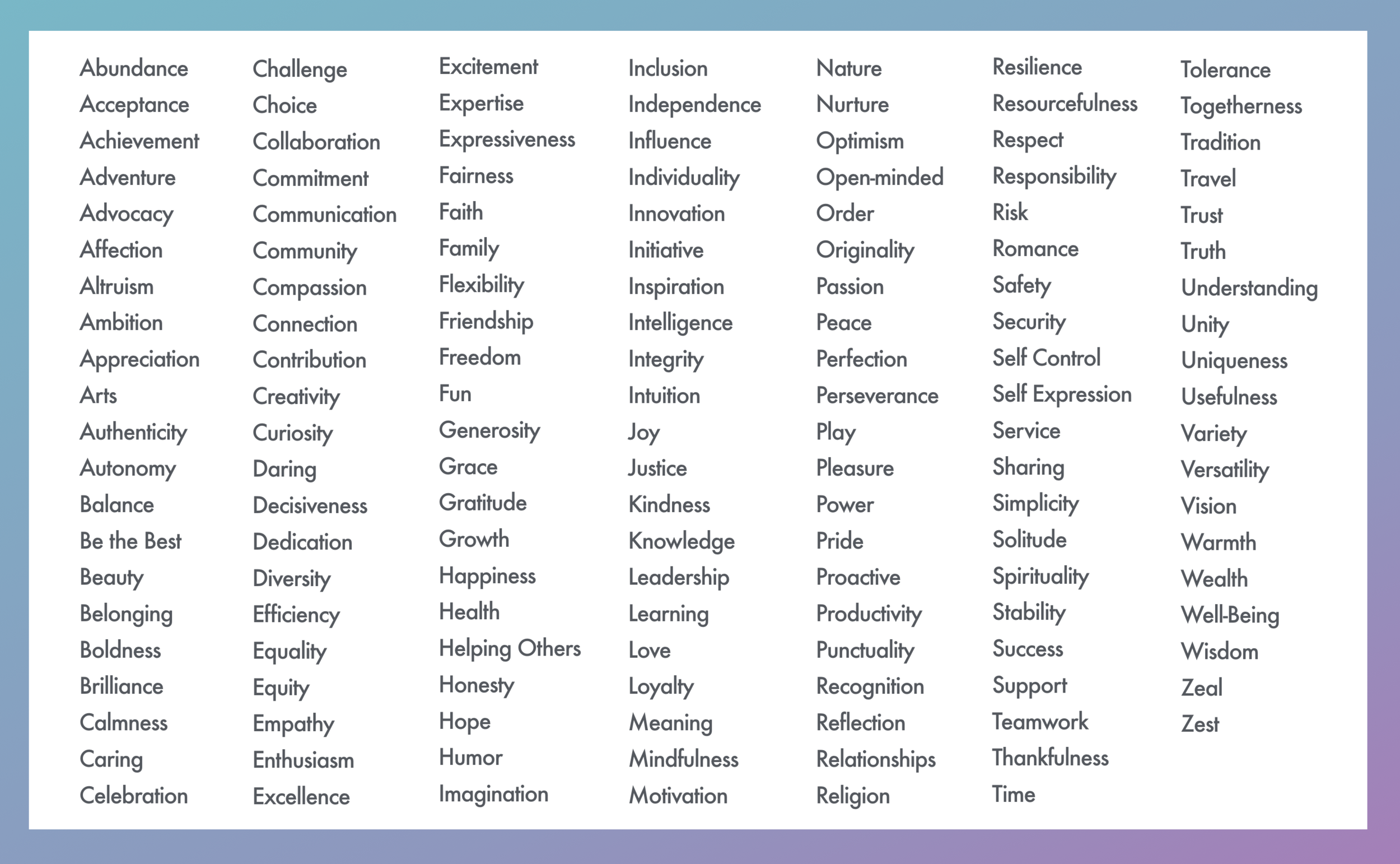
Table of Values
2. Convergence. Sit with this list and go through and circle the ones that resonate the most. Don’t worry about the number, this is a first pass.
3. Themes. Of the ones you’ve circled, which ones feel similar? Group them together and find a name that feels right for the group. The name could be one of the values in the group or something else. The more unique or distinctive the name can be for you, the easier it’ll be to keep it top of mind. For example, one of my clients has the value of Go beyond, Plus ultra which has personal resonance from an anime series. The value would feel entirely different if it was called 120% or resilience or grit.
4. Focus. Narrow down to your top 5 values. It’s hard to keep track of more than five items. Pick the ones that feel the most important right now. And it’s OK… this is a draft set that can and will change over time.
First Draft
So you have a set of values, great! Take a look at them and see if some feel different. Do some feel like foundational or core values that have been a part of you your entire life?
The first time I did a values exercise was about 10 years ago. This was my first set:
*Adventure/Change
*Challenge
Family
Visionary Leader
Embrace the Moment
The first two — Adventure/Change and Challenge — felt core to me. I’d grown up moving to a different country and culture every 3–4 years of my childhood with my father’s job. I had a love of travel and a fierce need to rise and conquer every challenge. Those two felt foundational.
Family was newer. My relationship with my immediate family — partner and two young daughters — was an emerging part of me. I was also exploring family as community spanning my work team, my friends, and all the circles I belonged to.
It’s OK to have a core / foundational number of values and then have experimental or aspirational ones that you continue to play with. Last year, when I left Facebook and wrote about the process, my values evolved to become:
Adventure
Challenge
Family
Transparency
Dance in This Moment
My earlier value of Embrace the Moment had now evolved to the more evocative Dance in this Moment. It had been liberally stolen from one of the foundational principles of my co-active coach training. Decades ago in college, I had performed as part of a vintage dance ensemble where we would waltz, swing, tango and swirl in all kinds of couples dancing. I still love dancing today. This phase of Dance in This Moment felt like it captured the value and gave it more color & vibrancy, making it easier for me to aspire towards.
Live Your Values
Living into our values means that we do more than profess our values, we practice them. We walk our talk — we are clear about what we believe and hold important, and we take care that our intentions, words, thoughts, and behaviors align with those beliefs.—Brene Brown
Values, similar to design principles, become useless if they are set and forgotten about it. Instead, start living with and experimenting with them.
Pick a value you want more of. Some of the values may already be how you live your life— great! Instead, pick one or two that you would like more of in your life and work. For me, my continual one is Dance in This Moment. How do I get closer to my sense of being, of following the flow, of staying present to what is and quiet my go-go-go driven problem-solver who likes to plan & control the future. Pick a value and consider what you might do to honor it in your life and work.
Stretch your values. Take a look at your draft list. Do some of them feel like they’re entirely part of your home list, and others feel part of work? Consider the “home” values and see what they would feel like if you applied them to work; and vice versa. Values tend to become the most true and resonant when they are more universal than siloed in different parts of your life.
Apply values to decision making. Here’s where things get really interesting. Next time you are faced with a non-automatic decision, take out your values and use them as a lens for the decision. For example, if you have values of Autonomy and Freedom, and are in the process of interviewing; then consider each conversation or organization that you talk to. For the role you’re applying for, on a scale of 1–5 how much Autonomy would you have? How much Freedom would you have with your manager? You can apply values to all types of decision-making whether it’s buying a house, dating / relationships, or deciding to embark on a new project. I ultimately left the corporate world because of a values misalignment.
Bottom-Line
Similar to how design principles form the guardrails and core of a product or organization, identifying and living your values is a tool for the intentional life. Values form the foundation for work and life and offer up another perspective on everything from relationships to career to decision-making.
More Resources:
Living Values Everyday: How Values Influence the Way we Work and Live talks about company values, rather than personal values, however, it has good examples of how to infuse them throughout a workplace.
Example of how the value of freedom is expressed differently in people’s work.
Simon Sinek on Why Values Matter. This is using geo-political metaphors but sometimes the metaphor helps to stick it.
Endings & the Spaces In Between

The Cape of Good Hope, at the tail end of Africa; Photo by Victor Smits on Unsplash
Hamilton’s July 3 debut as a film gave me chills and brought me back to my wondrous first viewing in a theatre. One of the most powerful moments is Christopher Jackson playing George Washington singing One Last Time of his decision to resign from the presidency:
We’re gonna teach ’em how to
Say goodbye
One last time— One Last Time, Hamilton (Original Broadway Cast Recording)
I’ve also reached the end of one of my coaching programs with the Co-Active Institute (CTI), which comprised of a weekly ritual with our group of ten that’s helped stabilize me through this wildly unpredictable 2020. So I’m thinking a lot about endings, new beginnings, and the spaces in between.
I tend to be a restless person and a speed freak, moving seamlessly from the end of one thing to the beginning of the next. I seek the next new adventure and shiny object.
Celebrating Endings
We all have different endings in our life. They can be as large as finishing a course or school program, leaving a job, ending a relationship, leaving a country, or experiencing a death. Endings can be as small as reading a book, writing a blog post, or wrapping up a lovely meal with friends. And you can imagine the range of intermediate endings in between.
Endings can be your choice or involuntary. Both have different types of pain associated with it, though this post is primarily focused on voluntary endings. Endings are important as a milestone, a point-in-time reflection, and a brief pause to consider what matters. Some key questions to close the chapter on a period of life.
What do you want to celebrate about your ending?
What do you want to honor and carry with you into the future?
What do you want to grieve and leave behind?
How do you carry the ending for a group? How do you “teach em how to say goodbye”?
As I complete this part of my ongoing professional education, there’s many things I want to celebrate — the intimacy and connection between ten once-strangers who’ve spent 25 weeks together on zoom, the stabilizing ritual of a weekly meeting through the chaos of pandemic, and the power of a group as it gels over time. I want to honor the principles and cornerstones of co-active coaching and continue practicing them in my future client sessions. I’m also sad to lose this weekly touchpoint and grieve the connection, yet I want to leave behind how restricted my Tuesdays have been. And finally, I look at this ending as not really saying goodbye to individuals, but to the group. I know that it’s the beginning of connections that I’ll expand and explore through my life.
If we look back at history, George Washington had two major endings — first resigning his post as commander-in-chief of the armed forces and then resigning from his second presidential term, setting into motion the two-term limit on the US presidency. It was unprecedented for a leader to step out of that much power, and with my hazy Hamilton-fueled grasp of US history, I’ll conjecture that he wanted to leave a legacy for a republic rather than the British monarchy that may have felt more dictatorial. Honoring his new country was the best purpose for his ending.
I’ve shared two examples of examining endings. The reason for pondering these questions is that if you have an unresolved ending or matters that haven’t been completely grieved or considered, they often follow up to your next beginning and insidiously creep their way in. It happens often in both romantic relationships, and how you show up at work with your boss & co-workers.
Space In Between
And what are you going to do next? It’s the typical question that’s asked after an ending. It’s not uncommon for people in tech to leave a job on Friday and start their next job the following Monday. During farewell celebrations, the forward-looking crowd typically peppers the departing employee with questions about what’s next. It’s much more rare for people to take months off to figure out their next move or spend time with the family. I’m deeply familiar with and have been guilty of falling into this mould. Of not being willing to make an ending until the next beginning is clear in my mind.
Yet that fails to take into account the huge value of the space in between endings and beginnings. This is a whitespace of freedom, exploration and possibility. It’s also deeply uncomfortable because it’s unknown, uncertain, and unplanned. It’s the huge space of possibility before a commitment. In this space, you can ask questions such as:
What am I longing for next?
What do I want to explore?
Can I focus on the present and live day-to-day without starting something?
Bottom-Line
How do you typically process your endings, beginnings, and the space in between? There isn’t a right way or a wrong way. Yet consider that you could try it differently next time to see if anything else opens up.
One of my wise CTI leaders, Andrea Sigetich left us with a poem by David Whyte entitled Finisterre, and I excerpt a portion of it to wish you safe pilgrimage through your endings, beginnings and the space in between.
to promise what you needed to promise all along,
and to abandon the shoes that brought you here
right at the water’s edge, not because you had given up
but because now, you would find a different way to tread,
and because, through it all, part of you would still walk on,
no matter how, over the waves.
Evoking Transformation in People and Product Design

Photo by Chris Lawton on Unsplash
¹Evoking transformation. Doesn’t that sound so grand and lofty? Let me put it in more relatable way. Change is inevitable. It’s a core part of our lives. 2020 has shown us that. Change often happens from the outside-in, whether it’s on a global level— a pandemic, acuteness of Black Lives Matter or on a very personal level— a breakup, a layoff, an illness or death. When change happens from the outside-in, we are reactive. We choose our perspectives and actions based on these external events. Now imagine the magical place where we create our own change from the inside-out. This change involves finding our voice, finding out what really matters to us and using it to evoke transformation. As people, we can evoke transformation in ourselves and in the other people and relationships around us. As product designers, we can evoke transformation in the process of creating/selling/building our product ideas & vision.
Find Your Voice
Finding your voice is not a binary state — you don’t have your voice vs not have it. Each of us already has a voice. We have a way of being and expressing ourselves that’s evolved since childhood. We have our patterns and typical ways that we show up. These are examples of different expressions of your voice at work:
I’m an introvert.
I’m comfortable connecting with people 1–1 or in small groups. Large groups are harder for me.
I’m first to raise my hand to ask a question.
I have a different work persona than how I show up at home.
I have strong opinions and I will share them with everyone.
I don’t feel like my opinion is needed in the room.
I listen to others to understand what they need and use that to inform my opinion.
We evoke transformation in ourselves and in the world around us by experimenting with how to authentically express ourselves. Consider the three attributes to authentic expression that you can play with — *1. Fierce Courage, 2. Aliveness, and 3. Connection.
And also consider, where in your life might you want to evoke transformation. Perhaps it’s a key relationship with a coworker or a boss, a friend, or a family member. Perhaps it’s to increase your impact as a designer on the products you create. Perhaps it’s to change something about yourself.
1. Fierce Courage
Fierce courage is being able to say the thing that no-one else dares to say. To speak your truth. In doing so you risk many things— not being liked, ridicule, not being heard, or being judged. You can speak your truth with kindness, as recommended from the philosophy of radical candor.
When you’re thinking about a relationship, has there been something that’s troubling you? How do you ask for what you want? Or empathetically ask the other person about something that’s been bothering you? Is there something that needs to be said to honor the relationship? Some examples:
To a manager: I have too much work. I’d like your support in figuring out how to prioritize my load.
To a spouse or partner: I’m feeling some resentment about how we balance housework and childcare. I’d like to get your perspective on it. Can we talk?
To a friend: I’ve noticed that you seem distracted and overwhelmed. Is this something that I could help you with?
What do you want to be different about your work impact or the impact of the products that you create? What feels like the right thing to say to improve your product or company?
The photos & illustrations in our product don’t reflect the gender and ethnic diversity of the people who use our product.
The current version of our MVP (minimum viable product) feels like it’s missing the mark on key use cases / quality / features and we should address the issues before the release.
As a company we talk about valuing product quality, yet it seems that our product teams are incentivized to release products as quickly as possible.
I’ve given some examples of fiercely courageous statements / questions above. What part of your voice needs to be fiercely courageous to make your relationships and products be the best that they can be?
2. Aliveness
Aliveness is having energy, fullness of feelings & emotions, and being in flow. It involves being fully present, and in the moment. There is a desire for movement, action, and forward momentum.
Consider who in your life brings you aliveness, and what is it about them that evokes aliveness in you.
Perhaps it’s a child that gives you permission to play and enjoy the simplicity of the world.
Perhaps it’s from long-time friends who love you unconditionally and never judge.
Perhaps it’s from another designer on your team with whom you can explore the most out-there, future-facing ideas and co-create something crazy together.
Perhaps it’s a data scientist who brings a completely different perspective to the work. This perspective feels so new and novel that it makes you think differently.
Consider what activities bring you aliveness, and how you could amplify your voice by doing more of these things.
Could it be a side-project or pro bono work that you can’t wait to work on because you care about the cause so passionately.
Or a logo that you’re designing for a friend because it’s so different from your day-to-day digital work and gives you such creative freedom
Or the design sprint where you love the collaboration and energy of possibility from everyone present.
Or the four hours of quiet focus time where you get to create an entirely new concept rather than push out tasks, small design tweaks, and respond to the needs of others around you.
With this audit, you’ll find what brings you aliveness. The next experiment is to bring more of that energy into the rest of your work. This helps to develop your voice, and how you choose to express yourself at work.
3. Connection
Connection is the quality of a trusted, empowered relationship. There is no judgement and there’s the space for all the parties to be themselves. Some relationships may already feel deeply connected, while there’s room to improve in others.
The best path to connection is a clear designed alliance for the role all the parties play in the relationship, whether it’s at work or at home. It’s an open conversation, likely developed over time which covers expectations, roles and desires.
Should some of the connection feel one-sided, approach the relationship with empathy and curiosity. I’ve written a lot more about connection in How to Work with Difficult People, Start with Listening…
Bottom-Line
There is change all around us. We can improve our relationships and product impact by finding our voice, and using our voices to evoke the transformation we want. The path to finding the authentic expression of your voice is through Fierce Courage, Aliveness, and Connection.
¹The concept of Evoking Transformation including the key attributes of Fierce Courage, Aliveness, and Connection are from teachings of the Co-Active Institute.
The Art of Receiving (Racial) Feedback

Photo by Trung Thanh on Unsplash
Given our collective focus on #BlackLivesMatter in the past month, like many of us, I’m on a life-long journey to re-examine my personal relationship with race. Most conversations I’ve had over the last three weeks have touched on the impact of race in our lives. I’m particularly deep into Robin DiAngelo’s White Fragility: Why It’s So Hard For White People To Talk About Racism and Layla Saad’s Me and White Supremacy. I’m fascinated by what we can do to change our own behavior as allies. One key to behavior change is how we receive feedback. While my inspiration has been learning about receiving racial feedback, these lessons go deeper and can be universally applied to all feedback.
1. Acknowledge the courage to give feedback
Consider the state of mind of someone who has summoned up the courage to give you meaningful feedback. It may be a peer review in performance review cycles. It may be a good friend who you’ve inadvertently offended. It may be a partner who you’ve tuned out because this feedback is so recurring. It may be someone on your team who wants a better working environment. In all cases, this person deeply values something about the relationship or your action has deeply touched something emotional within them. Acknowledge the courage and integrity that has sparked this person to take the active choice to give you feedback. 10x that acknowledgement if the person is in a lower power relationship to yourself whether that relationship is imbalanced by its very nature (e.g. teacher/student or manager/direct report) or for any of the following differences, actual or perceived:
socio-economic in wealth, experience, network
age
gender
race, with whiteness being commonly considered to be the norm (higher power)
When receiving the feedback, stop to consider that courage and summon up empathy and curiosity.
2. Focus on the content not the tone
Working in corporations, I’d always been told to watch the way that I say things— my tone, the expressions on my face, my body language, and my emotions. I’m aware that confidence and emotion that might be perceived as bold when a man says it, can come off as aggressive when a woman says it. We all have this implicit bias. While I’d been intimately affected and aware of the gender bias, unfortunately I’d paid much less attention to the stereotypes of the angry black man or woman, despite having black friends and devouring Michelle Obama’s Becoming.
What helps us fight these biases is to focus on the content, not the tone. The tone is based on our own implicit biases. Excerpts from Layla Saad’s Me and White Supremacy:
“Tone policing is a tactic used by those who have privilege to silence those who do not by focusing on the tone of what is being said rather than the action content.”
“A white person’s expression of anger is often seen as righteous, whereas a Black person’s anger is often seen as aggressive and dangerous.”
“Tone policing is both a request that BIPOC share our experiences about racism without sharing any of our (real) emotions about it and for us to exist in ways that do not make white people feel uncomfortable.”
When you receive any feedback, racial or otherwise, try to focus on the content not the tone. The giver of feedback is expressing their perspective in the way that’s they are best able to.
3. Listen to understand
It is hard to receive critical feedback. It’s natural and very human for us to get defensive, to feel that we’re being attacked for an honest mistake, or even worse that we’re being called a racist or white supremacist. Try to set aside those feelings and put on the calm, curious demeanor of a researcher or an anthropologist. Truly listen to what the other person is saying. If you ask questions, have them be from a place of curiosity so that you can better understand the feedback and context. Trust that the other person knows you have good intentions and is putting themselves on the line to give you this feedback.
DO NOT EXPLAIN YOURSELF. This can only come across as defensive in the moment. If you need to explain yourself, wait 24 hours then have a follow up conversation with the person.
It can also be hard to receive complimentary feedback. Compliments don’t sit well with us. We want to brush it over and dismiss it. How familiar are reactions like:
“Oh, I was just doing my job.”
“That? It was nothing.”
“You’re fabulous at X too!”
nervous laughter and changing the subject
With complimentary feedback, put on the same calm, curious demeanor. Ask questions if you don’t understand it or if it’s a surprise. Let the other person bask in the joy of giving feedback. Bask in the pleasure of the compliment. You’re worth it.
4. Give thanks
Robin DiAngelo in White Fragility: Why It’s So Hard For White People To Talk About Racism shares two cardinal principles for how to receive racial feedback:
1. How, where, and when you give me feedback is irrelevant — it is the feedback I want and need. Understanding that it is hard to give, I will take it in any way I can get it. From my position of social, cultural, and institutional white power and privilege, I am perfectly safe and I can handle it. If I cannot hand it, it’s on me to build my racial stamina.
2. Thank you.
Feedback is a gift. Sometimes it’s a mantra I repeat over and over again to myself through gritted teeth. I truly believe it, and it’s also hard. There’s only one reaction that’s truly needed— say thank you.
5. Process and choose
Finally, as the receiver of feedback, later once you’re alone, you can process the feedback and choose the action you want to take. If feedback is a gift, you can choose if you want to:
Wear the gorgeous gift with pride
Stick it in the back of your closet to be forgotten
Re-gift it to someone else
Throw it in the dustbin
You don’t have to act on the feedback. Growth will come from taking the time to process, and actively choosing what you’re going to do. If you trust the feedback giver and the relationship, or if it happens to come from your boss, you’ll likely have to get back to them and let them know what you’re doing with the feedback. Remember, that it’s ultimately your choice.
Bottom-Line
Right now, it’s hard for me to disentangle any leadership or way of being from the conversations about race. My hope is that we can build better relationships and have deeper conversations by following these 5 steps to the art of receiving feedback.
If you’d like more, I’ve previously written The Art of Giving Feedback
The Magic of Paradox

Photo from Gödel, Escher, Bach: An Eternal Golden Braid by Douglas R Hofstadter
I’ve always had an obsession with paradox. I am a person of contradiction and skepticism. The concepts that fascinate me the most have a pure simplicity that cuts through their seeming-complexity. Paradox is an inherently human trait. It’s born from our messiness, where our brains turn over to re-examine concepts and our hearts tug towards or away from other concepts. Paradox has been a core part of both my design and coaching lives. I actively seek out paradox as I find the greatest truth to be in the magic that lies beneath the contradiction.
A paradox is a statement that seems self-contradictory because it holds two opposing ideas yet when deeply considered, is truthful. The magic of paradox is that it can be so absurd or insidious that it drives transformation. It’s the kernel of an idea that once considered, keeps growing.
Both as a designer and as a leadership coach, I’m in the transformation business. Designers seek to create product experiences that solve meaningful problems for the world whether it’s a new way for businesses to get insights from big data or enabling a platform for video creators to share their messages with their fans. In the technology space, new products get dreamed up or existing products get iteratively revamped to be better. In the coaching space, there is only one topic— how do I be a better leader and more fulfilled in my life.
The biggest enemy to evoking transformation is the status quo. Often it’s too scary or painful to contemplate the change, even though there’s clearly something wrong with the status quo. The magic of paradox is that it starts to introduce absurd or infectious thinking to infiltrate life and help sow seeds of ideas to challenge the status quo.
Paradox #1: People are Naturally Creative, Resourceful and Whole (NCRW) / Evoke Transformation
These are two foundational concepts from my coach learnings from the Co-active Training Institute. The principle that People are Naturally Creative, Resourceful and Whole means that people do not need fixing— we have all the ability we need to overcome external circumstances. As a coach and a leader, I see the best in the people that I work with. They are high performers. Amidst the chaos of being human, they carry an inner essence that is values-based and introspective. I see them as the hero of their story. I have unconditional love and acceptance for who they are. Even if they may not (yet) for themselves.
Simultaneously, as a coach, I am a guide who helps Evoke Transformation in people. All of us are in a state of change and experimentation. Externally, the world is burning— first from our first global pandemic together and now from the rage of racial injustice that’s expressed with protests and riots. This outside-in driven change is causing many of us re-examine our personal relationship with race, for some of us or white or Asian privilege, and for others, it’s yet-another-day. Finally, everyone else waking up to what black people have been fighting for generations. I believe that humans are fundamentally in transition. It may be a slow passive unconscious burn, or it could be a fierce drop into chaos or exuberance. Part of what I do as a coach is to be the spark, the trigger to evoke transformation within clients.
Another version of this paradox around which I’ve had many discussions with designers over the years, especially during performance review time is: “How can you tell me to celebrate my strengths, and at the same time talking about all the critical feedback and the things that I need to improve?”
Most of the people I work with, myself included, will flip through the 3 paragraphs of positive feedback and immediately jump to the critical feedback. We want to know what’s wrong with us. We want to jump into action, to fix ourselves, and to solve ourselves as the problem. That’s a characteristic of driven, ambitious people. If this sounds like you, the way that we grow the most is to embrace the part of ourselves that is not-so-familiar. So if you’re the type of person who jumps to the critical feedback, why not run an experiment? Don’t read the critical feedback immediately. Leave it for 24-hours. You won’t forget it… that’s your natural way of being. Instead, stay with the positive to remember what you’re doing right, and learn the art of celebrating wins. If you need to make an action plan, capture how you do more of what works.
Paradox #2: To Be a Strong Leader, Be Vulnerable¹
As a leader you want to be inspiring, make good decisions, and chart a roadmap for your organization that’s both visionary and operationally-strong. I remember the first time I started managing in an organization, having been promoted to lead my former peers. Not really knowing what to do, I put on a strong facade and blustered through, faking it until I would hopefully eventually make it. Solo, I created a strategy for the product, and plan for the team, and as a mini-general, told everyone what to do. In my attempt to fake it as a “strong” manager, I was a terrible leader. My “strength” continued as I worked as a Creative Director at design firms for many years. In this role, I was the visionary design expert leading our teams to show global companies— Samsung, Sony, Google, Nokia, Microsoft— what their future digital experiences would look like. My “strength” was in expertise, a style of command-and-control to perform and convince that our design concepts were exactly what they needed.
It wasn’t until I led teams at startups and then at Facebook that I realized there was another way. I stopped putting on the mighty armor of “strength” and started acting more authentically by sharing my vulnerability and truth— how I balanced my commute hours from San Francisco to Menlo Park with raising children, how I always felt imposter syndrome amidst all the brilliance, how I struggled as a female in tech, how to truly lead a team with diverse opinions when we couldn’t get to any consensus, and how I failed to build relationships with key leaders and got asked to leave one of my past teams. I realized that my role models, the strongest leaders I knew were the ones who led authentically as themselves and were unabashed in sharing their mistakes and struggles.
I keep reminding myself in my current roles & in my writing — To be a strong leader, be vulnerable.
¹Courtesy of one of my coaches, Rich Litvin.
Paradox #3: Rest Day is a Training Day²
I recently heard a brilliant talk by ²Matt Chavlovich, an Ironman athlete, pro soccer player, and fellow leadership coach. From his training, he shares the brilliant paradox of Rest Day is a Training Day. As many athletes know, part of a physical training regimen is building in a rest day. Muscles grow when they’re not in motion. The rest day allows muscles as well as nerves, bones, and connective tissue the time to rebuild. Because you’re training for a marathon not a sprint.
I am an ambitious and driven person. I like to move fast and get things done. Hard work, grit, and discipline have gotten me to my current success. I’m intimately familiar with my workaholic tendencies that drive me to exhaustion and burnout.
I also know that I’m my most creative when I build blocks of empty space into my days. It lets me focus and create what matters the most, or lets me simply play. And when my saboteur tries to shame me about the time-wasting or idleness of not doing something important, I can tell that part of myself to shut-up because rest day is a training day.
Bottom-Line
Perhaps, like me, you are obsessed with paradoxes. I adore the complexity of the contradiction, and it sticks in my brain. As a coach and leader, I can simultaneously hold that people are brilliant and that they can continue to transform. I remind leaders I coach that To Be a Strong Leader, Be Vulnerable. And perhaps most personally, I continually remind myself that Rest Day is a Training Day.
My Asian Privilege

I am a racist. I grew up in a racist culture and I am actively working on becoming an anti-racist. For most of my life, as a female I’ve been aware of sexism and I am an active feminist. Yet as an Asian, I’ve been lucky to not experience much racism towards me, while unthinkingly exhibiting racism towards others. Writing this is uncomfortable. I’m worried that I might offend or say the wrong thing. And this is better than silence.
I am an immigrant. I grew up all over the world, often as an “other,” not from the color of my skin or my gender, but from a sense of not truly belonging here. I’ve lived in Singapore, Thailand, and Hong Kong, where my race has been that of the majority. I’ve lived in the Netherlands and England where my race is the distinct minority, and I have little to no racial memories of those years. I currently live in San Francisco. Most of my working experience has been in California and in Silicon Valley, where Asians are as prevalent as white and are considered part of the majority. Yes, I’ve experienced some rare racism in the form of hurled insults from passersby, or a tokenism when I visited my white boyfriend’s tiny town in western Colorado and I was the first Asian that some had ever seen. But throughout my life, I’ve experienced far more sexism than any form of racism. I’ve been privileged.
Growing up in Bangkok within the culture of my upper middle class family, racism towards others is a casual fact of life. White supremacy is dominant, and I grew up within this commonly accepted cultural understanding of the hierarchy of races:
White is best. Western is best.
East Asian is good. We are Asian, and here’s where we fit.
Brown is not-so-good. We are better than Indians, Muslims, Mexicans (the blanket term used for anyone Latinx).
Black is at the bottom.
I was privileged to attend Stanford University. My parents were horrified that I was dating a white man, because he was non-Asian. Yet they accepted it because white is best. Tiger Woods, already a celebrity, attended Stanford at the same time. He is half Thai and half African-American. My parents only half-jokingly threatened to ex-communicate me should I ever date him. His Thai-ness (and celebrity) did not come close to overcoming his blackness.
I’ve never questioned my cliche of dating white men, and I have two bi-racial daughters who are half-Asian and half-white. In San Francisco, they are considered part of the majority. When in Asia, strangers will comment on the beauty and lightness of my daughters’ skin. Being more white is prized. Movie stars, models, and celebrities in Thailand are often half-Asian and half-white.
In my professional life, I’ve been an ardent feminist and, almost as an afterthought, an advocate of diversity. As a leader at Facebook, I had a reputation for inclusion — at one point in time, my team had a 50/50 gender ratio and also had a near 50/50 ratio of white+Asian (the majority in tech) to non-majority races. In addition to the demographic, I believe that I practiced the psychographic of encouraging dissenting opinions, diverse perspectives and using them to generate conversation, ideas, and better products to represent our world. I learned of my own unconscious bias, both against working women as well as most strongly against African Americans.
As a leadership coach, the majority of my clients are women and minorities. I help to draw out their individual voices, stories, background and encourage pride & celebration in their unique leadership. The white men that I coach have their own diversity and they are woke— quiet leaders and fierce allies.
As an avid reader, I’m in a feminist bookclub that primarily reads female authors. Increasingly we’ve tried to focus on women of color and non-American voices. I remember initially questioning why all this mattered, that there’s plenty of good books by white males. Over time, I learned the value of seeking out more underrepresented voices and authors. I have choices in my reading material.
My network of friends is multi-colored. I went to high school in an elite international school in New Delhi. We would joke that our photos looked like a United Colors of Benetton ad.
Yet all of these paragraphs feel like weak, shallow justifications. They’ve been activities that I’ve passively stumbled into. I’m ashamed to say that I’ve often been on the periphery and resolutely silent on the conversation of race. Life has felt hard enough. I’ve kept my head down about race, remained silent when I’ve been in the presence of blanket judgements about black people (and Asians), and felt that I had enough on my plate with my own feminist struggles. Why rock the boat? Why take on someone else’s problem when I have enough to handle. Yet… Silence is violence.
“In the end, we will remember not the words of our enemies, but the silence of our friends.” — Martin Luther King
I can do more and I need to do more. I will understand my majority privilege. I will examine my Asian-ness, and my relationship with race. I will better educate my bi-racial girls.
This week, every conversation I’ve had has been about race. It’s been as small as acknowledging what’s happening around us, and as large as holding the space for a client experiencing flashbacks of police violence from decades earlier. I remember a conversation with a fellow coach, a white woman from a family of small business owners. She talked about the plight of restauranteurs who are just now starting to reopen after being pandemic-shuttered for months, and are now faced with broken windows and looted property from this week’s riots. For the first time, I was brave. While trying to hold trust, instead of building upon her empathy, I provided another perspective. Clumsily, I talked about generations of rage and anger… of the inability and impotence against a systemic racism in this country… and of how I still struggle to understand, and feel so far away from truly feeling and living it every day because I am not marked by the color of my skin. It wasn’t much, and it was a start.
“A riot is the language of the unheard. And what is it America has failed to hear? … It has failed to hear that the promises of freedom and justice have not been met. And it has failed to hear that large segments of white society are more concerned about tranquility and the status quo than about justice and humanity.” —Martin Luther King
What I’m Doing
1. I’m understanding and claiming my Asian privilege
These are many aspects of Peggy McIntosh’s daily effects of white privilege that I cannot claim. Given that I’d been trying to live a color-blind life, it was surprising to me that almost half of them did not apply. My wealthy tech-bubble privilege has blinded me to the fact that I am not white and not the majority. Yet, there were others that resonated and are an effect of my Asian privilege:
3. If I should need to move, I can be pretty sure of renting or purchasing housing in an area which I can afford and in which I would want to live.
4. I can be pretty sure that my neighbors in such a location will be neutral or pleasant to me.
14. I can arrange to protect my children most of the time from people who might not like them.
15. I do not have to educate my children to be aware of systemic racism for their own daily physical protection.
16. I can be pretty sure that my children’s teachers and employers will tolerate them if they fit school and workplace norms; my chief worries about them do not concern others’ attitudes toward their race.
18. I can swear, or dress in second hand clothes, or not answer letters, without having people attribute these choices to the bad morals, the poverty or the illiteracy of my race.
25. If a traffic cop pulls me over or if the IRS audits my tax return, I can be sure I haven’t been singled out because of my race.
2. I’m reading widely as a portal to reframing my relationship with race
In the past, there have been many heavy books on race that I’ve been unable to finish. I’m currently reading White Fragility: Why It’s So Hard for White People to Talk About Racism by Robin DiAngelo and working through the 28-day exercises in Me and White Supremacy by Layla Saad. Reading informs my opinions. It’s a way for me to process the world, and then share my questions, discomfort and thoughts.
3. Open discussions with my bi-racial girls
Our world is changing and we are living through history right now. My role as a parent is to educate my girls to not be color-blind. We watch the videos together, and discuss their reactions to them. I may have crossed the line showing the video of George Floyd to my nine year old, yet I’d rather err on the side of over-sharing, and sit with her through her fear and sadness. It’s the least we can do given the fear that nine year old black boys and girls have to internalize daily.
Bottom-Line
I don’t know the answers. I don’t know what to say. I continue to be racist and make mistakes while working towards being anti-racist. I do know that speaking is the only way to end the violence. I acknowledge my Asian privilege and I’m starting the conversations right now.
The Power of Play

The Fool; Courtesy of Motherpeace tarot
The Fool, the first card in the major arcana of a tarot deck is inspiration for the Power of Play. She represents frivolity, joy, spaciousness, lightheartedness and the willingness to embrace the beginner’s mind without the fear of being foolish. She is embarking on her hero’s journey without a care in the world.
Embracing one’s inner elf is the secret to the power of play.
Play and curiosity go hand in hand for me. They are the counterbalance to serious grinding in dogged pursuit of oh-so-important goals. The power of play can be easier to find in leisure, yet the same ease and curiosity is also accessible at work. Play is a state of being; the opposite of getting things done.
Play at Leisure
We all have our forms of leisure, call them hobbies or rejuvenation or simply how we show up when we’re on vacation. For me, I have adventurous play and relaxing play.
Adventurous play is activities that get my heart racing and challenge me to push my edge. They include some quiet and rejuvenation, and often involve physical activity. My examples:
Surfing
Snowboarding
Hiking the wilderness, or urban exploring San Francisco’s Crosstown Trail
Exploring a new city without a map, a destination or a plan
Couples dancing or following a new dance routine
Parts of my strength/cardio workout that involves a sledgehammer on a tire, boxing, or ball slams
Relaxing play is activities that calm me down and refuel my soul. Some aspect of creativity & making is often included. My examples:
Reading fiction and non-fiction
Sketching and painting
Writing
Petting & playing with my cats
Baking
Taking my time exploring a museum
People-watching
Napping
Both forms of play are needed, though I often make the mistake of prioritizing adventurous play— it’s my driven nature that I work to counterbalance.
Play at Work
What parts of work feel like play? What gives you energy and joy? What gets you in a state of flow where time flies by?
For me as a designer, it was:
Starting a new project and getting lost in all the discovery and exploration of an unknown space
Staff meetings / team critique where anything goes and it’s a place of safety and fun
1–1 conversations that focus on what really matters, not the petty annoyances of each day’s work
Sketching a large variety of design solutions with pen and paper
Listening to an inspiring speaker
For me as a coach, it is:
Creating new programs, projects, and visualizations. Every one is a new experiment to try.
1–1 conversations with clients where we get to deep insight and a lot of laughter
Connecting with someone who feels instantly like “my people”
Reading tarot to access a different and intuitive perspective
How to Harness the Power of Play
When you watch children, there is no distinction between Play at Leisure and Play at Work. Throwing a ball is play. Pretend games with dolls and trucks is play. Cleaning windows is play. Learning to sound out the alphabet is play. How might we think like a child and add more play in our lives regardless of whether it’s for leisure or work?
1. Find your flowList your activities for Play at Leisure and Play at Work. Figure out which of those causes you to lose track of time and fall into a flow state. What do you start at 10pm at night and then suddenly look up to find that it’s 3am? What are themes & characteristics of these activities? And how might you honor these themes throughout your life.
2. Be curiousImagine that you’re a cultural anthropologist or a researcher observing your family, your coworkers, your activities at work for the very first time? What are these people focused on? Why are they doing this? What matters to them? What gets them the most upset? Should I try this too? Bring in an atmosphere of curiosity and questioning which can help reframe and alleviate a lot of what’s currently happening. Curiosity is a gateway to play.
3. Be foolishTaking inspiration from the fool tarot card, approach tasks & activities with a beginner’s mind— be able and willing to ask questions. Be prepared to look and sound foolish when you’re trying to do something for the first time (or for the 100th time). Accept that mistakes are part of the learning process. Giving yourself this permission to be foolish taps into the power of play.
4. Make it a game
Game designers know that the system must be meticulously created so that players will have the most fun and challenge. There are consistent rules of the game, an understanding of all the levels, the ability to collect prizes and complete achievements, and there is a the final task and celebration when you win the game. How might you gamify the activities in your life to create a sense of play? What are the levels to complete? What are the rewards & celebration? What’s the role of competition, either with yourself or others?
Bottom-Line
Play is more than play. Play is the source of pleasure, joy, energy and flow-state in our lives. Tapping into the power of play leads to more ease and fulfillment in leisure and work.
The Perfect System for Success (& Exhaustion)
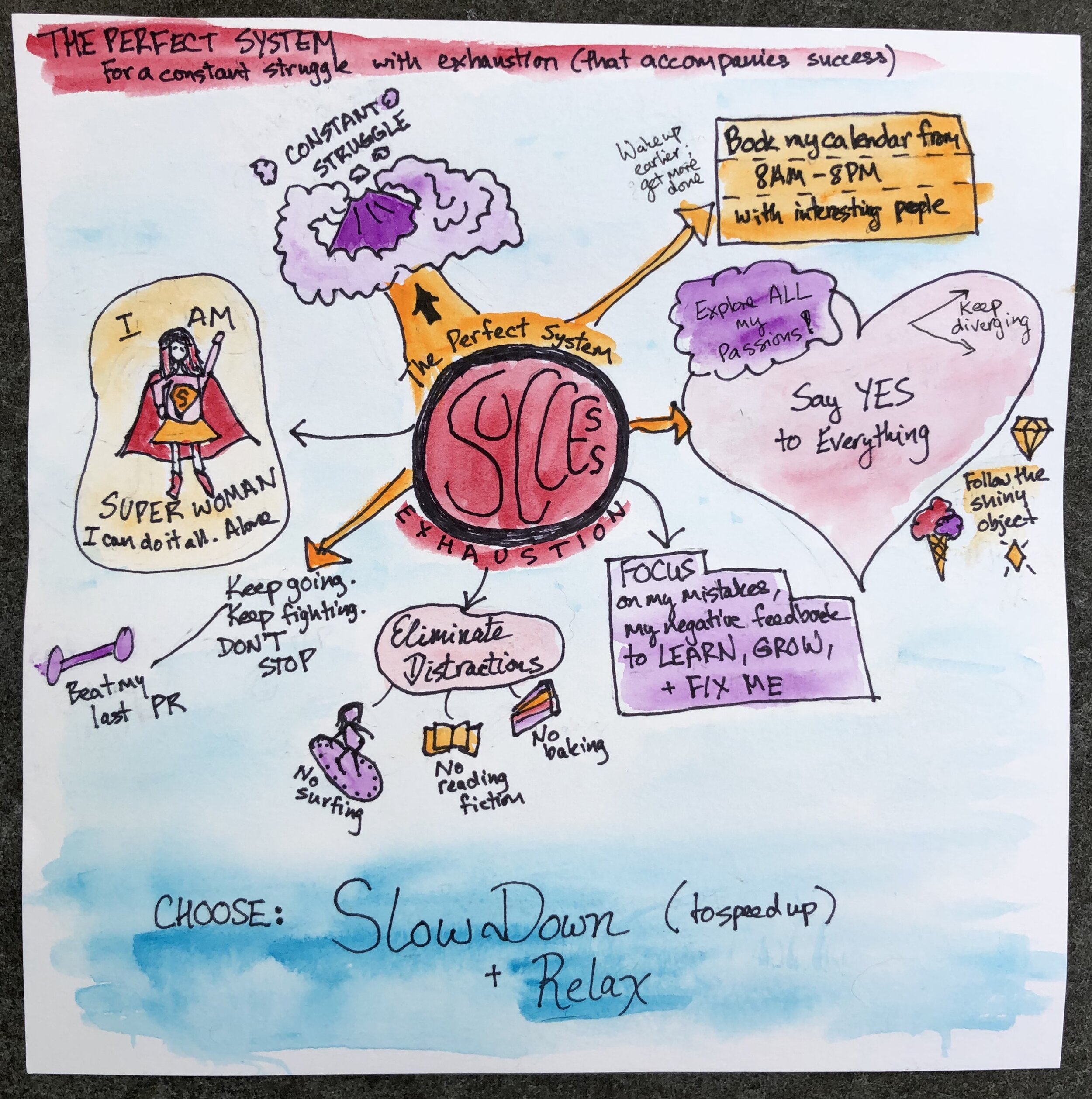
The Perfect System in one sketch
I’ve had what most people would call success throughout my academic and professional career. I’m driven and ambitious. It’s a part of me that’s both nature and nurture from my Thai-Chinese tiger mom. One of my coaches, Rich Litvin, introduced me to this tool of creating The Perfect System — it’s a tongue-in-cheek, playful reminder that when I push for success at all costs, it leads to exhaustion and burnout.
I’m sharing the six aspects of my Perfect System to Success + Exhaustion. All the examples are real ones from my life. This isn’t my reality right now, yet it is all-too-familiar. And I continue to fall into the same traps. I recommend that you do not follow all these aspects.
1. Book my calendar from 8am to 8pm
I thrive by interacting with people. I work with fascinating parters to brainstorm and co-create new things into the world. I serve my clients to become better leaders and to lead more fulfilling lives. I am busy all the time, and it makes me feel important, especially when my calendar is double- or triple-booked. When I am extra-busy, I pull out the three reserve superpowers:
Wake up earlier to get more done
Go back to work late at night after my kids go to bed
Work on Sunday afternoons & nights to get a head-start to the week
When someone stops to talk to me, or ask me how I am, I’m often too busy to even reply. And when I reply, it’s quite clear that I’m wielding my badge of “I’m good, I’m soooo busy!” as a measure of my importance.
2. Say YES to everything
I am interested in so many things. I have to keep exploring all my creative and most fascinating passions. Keep diverging and brainstorming and creating more ideas. Follow the thrill of the next new shiny object.
Co-create a workshop with a long-admired hero? YES
Teach workshops for a non-profit who’s cause I passionately believe in? YES
Speak about applying the design process to leadership to many former colleagues at tech companies? YES
Take on a 4 hour drive east to try skydiving for the first time? YES
Add the beautiful Artist’s Way to my packed schedule because I need more self-reflection? YES
Raise my hand first, even though I’m not sure what I’m volunteering for? YES
Decide to work with my fourth coach, because three was not enough? YES
Go to London to help a new design client create & launch their media strategy? YES (as long as you let me bring my 6-week old baby)
Keep going. Keep saying Yes. Keep adding more things to my plate because I can handle it all.
Hat tip to one of my heros, Shonda Rhimes, with no disrespect to her Year of Yes.
3. Focus on my mistakes to FIX ME
In my last corporate job, as I sat for my performance review, I impatiently squirmed and nodded through the excruciating 5 minutes of compliments, what I did well, how I inspired the team, how I impacted the company, blah blah blah… until we get to the good juicy stuff— the opportunities for growth. Now we’re talking. I lean forward. I dig in. I engage. I listen to the feedback and eagerly ask questions to understand my peers’ perspectives and immediately put an action plan into place. I will be better. I will learn and grow. I will work on my weaknesses. I will eliminate all of them and FIX ME.
I am a broken human being. Once I eliminate all my mistakes, then I must become perfect. Right?
4. Don’t stop
Both my daughters play soccer. One of them, like many of her female teammates, is social and collaborative. Her team is great at passing the ball to each other and at defense, coming together as as team to protect the reluctant goalie. What her coach says to almost all the girls when they’re playing offense and coming up to make shots on goal is: “Don’t stop!” The watching crew of over-zealous parents yells out in a chorus of encouragement and frustration: “Don’t stop! Keep going. Keep running. You can do it. Don’t stop!” We want our girls to do more, be more, keep going, keep taking shots on goal, keep running closer to the other goal before shooting, and just to keep going no matter what. I don’t care that my daughter has a headache, or a cramp, or that it’s insanely hot out for a San Francisco native, just Don’t Stop.
I work with a personal trainer. I keep striving to break my PR (personal record) for squats or bench all the time. I hate easy days of many slow reps of a lighter weight. I hate coming back after a vacation and seeing the strength I’ve lost. I need and crave more PRs. Don’t stop.
If you keep going, you can have it all. Persevere through the pain. The hardship and pain is simply part of the process. Don’t stop.
5. I am superwoman
I can do it all. I don’t need help from anyone. And if I need help, I’ll pay for the help so it’s a transaction. I outsource my grocery shopping, my cleaning, my yard-work, my childcare so that I can focus on the things that make me super. I don’t need help in having it all. Best marriage. Best friend, always there when anyone needs support. Best leader. Best designer. Best parent. Best organizer. Best coach. I can do it all, all at the max speed, going full hell for leather. To be the best at everything. I am superwoman. I won’t ask for help.
6. Eliminate the distractions
There’s no room for distractions and frivolity in my life. Don’t read that fiction novel, what’s there to learn in a made-up story? Instead, pick up the non-fiction and learn how to be a better negotiator or learn about Elizabeth Warren’s leadership. Don’t flip through that People magazine or that teen romance my daughter’s trying to share with me. Don’t surf. How could I waste a prime two hours of creative time first thing in the morning? Don’t bake. If I have time, cook and make more practical & healthy meals, rather than wasting a day with a pretty & throw-away rainbow layer cake.
Bottom-Line
All six of these steps are mistakes and false traps of success that I’ve fallen into. Every time I follow an external definition of success, I push myself beyond measure. These drivers & feelings are oh-so-familiar to me, honed from decades of living.
This is not intended to make you feel bad, as a comparison that there’s so much more you could be doing. Naming this Perfect System and sketching it, is a tool to remind me to slow down and relax. Speeding up is in my nature. And I need to remind myself to add practices and habits that don’t feel so natural. When I do slow down is when I’m the most fulfilled, but those stories are for other articles. What’s your Perfect System for your biggest demon? It could be your relationship with money, with trusting others, with asking for help, or perhaps, like mine, it’s a flavor of success & exhaustion.
I continue to remind myself, and will likely do so for the rest of my life:
Slow down to speed up
Thank you to one of my coaches, Rich Litvin, for introducing me to this wonderful tool of The Perfect System and to the mantra of Slow Down to Speed Up
How to Work with Difficult People… When You're the Difficult Person

Photo by George Pagan III on Unsplash
I am a difficult person. I am a walking mass of paradox and contradictions. This is my weird. This is my leadership. In the past, when I worked in corporate across design firms, startups, and tech companies, I had a reputation for being difficult. And on top of being Difficult, I was also Divisive, Dismissive, and Disruptive. While I’ve shed a some of those Ds in my journey, I proudly celebrate that I am prickly and difficult.
I am polarizing— people love me or hate me.
Honoring my values of growth, I once asked my manager at Facebook to send an anonymous survey out to people with the question “How much do you enjoy working with Tutti?” on a 1–10 scale. The results clearly indicated polarization — several people at a 1 and a large mass of others at a 9 or 10.
I’ve seen this polarization throughout my career in corporate.
The negative pole of feedback:
Aggressive and impatient. Dismissive of bad ideas. Feels like you’re being interrogated. It’s intimidating.
She is too quick, confident, and competent in coming up with the right answer.
Too intense. Too much for some people. Tends to let her emotions take over.
The positive pole of feedback:
Tutti has X-ray vision and the energy like a 5 year old.
Tutti brings so much passion to the table. She is a clear, direct, and compassionate communicator, and this positive energy rubs off on the rest of the team
She isn’t afraid to fight for the right thing to do. While it’s not always comfortable, I do like that Tutti challenges us all to think more broadly or deeply about the problems being solved. She sets a huge vision and keeps us honest.
Loneliness
I’ve worked with many difficult leaders, both within organizations and now as their coach. These are high performers— brilliant at their craft, visionary, powerful operators, and indispensable to their orgs. They are also incredibly intelligent. They know what’s going on and are completely aware of their impact on others.
It’s an incredibly lonely place to be. There are hidden, never-to-be-spoken regrets of the pain that they’ve caused to others. It’s a life of regret. Of secret shame for the impact that they’ve had on others. Many have big emotions… sometimes it feels like it needs to come out, that it’s a giant volcano of passion and energy that’s about to blow, and they can’t stop it.
Most difficult leaders trap this away under a persona of high expectations and competence. Their outer veneer is a prickly exterior protection for the soft inside. I know because it’s a familiar place.
Signs that You Might be a Difficult Person
You hardly listen to others.You have fixed & rigid ideas.
You are quick to criticize.
You focus on the negative and draw-backs to an idea.
You are easily irritated by others.
You lack patience and tolerance.
You are very competitive in all aspect of life.
You are in love with your ideas
If some of these signs resonate, you may be difficult for people to deal with.
Starting to Change: Name it to Tame it
If you’re longing for something to be different, the first step is to recognize that you are part of the problem, and acknowledge that there is a desire to change.
Perhaps there is a yearning:
For stronger, deeper relationships
To be liked / respected / admired
To have better predictability over your emotions
For me, there was a yearning for all three. I had learned to thrive in my difficult personality in agencies and design firms where I was the Design Director or Creative Director responsible for the innovative concepts we were producing for the world’s top brands. Often the sole female leader in the room, I put on my armor of extreme competence and played my part in the performance to sell clients on the brilliance of our solutions. I was fantastic with our clients.
Yet it still wasn’t enough within the leadership of the design firm as I wasn’t able to “hang with the boys and shoot the shit.” Even in my excelling, I was failing.
After design firms, I transitioned to startups and tech companies that valued culture, processes, and relationships in addition to product excellence. They taught me a new model of leadership where I could celebrate being myself and acknowledge that some of the dismissiveness and need-to-be-right was from my own pain and insecurities. I learned that I could relax the armor and start to show more of my inside self. I learned to share my vulnerabilities and form strong, lasting relationships. It felt more like home.
I shed parts of my difficult self and it took a lot of work. I’ll share two openings for what’s worked.
Opening 1: Focus on Relationships not Ideas
Harvard University research into adult development tracked 724 participants over the course of 75 years and found that the key to long-term fulfillment is… relationships. Excerpted from the Mindmaven blog,
Here’s Robert Waldinger, director of the Harvard Study of Adult Development:
“The clearest message that we get from this 75-year study is this: Good relationships keep us happier and healthier. Period.”
In other words: The quality of our life — emotionally, physically, and mentally — is directly proportional to the quality of our relationships.
The first opening for me was considering the impact that I was having on other people. And what that impact became over time as each negative or difficult interaction was compounded month over month. You see, I truly cared about people. My team was family (family is one of my core values) and I would go to the ends of the earth for them. I had to re-frame that every single person I interacted with at work was “my team.” I needed to be gentler about judgement, both of them and myself. I needed to slow down, be patient and consider the longer view.
I needed to drop my attachment to ideas. As a product person and designer, this is hard. The craft of a product designer is coming up with ideas and bring them to life in a prototype or video to paint this future vision for everyone else to see. Ideas are cheap. Many of the best ideas in Silicon Valley are copycats with a tweak. Good artists steal and adapt.
I realized as I launched product after product over my years in technology, that I wasn’t proudest of the products. I was proud of the work and the impact of the products on people’s lives. But most of all, I remembered the people, the relationships, the culture, and camaraderie of getting to an idea together.
The opening for me was following the path of relationships and curiosity. Instead of ideas, I spent more time with people. Listening more, understanding them more, and truly seeking to discover what mattered to them.
Opening 2: Find Your People
So remember I started this post about being a walking mass of paradox and contradictions? This second opening is a paradox when paired with the first one. This second opening is to celebrate what makes you a difficult person. I am challenging, direct, and prickly. I am highly emotional— I will dance with joy to celebrate your victory, and I will cry tears of empathy when touched by a story. I will challenge you to dream bigger and I will always speak my truth. I am polarizing and I am uniquely me.
To celebrate your weird and difficult, you need to find your people.
How did you feel when you read the negative feedback that I shared above?
One woman in my close circle wrote to me:
“This feedback made me feel kind angry. It reads as white men giving an assertive women feedback “aggressive, too confident, too emotional.” Women who are “difficult” are often called out as such a lot more than their male counterparts.”
I hadn’t originally shared my fierce feminist perspective. That’s a future conversation for later. I believe that we live in a world of unconscious bias and we all hold these biases. And that’s OK. Part of being a difficult person is being myself. There will be people who love it, and others who will be repelled. The woman in my close circle who voiced her anger— she is my people.
As I’ve transitioned into running my own business, I’ve learned to find my people. I follow the weird, the interesting, the different. I look for diversity, both for people who have shared backgrounds and experiences, and I also look for people completely foreign to me. I’m following the relationships, and finding the people I can be completely at home around.
How will you to find your people? How can you celebrate what makes you weird?
Bottom-Line
If you feel like you’re surrounded by difficult people and want to work better with them, first consider if you’re the difficult person. It’s OK to be a walking paradox. You can be a difficult person and celebrate that. You can also work on your range and choose when to be difficult, when to focus on relationships, when to find your people, and when to choose all of the above.
Reach out to me for a chat… I’m a champion of difficult people. I’ve been there. You are not alone.
This is a continuation of the Difficult People series. The entire series is:
Thank you to Parissa Behnia and Julie Colbrese for opening my eyes to the magic of championing difficult people.